

 AFDP 2-0 ·Air Force ·2026
Intelligence
Intelligence is a joint function that serves to provide information, assessments, and estimates to the commanders and their staff to support situational understanding and enable decision-making. Global Integrated Intelligence,… AFDP 3-22 ·Air Force ·2026
Foreign Internal Defense
Today's global landscape presents complex security challenges, demanding adaptable approaches to foreign internal defense (FID). This publication provides the United States Air Force (USAF) framework for assisting host nations (HNs)… ADP 2-0 ·Army ·2012
Intelligence
Intelligence is critical to unified land operations and decisive action. We have made tremendous progress over the last ten years by utilizing lessons learned to improve the intelligence warfighting function. Intelligence enables mission… ADRP 2-0 ·Army ·2012
Intelligence
Intelligence is the product resulting from the collection, processing, integration, evaluation, analysis, and interpretation of available information concerning foreign nations, hostile or potentially hostile forces or elements, or areas… ATP 2-01 ·Army ·2014
Collection Management
ATP 2-01 establishes doctrine for the specific functions under planning requirements and assessing collection. It expands on the principles in FM 3-55. ATP 2-01 should be used in conjunction with FM 3-55 and with FM 2-0. It outlines the… ATP 2-01.3 C3 ·Army ·2019
Intelligence Preparation of the Operational Environment
01 March 2019 ATP 2-01.3 (INCL C3) ix Acknowledgement The term Cyber Kill Chain, including Cyber Kill Chain methodology, in paragraphs D-33 through D-37, has been used with permission from Lockheed Martin Corporation,… ATP 2-01.4 ·Army ·2026
Intelligence Support to Army Targeting
Intelligence support to Army targeting is a specialized and synchronized effort as it overlaps with all components of the intelligence warfighting function. Specifically, intelligence support to Army targeting incorporates several… ATP 2-22.7 ·Army ·2025
Geospatial Intelligence
GEOINT, in its most basic form as an intelligence discipline, includes— • Imagery. • Imagery intelligence. • Geospatial information. This composition forms the foundation of Army GEOINT products and allows the Army to build on that… ATP 2-22.85 ·Army ·2016
Multi-Service Tactics, Techniques, and Procedures for Tactical Employment of Biometrics in Support of Operations
 ATP 2-33.4 C1 ·Army ·2020
Intelligence Analysis
ATP 2-33.4 discusses doctrinal techniques—descriptive methods for performing missions, functions, or tasks as they apply to intelligence analysis. ATP 2-33.4— Describes the intelligence analysis process. Discusses structured analytic… ATP 3-20.96 ·Army ·2016
Cavalry Squadron
Doctrine consists of fundamental principles that describe how to fight. At the tactical level, doctrine consists of authoritative principles concerning how to execute reconnaissance and security operations that require professional… ATP 3-20.97 ·Army ·2024
Cavalry Troop
To understand the doctrine of ATP 3-20.97, readers should review ADP 3-0 and the doctrinal principles in ADP 3-07, ADP 3-90, FM 3-55, FM 3-90, FM 3-98, and ATP 3-20.96. Readers should also understand offensive, defensive, and stability… ATP 3-20.98 C1 ·Army ·2019
Scout Platoon
Techniques for the scout platoon conducting reconnaissance and security tasks: organization, mounted and dismounted movement, and platoon operations. Supersedes the 2013 edition. ATP 3-24.3 ·Army ·2015
Cultural and Situational Understanding
Understanding culture is essential in conducting irregular warfare. Irregular warfare requires a deliberate application of an understanding of culture due to the need to understand a populated operational environment, what specifically is… ATP 3-55-12 ·Army ·2013
Multi-Service Tactics, Techniques, and Procedures for Combat Camera (COMCAM) Operations
This multi-Service tactics, techniques, and procedures (MTTP) publication is a project of the Air Land Sea Application (ALSA) Center in accordance with the memorandum of agreement between the Headquarters of the Army, Marine Corps, Navy,… ATP 3-55.4 C1 ·Army ·2016
Techniques for Information Collection During Operations Among Populations
Every Soldier plays a role when it comes to situational awareness through reporting. Soldiers and DA Civilians have the obligation to collect, safeguard, and report information, which contributes to the commander's situational… CALL ·Army ·1998
Basic Terminology and Concepts in International Peacekeeping Operations: An Analytical Review
LY he Foreign Military Studies Office (FMSO) is a research organization of the Center for Army Lessons 7Learned (CALL), located at the Combined Arms Center, Fort Leavenworth, Kansas. As a part of CALL, FMSO's basic mission of mid-term… CALL ·Army ·1998
Artillery and Counterinsurgency: The Soviet Experience in Afghanistan
LY he Foreign Military Studies Office (FMSO) is a research organization of the Center for Army Lessons 7Learned (CALL), located at the Combined Arms Center, Fort Leavenworth, Kansas. As a part of CALL, FMSO's basic mission of mid-term… CALL ·Army ·1998
Organizing the Interaction of Nations Participating in a Multi-National Operation
LY 7 he Foreign Military Studies Office (FMSO) is a research organization of the Center for Army Lessons Learned (CALL), located at the Combined Arms Center, Fort Leavenworth, Kansas. As a part of CALL, FMSO's basic mission of mid-term… DA PAM 550-104 ·Army ·1966
Human Factors Considerations of Undergrounds in Insurgencies
The dynamics of social change are of prime concern for many social scientists. However, in the desire to understand the broad characteristics and societal impact of revolutionary movements, we often neglect the study of the human element… DA PAM 30-50-2 ·Army ·1960
Handbook on the Satellite Armies
This publication, a complete revision of DA Pam 30-50-2, 15 May 1954, deals with the armies of the seven Satellite nations of eastern Europe. While each is treated in a separate chapter, extensive material applicable to most or all of them… EN0054 ·Army ·Undated
Engineer Intelligence and Reconnaissance
Engineer intelligence is processed engineer information which is immediately or potentially significant in planning and making sound decisions to accomplish a specific mission. The engineer, however, has a dual responsibility for producing… FM 100-13 ·Army ·1996
Battlefield Coordination Detachment
Efficient planning, coordination, and execution of air support to United States (US) Army forces (ARFOR) ground operations is essential to overall success of the ARFOR mission. This manual describes the role of the battlefield coordination…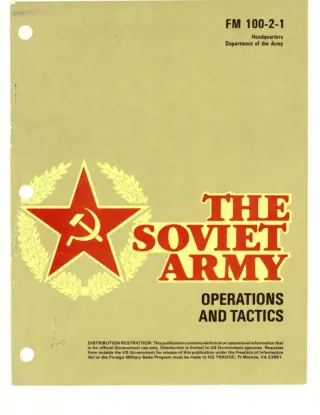 FM 100-2-1 ·Army ·1984
The Soviet Army-Operations and Tactics
The cover design is an adaptation of this patch which is worn by Soviet motorized rifle troops, whose organization is representative of the Soviet combined arms theme. FM 100-2-2 ·Army ·1984
The Soviet Army: Specialized Warfare and Rear Area Support
The cover design is an adaptation of this patch which is worn by Soviet motorized rifle troops. whose organiza tion is representative of the Soviet combined arms theme. FM 100-2-3 ·Army ·1991
The Soviet Army Troops Organization and Equipment
the combat support areas to deal with specific ground forces problems. These directorates act as a ground forces administrative echelon for the superior MOD directorates. Engineer As ground elements of the combined arms field forces,… FM 100-60 ·Army ·1997
Armor- And Mechanized-Based Opposing Force
The primary purpose of the field manuals in the 100-60 series is to provide the basis for a realistic and versatile OPFOR to meet U.S. military training requirements. They can support training in the field, in classrooms, or in automated… FM 100-62 ·Army ·Undated
OPFOR
The military aspect of doctrine conforms to the State's political aims. It encompasses the following elements that directly pertain to the OPFOR: • Organizational development. • Training. • Combat readiness. • Equipment types and numbers.…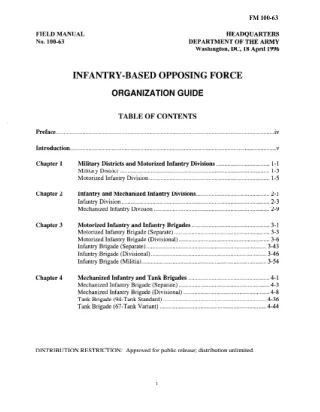 FM 100-63 ·Army ·1996
Infantry-Based Opposing Force Organiisation Guide
Organization guide for the infantry-based Opposing Force (OPFOR) used to portray realistic threat forces in U.S. Army training (1996).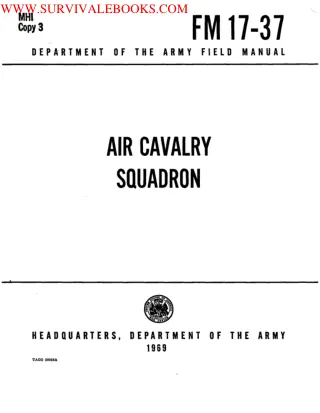 FM 17-37 ·Army ·1969