

 FM 55-46-1 ·Army ·1967
Army Air Transport Operations (TEST)
This manual provides interim guidance to commanders, staff officers, and other personnel concerned with Army air transport support under the TASTA-70 (The Administrative Support, Theater Army 1965-1970) concept of organization and… FM 55-50 ·Army ·1976
Army Water Transport Operations
CHAPTER 2 THE ARMY WATER TRANSPORT FLEET 2-1. Background Upon its establishment on 31 July 1942, the Army Transportation Corps assumed responsibility for worldwide movement of cargo on oceangoing vessels owned or chartered by the US Army.… FM 55-50-1 ·Army ·1967
Transport Amphibian Operations (TEST)
This manual provides interim guidance to commanders, staff officers, and other personnel concerned with amphibian operations support under the TASTA-70 concept of organization and operation. This information can be utilized to facilitate… FM 55-506-1 ·Army ·1977
Basic Electricity
This manual provides basic electrical fundamentals for Army watercraft engineers. It provides watercraft personnel at all levels a basic overview of electrical fundamentals needed to accomplish maintenance on electrical components aboard…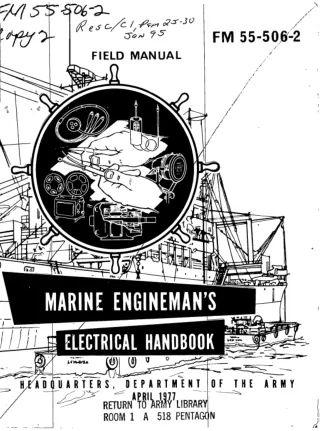 FM 55-506-2 ·Army ·1977
Marine Enginemans Electrical Handbook
This manual provides electrical theory necessary to effectively troubleshoot and repair shipboard electrical components and systems. The manual can be used at all marine maintenance levels; however, it is primarily intended for the… FM 55-51 ·Army ·1972
Army Water transport Units
This manual is published as a training, planning, and operational guide for unit commanders, staff officers, key noncommissioned officers, and other personnel concerned with Army water transport units of the water terminal family as a part… FM 55-55-1 ·Army ·1967
Transportation Terminal Operations (TEST)
This manual is published to provide interim guidance to commanders, staff officers, and other personnel concerned with terminal operations support under the TASTA-70 concept of organization and operation. This information can be utilized… FM 55-57 ·Army ·1960
Transportation Harbor Craft Units and Marine Maintenace Units
evaluation. Comments should be forwarded direct to US Army Transportation School. 2. References The duties and responsibilities of key personnel and the technical operations of harbor craft are discussed in FM 55-58 and TM 55-501.… FM 55-6 ·Army ·1961
Transportation Services in Theaters of Operations 9-29
the specific page, paragraph, and line of the text in which the change is recommended. Reasons should be provided for each comment to insure understanding and complete evaluation. Comments should be forwarded direct to the Commandant, U.S.… FM 55-6-1 ·Army ·1967
Transportation Service in Theaters of Operation (TEST)
This manual provides interim guidance to commanders, staff officers, and other personnel concerned with transportation services support under the TASTA-70 concept of organization and operation. This information can be utilized to… FM 55-61 ·Army ·1973
Milstamp Guidance Manual
FM 55-61 CHAPTER 2 MILSTAMP DEFINED 2—1. General a. The deployment of our armed forces in various parts of the world requires the Depart- ment of Defense to organize a logistics system so that essential supplies will reach the customer in… FM 55-62 ·Army ·1973
Inspection of Household Goods and Personal Property for Shipment, Storage, or Damage and Loss Claims
FM 55-62 Modes of Transportation. As used in this manual, this refers to a type of transportation service, such as air-van, door-to-door container, motor-van, sea-van, etc. g. Packaging. The necessary treatment to ren- der an item safe for… FM 55-63 ·Army ·1974
Fundamental of Airframe Maintenance
1. 3. Eairiy ÂîireraiFtf Sfîmuneîyres a. In aviation's early days, wood and fabric, reinforced by metal accessories, were strong enough to withstand the vibrations and torsional stresses occurring in slow flying aircraft. Main- tenance of… FM 55-65 ·Army ·1976
Preparation for Unit Movement Overseas by Surface Transportation
FM 55-65 CHAPTER 2 GENERAL 2—1. Application a. A company or similar military unit starts preparing for its combat mission at the time of its activation. This mission may require actively en- gaging the enemy or furnishing combat service…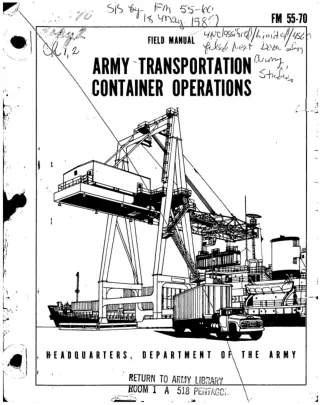 FM 55-70 ·Army ·1977
Army Transportation Container Operations
This manual provides commanders, staff officers, and others concerned with general guidance pertaining to transportation container operations in the Army. The manual is intended as interim guidance to serve until operational experience… FM 55-8 ·Army ·1970
Transportation Intelligence
FM 55-8 CHAPTER 2 SOURCES AND SCOPE OF TRANSPORTATION INTELLIGENCE * 1 L 2-1. Definitions and Employment of Intelligence a. Intelligence Intelligence is the product resulting from the collection, evaluation, analysis, integration, and… FM 57-1 ·Army ·1967
Doctrine for Airborne Operations
structure and base complexes may be presumed to be limited, and use of prestocked land or floating strategic bases should be considered. e. In a cold war situation, objectives may include a show of force, a rapid change in the balance of… FM 57-10 ·Army ·1962
Army Foces in Joint Airborne Operations
support for the execution of a tactical or strategic mission. The means employed may be any combination of airborne units, air transportable units, and transport aircraft, depending on the mission and the situation. Whenever the term… FM 57-30 ·Army ·1959
Airborne Operations
I. General a. Airborne operations consist of the movement and delivery by air, into an objective area, of combat forces and their administra- tive support for the execution of tactical and strategic missions. Such operations are normally… FM 57-35 ·Army ·1971
Airmobile Operations
The revised FM 57-35 incorporates the latest combat-proven doctrine on airmobile operations. It was compiled as a coordinated dffort between the USACDC Infantry Agency and the CON ARC Infantry School to keep the manual abreast of rapid… FM 57-38 ·Army ·1968
Pathfinder Operations
1. General a. The material contained in this appendix illustrates the techniques, procedures, and equipment required for developing and main- taining proficiency in rappelling from the UH—1 series helicopters (fig 38). h. This appendix… FM 6-1 ·Army ·1979
Tacfire Operations
If there is a major conflict, the United States Army will face a tough, capable, well-trained, and numerically superior force. This force can operate in a nuclear, chemical, or conventional environment. It will be equipped with high… FM 6-10 ·Army ·1975
Field Artillery Communications
1-1. Purpose and Scope This manual is a guide for commanders, staff officers, and personnel concerned with field ar- tillery communications. The purpose of the manual is to provide, in a detailed but non- technical explanation, the basic…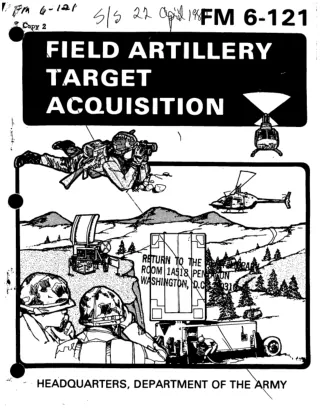 FM 6-121 ·Army ·1978
Field Artillery Target Acquisition
Our capability to acquire targets is a product of the knowledge and understanding of those who participate in the effort. 1-1. Purpose This manual describes the doctrine, tactics, organization, and procedures for the manage- ment of target… FM 6-122 ·Army ·1979
Artillery Sound Ranging and Flash Ranging
FM 6-122 PART ONE Sound/Flash Ranging Organization, Missions, and Installations CHARTER 1 General 1-1. Purpose and Scope WHY □ Efficient use of a unit is based on an understanding of how it is employed. WHAT □ This chapter describes: □… FM 6-125 ·Army ·1972
Qualification Tests for Specialists Field Artillery
FM 6-125 CHAPTER 1 GENERAL 1—1. Purpose and Scope a. This field manual prescribes tests to be used in determining the relative proficiency and quali- fications of individual specialists assigned to the field artillery. The tests are… FM 6-130 ·Army ·1940
Field Artillery Reference Data
Über dieses Buch Dies ist ein digitales Exemplar eines Buches, das seit Generationen in den Regalen der Bibliotheken aufbewahrt wurde, bevor es von Google im Rahmen eines Projekts, mit dem die Bücher dieser Welt online verfügbar gemacht… FM 6-135 ·Army ·1969
Adjustment of Artillery Fire by the Combat Soldier
The purpose of the conduct of fire is to place effective fire on the target by adjusting the fire with data derived from bursts previously ob- served. The fire can be considered as being ad- justed on the target when rounds or fragments… FM 6-140 ·Army ·1973
Field Artillery Organizations
FM 6-140 T Section II. FIELD ARTILLERY ORGANIZATION 1—3. General The organization of all field artillery units and headquarters is shown in detail in the appropri- ate tables of organization and equipment (TOE). 1—4. Classification… FM 6-141-1 ·Army ·1975