

 TC 5-31 ·Army ·1969
Viet Nam version
TC 5-31 tinction between antipersonnel mines and boobytraps is often academic. Users cf this circular should Jearn what materiel and devices are actvally being used by the VC for various purposes, and not attempt to place the into academic… FM 30-101A ·Army ·1959
Aggressor the Maneuver Enemy Esperanto Language
SECTION I INTRODUCTION 1. Purpose and Scope The purpose of this manual is to provide United States forces, portraying AGGRESSOR, with a different language, the use of which will enhance intelligence play and add realism to field exercises.… FM 17-22 ·Army ·1942
Armored Force Field Manual, Reconnaissance Battalion
FM 17-22 1-2 RECONNAISSANCE BATTALION ARMORED FORCE FIELD MANUAL SECTION I GENERAL E 1. PURPOSE.-a. The purpose of this manual is to outline general methods of training and employing the reconnaissance battalion of the armored division.… FM 3-21.71 ·Army ·2002
Mechanized Infantry Platoon and Squad (Bradley)
FM 3-21.71(FM 7-7J) 1-1 CHAPTER 1 THE ROLE OF THE MECHANIZED INFANTRY RIFLE PLATOON (BRADLEY FIGHTING VEHICLE) The mission of the mechanized infantry is to close with the enemy using fire and movement to defeat or capture him, or to repel…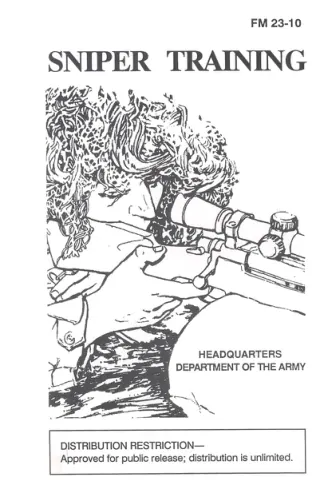 FM 23-10 ·Army ·1994
Sniper Training
The sniper has special abilities, training and equipment. His job is to deliver discriminatory highly accurate rifle fire against enemy targets, which cannot be engaged successfully by the rifleman because of range, size, location,…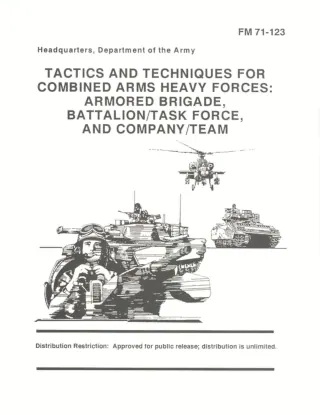 FM 71-123 ·Army ·1992
Tactics, Techniques for Combined Arms Heavy Forces
Users of this field manual must first read and understand the doctrinal field manuals: FM 71-3 (brigade), FM 71-2 (battalion), and FM 71-1 (company). This manual DOES NOT replace the doctrinal manuals; rather, it supplements them with… FM 34-1 ·Army ·1987
Intelligence and Electronic Warfare Operations
CHAPTER 1 The Mission Armies that maintain coherence and con- fidence and can concentrate superior com- bat power at decisive times and places are the winners of battles and campaigns. While there are no simple formulas for win- ning,…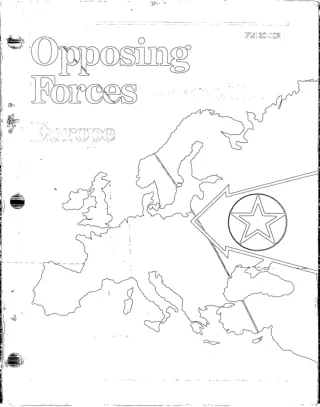 FM 30-102 ·Army ·1977
Opposing Forces Europe
This manual provides the US soldier information concerning oppos- ing forces weapons, equipment and tactics, for use in accomplishing our objective—WINNING THE LAND BATTLE of the next war, even though outnumbered. Because entire forces can… FM 30-15 ·Army ·1973
Intelligence Interrogation
Section I. GENERAL 1-1. Purpose This manual sets forth doctrine pertaining to basic principles of interrogation and establishes procedures and techniques applicable to Army intelligence, interrogations of non US personnel, to include… FM 31-1 ·Army ·1971
Employment of Unattended ground Sensors (TEST)
FM 31-1 (TEST) CHAPTER 1 GENERAL 1 -1. (U) Purpose The purpose of this manual is to provide employment techniques, command and control concepts, and a ready equipment reference for elements directly responsible for the emplacement and… FM 6-121 ·Army ·1967
Field Artillery Target Acquisition
for the purpose of conducting atmospheric soundings and disseminating current meteoro- logical data. Each division artillery has one meteorological section; and the corps FAT AB has two. Thus, a 12-division, three-corps field army has at… FM 101-15 ·Army ·1944
Traffic Circulation and Control
Field manual on traffic circulation and control: route planning, circulation maps, and control of military road movement (1944). CALL ·Army ·1998
Armor, July-August 1998. Light/Heavy Integration at the Joint Readiness Training Center
of the new round, the Bradley 25 MM HEIT is also very effective, with a killing burst radius of five meters. - In Vietnam, we modified the M113, eventually giving birth to the Armored Cavairy Vehicle (ACAV). At first it came out with a .50… FM 3-98 ·Army ·2023
Reconnaissance and Security Operations
FM 3-98 provides the commander and staff of Cavalry formations with doctrine relevant to Army and joint operations. This publication explains how effective reconnaissance and security operations generate depth, allow commanders reaction… ATP 3-09.50 ·Army ·2016
The Field Artillery Cannon Battery
Army Techniques Publication (ATP) 3-09.50 provides doctrinal guidance for commanders and subordinate leaders who are responsible for conducting cannon battery functions or tasks. It serves as an authoritative reference for personnel…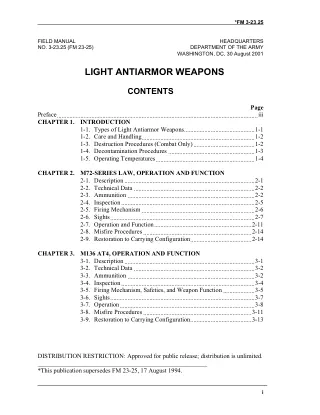 FM 3-23.25 ·Army ·2001
Light Anti-Armor Weapons
This chapter provides information common to the light antiarmor weapons discussed in this manual. Topics include care and handling, destruction and decontamination procedures, and operating temperatures. Light antiarmor weapons are used…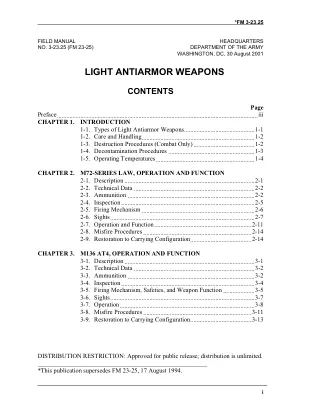 FM 3-23-25 ·Army ·2001
Light Anti-Armor Weapons
This chapter provides information common to the light antiarmor weapons discussed in this manual. Topics include care and handling, destruction and decontamination procedures, and operating temperatures. Light antiarmor weapons are used… FM 10-416 ·Army ·1998
Petroleum Pipeline and Terminal Operating Units
The mission of the United States Army is to protect and defend the Constitution of the United States of America. The Army does this by deterring war and, when and/or if deterrence fails, by achieving quick, decisive victory anywhere in the… FM 31-21 ·Army ·1965
Special Forces Operations
1. Purpose and Scope a. This manual provides doctrinal guidance to commanders and staffs responsible for the training and operational employment of U.S. Army special forces in unconventional warfare (ITW) and in counterinsurgency (CI)… ST 30-5-1 ·Army ·1955
Combat Intelligence
This text is published for the use and guidance of ail concerned with combat intelligence at division. 2. SCOPE a. For these echelons this text describes the organization which produces in telligence, the production of intelligence from… FM 34-7 ·Army ·1993
Intelligence and Electronic Warfare Support to Low-Intensity Conflict Operations
This manual is about IEW support to LIC operations. The purpose of this chapter is to provide framework for the subsequent discussion of how IEW supports LIC in each of the four operational categories: support for insurgency and… ATP 3-37.10 ·Army ·2017
Base Camps (Mcrp 3-40D.13)
Meeting America's strategic objectives hinges on the ability to rapidly deploy forces at any time, in any environment, and against any adversary. Contingency basing provides strategic integration of policy, planning, and resourcing for… FM 7-30 ·Army ·1965
Infantry, Airborne and Mechanized Division Brigades
Section II. MISSIONS AND ROLES OF THE INFANTRY, AIRBORNE, AND MECHANIZED DIVISION BRIGADES 3. Mission a. The Brigade. The basic combat mission of the brigade is to close with the enemy by means of fire and maneuver in order to destroy or… DA PAM 310-3 ·Army ·1959
Military Publications Index of Training 7-30
Department of the Army index of training publications current in 1959: field manuals, training circulars, ROTC manuals, training programs, subject schedules, training tests, posters, and firing tables. FM 310-3 ·Army ·1959
Military Publications-Index of Training Publication
Military publications index of training publications: lists of current field manuals, training circulars, and other training literature (1959). FM 54-8 ·Army ·1967
The Administrative Support Theater Army TASTA-70 (TEST)
This manual is published to provide interim guidance to commanders, staff officers, and other personnel concerned with Combat Service Support under the TASTA-70 concept of organization and operation. Additional, more detailed guidance is… FM 21-6 ·Army ·1954
Techniques of Military Instruction
1. Purpose This manual is designed to assist Army instructors in teaching efficiently. All officers and noncommissioned officers must know how to teach. As specialists, they may have an excellent knowledge of some phase of the military… FM 4-90.7 ·Army ·2007
Stryker Brigade Combat Team Logistics
Fundamentals of SBCT Logistics 10 September 2007 FM 4-90.7 1-1 Chapter 1 Fundamentals of SBCT Logistics 1-1. Incorporating logistics functions into the SBCT presents some unique challenges. It is an early entry force, designed for… FM 101-5-2 ·Army ·1998
US Army Reports and Message Formats (DRAFT)
FM 101-5-2 is the Army's capstone manual for standardized report and message formats. It provides a standard, readily available reference from which soldiers as well as automation designers can extract report and message templates. FM… FM 7-93-3 ·Army ·1995