

 ADP 3-09 ·Army ·2012
Fires
Fires forces create responsive, scalable, and accurate fires providing unprecedented reach and mobility for the Army and joint force commander. The Fires Center of Excellence has developed a Fires Strategy that provides an excellent… ADRP 3-09 ·Army ·2012
Fires
Army Doctrine Reference Publication (ADRP) 3-09, Fires, is one of the ADRPs released under Doctrine 2015. ADRP 3-09 expands on the foundations and principles found in ADP 3-09. This Army doctrine for fires builds on the collective… AMCP 706-160 ·Army ·1962
Terminal Ballistics Kill Mechanisms
UNCLASSIFIED i tri i As a condition for obtaining DTlC services, all information received from DTlC that is not clearly marked for public release will be used only to bid or perform work under a US. Government contract or grant or for… ATP 3-01.16 ·Army ·2016
Air and Missle Defense Intelligence Preparation of the Battlefield (Amd IPB)
Air and Missile Defense IPB is a systematic continuous process of analyzing the adversary's aerial and Tactical Ballistic Missile (TBM) forces and environment in a specific geographic area and the battlefield around it. By determining the… ATP 3-01.50 ·Army ·2013
Air Defense and Airspace Management (Adam) Cell Operation
The purpose of this FM is to provide doctrine on the structure, training, tactical employment and operations of the ADAM cell. There is ADAM cells in the corps, division, brigade combat teams (BCTs) (Heavy, Infantry, and Stryker) and the… ATP 3-01.64 ·Army ·2016
Avenger Battalion and Battery Techniques
ATP 3-01.64 describes Army ADA in near term or current operations and discusses emerging changes to Army ADA includes the transformation from weapon system capabilities to an integrated joint team at strategic, operational, and tactical… ATP 3-01.7 ·Army ·2016
Air Defense Artillery Brigade Techniques
ATP 3-01.7 describes the ADA brigade techniques and organization in support of the ADA battalions and battery's. ATP 3-01.7 is a revision of FM 3-01.7, Air Defense Artillery Brigade Operations, last published in February 2011. ATP 3-01.7… ATP 3-01.8 ·Army ·2016
Techniques for Combined Arms for Air Defense
ATP 3-01.8, focuses on how a combined arms force protects themselves from an adversary's air attack. Aerial threats include Unmanned Aircraft Systems (UAS); fixed- and rotary-wing aircraft; rockets, artillery, and mortars (RAM); ballistic… ATP 3-01.81 ·Army ·2025
Counter-Unmanned Aircraft System (C-Uas)
ATP 3-01.81 establishes how the Army prevents threat UAS from impacting Army operations. Threat UAS are a condition of the modern battlefield that must be accounted for by leaders and Soldiers at every echelon. Countering unmanned aircraft… ATP 3-09.02 ·Army ·2016
Field Artillery Survey
Active component divisions now have a division artillery (DIVARTY), each corps and 8th Army has an associated field artillery brigade (FAB), and FA battalions are organic to brigade combat teams (BCT). FA Survey teams now belong to the… ATP 3-09.12 ·Army ·2021
Field Artillery Counterfire and Weapons Locating Radar Operations
ATP 3-09.12 contains the fundamental techniques and guidance required for planning, coordinating, conducting FA counterfire, and the employment of FA WLRs. It provides information on how to train and conduct operations and describes the… ATP 3-09.13 ·Army ·2015
The Battlefield Coordination Detachment
ATP 3-09.13 makes numerous changes from Army Tactics, Techniques, and Procedures (ATTP) 3-09.13. It includes a brief discussion on the activities of the BCD during the operation phases. Information on the ground liaison detachments (GLD)… ATP 3-09.23 ·Army ·2026
Field Artillery Battalion Operations
The techniques herein build on the collective knowledge and experience gained through operations, numerous exercises, and the deliberate process of informed reasoning. These techniques are rooted in the fire's principles identified in ADP… ATP 3-09.24 ·Army ·2022
The Field Artillery Brigade
ATP 3-09.24 expands on the foundations and tenets found in Army Doctrine Publication (ADP) 3-19, and Field Manuals 3-0 and 3-09. The publication of ADP 3-0 expands the Army's operational concept of unified land operations by retaining… ATP 3-09.30 ·Army ·2017
Observed Fires
Army forces are employed with other Services as part of a joint force. Consequently, this ATP is grounded in joint doctrine as found in joint publications JP 3-09, JP 3-09.3, and JP 3-60. ATP 3-09.30 ties prescriptive Army doctrine… ATP 3-09.42 ·Army ·2016
Fire Support for the Brigade Combat Team
ATP 3-09.42, Fire Support for the Brigade Combat Team, provides BCT fire support considerations for offensive, defensive, and stability tasks, for Defense Support of Civil Authorities, and for tactical enabling and other tasks. It also… ATP 3-09.50 ·Army ·2016
The Field Artillery Cannon Battery
Army Techniques Publication (ATP) 3-09.50 provides doctrinal guidance for commanders and subordinate leaders who are responsible for conducting cannon battery functions or tasks. It serves as an authoritative reference for personnel… ATP 3-09.70 ·Army ·2015
Paladin Operations
Army forces are employed with other Services as part of a joint force. Consequently, this ATP is grounded in joint doctrine as found in joint publications JP 3-09, JP 3-09.3, and JP 3-60. ATP 3-09.70 ties Army doctrine publications such as… ATP 3-09.90 ·Army ·2017
Division Artillery Operations and Fire Support for the Division
Effective DIVARTY operations and fire support require leadership, knowledge, and situational understanding. Situational understanding is the product of applying analysis and judgement to relevant information to determine the relationship… ATP 3-27.3 ·Army ·2025
Ground-Based Midcourse Defense Operations
ATP 3-27.3, Ground-based Midcourse Defense Operations (GMD) is a proponent-level publication. It is the principal publication for describing GMD operations and the Army's GMD mission in defense of the United States homeland, friends, and… ATP 3-60 ·Army ·2015
Targeting
ATP 3-60, Targeting describes Army targeting. Each chapter and appendix addresses how decide, detect, deliver, and assess (D3A) methodology enhances targeting. D3A is a methodology which optimizes the integration and synchronization of…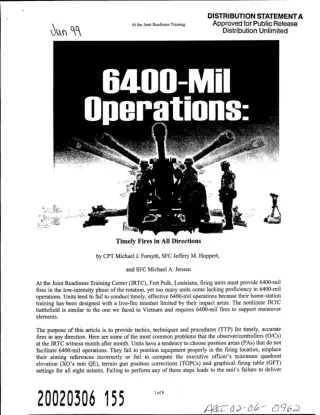 CALL ·Army ·1999
6400-Mil Operations: Timely Fires in All Directions
At the Joint Readiness Training timely, massed and accurate fires in all directions. Choosing a Position Area. The most important aspect of providing 6400-mil fires is choosing a position that facilitates this mission. Optimally, a… CALL ·Army ·1996
Use of Multiple Launch Rocket System (MLRS) in Military Operations on Urbanized Terrain (MOUT)
The proper application of fire support assets is a critical planning factor in any combat situation. Successful employment of MLRS in MOUT requires exceptional planning and C2 down to the launcher level. The purpose of this review of… CALL ·Army ·2001
Use of Mortars in Military Operations on Urbanized Terrain (MOUT)
Use of Mortars in Military Operations on Urbanized Terrain (MOUT) Mortars are valuable in providing indirect fire support during military operations on urbanized terrain. Indirect fire by FA has often been unavailable to infantrymen and in… FM 20-33 ·Army ·1970
Combat Flame Operations
C 3, FM 20-33 :•b. M202 Rocket Launcher. This standard fires a rocket warhead containing pyrophoric fuel-a fuel that ignites spontaneoqsly on exposure to air. Since exposure occurs on impact, no fuel is wasted by burning enroute to the… FM 3-01 ·Army ·2025
U.S. Army Air and Missile Defense Operations
Department of Defense Directive 5100.01 charges the Army to "conduct air and missile defense to support joint campaigns and assist in achieving air superiority." FM 3-01 describes the contributions of ADA, the Army's dedicated AMD… FM 3-01-20 ·Army ·2001
JAOC-AAMDC Coordination
1. Scope This publication is the result of a 1997 Army-Air Force Warfighter Conference tasking. It documents the tactics, techniques, and procedures (TTP) that a Joint Air Operations Center (JAOC) and the Army Air and Missile Defense… FM 3-01-85 ·Army ·2002
Patriot Battalion and Battery Operations
This field manual provides doctrinal how-to-fight guidance for the Patriot battalion and battery, and is intended primarily for battalion commanders, staff officers, battery commanders, platoon leaders, and tactical directors. This FM is… FM 3-01.11 ·Army ·2000
Air Defense Artillery Reference Handbook
The purpose of this field manual (FM) is to familiarize personnel with ADA operations and weapon systems. This FM will be useful to personnel serving in the following types of positions: • staff positions requiring general knowledge of Air… FM 3-01.16 ·Army ·2002