

 ADP 1 ·Army ·2019
The Army
ADP 1 and ADP 3-0, Operations, are the two Army capstone doctrinal manuals that serve as the foundation of our professional body of knowledge. It explains our Army's historical significance in the formation and preservation of our Nation… ADP 1-02 ·Army ·2012
Operational Terms and Military Symbols
31 August 2012 ADP 1-02 1 This publication begins by discussing the professional language of land warfare. It then discusses terminology, followed by acronyms and abbreviations. It concludes by discussing the role of symbology in relation… ADP 2-0 ·Army ·2012
Intelligence
Intelligence is critical to unified land operations and decisive action. We have made tremendous progress over the last ten years by utilizing lessons learned to improve the intelligence warfighting function. Intelligence enables mission… ADP 3-0 ·Army ·2025
Operations
ADP 3-0 describes how the Army, in multidomain operations, contributes to the joint operational concept of unified action to synchronize, coordinate, and integrate military activities designed to overcome the challenges posed by peer…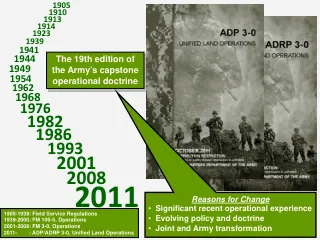 ADP 3-0-BRIEFING ·Army ·1939
ADP 3-0 Briefing: A Blueprint for an Uncertain Future
Size of theater (space and population) will exceed US ability to control. Operational Environment replaces battlespace as a term. Operational Environment is not the Area of Operations. ADP 3-05 C1 ·Army ·2019
Army Special Operations
ADP 3-05 provides the strategic context for employment of Army special operations forces and defines special operations. It describes the role of Army special operations formations. A role is the broad and enduring purpose for which the… ADP 3-07 ·Army ·2019
Stability
Throughout U.S. history, the U.S. Army has learned that military force alone cannot secure sustainable peace. U.S. forces can only achieve sustainable peace through a comprehensive approach in which military objectives nest in a larger…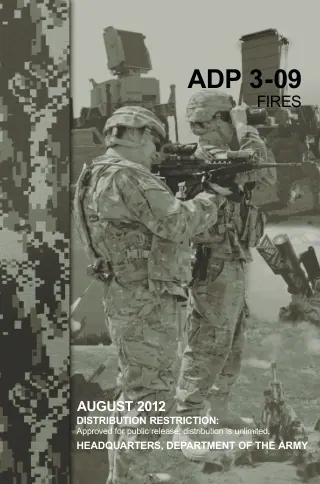 ADP 3-09 ·Army ·2012
Fires
Fires forces create responsive, scalable, and accurate fires providing unprecedented reach and mobility for the Army and joint force commander. The Fires Center of Excellence has developed a Fires Strategy that provides an excellent… ADP 3-13 ·Army ·2023
Information
Information is central to everything we do—it is the basis of intelligence, a fundamental element of command and control, and the foundation for communicating thoughts, opinions, and ideas. As a dynamic of combat power, Army forces fight… ADP 3-19 ·Army ·2019
Fires
Success in large-scale combat operations is dependent on the Army's ability to employ fires. Fires enable maneuver. Over the past two decades, potential peer threats have invested heavily in long-range fires and integrated air defense… ADP 3-28 ·Army ·2019
Defense Support of Civil Authorities
ADP 3-28 clarifies similarities and differences between defense support of civil authorities (DSCA) and other elements of decisive action. DSCA and stability operations are similar in many ways. Both revolve around helping partners on the… ADP 3-37 ·Army ·2026
Protection
Protection is the preservation of the effectiveness and survivability of mission-related military and nonmilitary personnel, equipment, facilities, information, and infrastructure deployed or located within or outside the boundaries of a… ADP 3-90 ·Army ·2019
Offense and Defense
ADP 3-90, Offense and Defense, articulates how Army forces conduct the offense and defense. It contains the fundamental tactics related to the execution of these elements of decisive action. Tactics employs, orders arrangement of, and… ADP 4-0 ·Army ·2026
Sustainment
In just a few years, the number of conflicts globally has increased in number and intensity. Insights gained from observing these conflicts will shape how the joint force utilizes advancements in military technology to sustain and conduct… ADP 6-0 ·Army ·2019
Mission Command: Command and Control of Army Forces
Acknowledgements vi ADP 6-0 31 July 2019 Quote reprinted courtesy Erin Johnson, "Schwarzkopf Speaks of Leadership at Symposium," The Daily Universe, 21 October 2001. Online… ADP 6-22 C2 ·Army ·2019
Army Leadership and the Profession
31 July 2019 ADP 6-22 (INCL C2) ix ADP 6-22 establishes and describes the Army profession and the associated ethic that serve as the basis for a shared professional identity. It establishes and describes what leaders should be and do.… ADP 7-0 ·Army ·2024
Training
ADP 7-0, Training, provides Army leaders with a common, practical framework to effectively train Soldiers and units to conduct multidomain operations. ADP 7-0 establishes the principles and concepts of training. It introduces the Army's… ADRP 1 ·Army ·2013
The Army Profession
Our nation's founders developed a republic in which citizens of character work together to establish justice, ensure domestic tranquility, provide for the common defense, promote the general welfare, and secure liberty. As a result of the… ADRP 1-02 ·Army ·2012
Operational Terms and Military Symbols
Army Doctrine Reference Publication (ADRP) 1-02 contains a compilation of Army operational terms, definitions, abbreviations, and acronyms as reflected in the latest editions of Army doctrinal publications. These terms are commonly used… ADRP 1-03 ·Army ·2009
The Army Universal Task List
The Army Universal Task List (AUTL) describes what well-trained, well-led, and well-equipped Soldiers do for the Nation. While focused on the land dimension, abilities of Army forces complement abilities of other Services. The ability of… ADRP 2-0 ·Army ·2012
Intelligence
Intelligence is the product resulting from the collection, processing, integration, evaluation, analysis, and interpretation of available information concerning foreign nations, hostile or potentially hostile forces or elements, or areas… ADRP 3-0 ·Army ·2012
Unified Land Operations
Army Doctrine Reference Publication (ADRP) 3-0, Unified Land Operations, is the first ADRP released under Doctrine 2015. ADRP 3-0 expands on the foundations and tenets found in Army Doctrine Publication (ADP) 3-0. This ADRP expands on the… ADRP 3-05 ·Army ·2012
Special Operations
ADRP 3-05 is a new publication that expands on the principles of special operations found in ADP 3-05. Overall, the doctrine in ADRP 3-05 remains consistent with FM 3-05, Army Special Operations Forces. The most significant change from FM… ADRP 3-07 ·Army ·2012
Stability
Throughout U.S. history, the U.S. Army has learned that military force alone cannot secure sustainable peace. U.S. forces can only achieve sustainable peace through a comprehensive approach in which military objectives nest in a larger… ADRP 3-09 ·Army ·2012
Fires
Army Doctrine Reference Publication (ADRP) 3-09, Fires, is one of the ADRPs released under Doctrine 2015. ADRP 3-09 expands on the foundations and principles found in ADP 3-09. This Army doctrine for fires builds on the collective… ADRP 3-28 ·Army ·2013
Defense Support of Civil Authorities
ADRP 3-28 clarifies similarities and differences between defense support of civil authorities (DSCA) tasks and other tasks of decisive action. Stability tasks and DSCA tasks are similar in many ways. Both revolve around helping partners on… ADRP 3-37 ·Army ·2012
Protection
ADRP 3-37 is a new publication that expands on the protection principles found in ADP 3-37. The doctrine described in this publication is nested within ADRP 3-0 and describes protection as a continuing activity and a warfighting function.… ADRP 3-90 ·Army ·2012
Offense and Defense
To understand ADRP 3-90, the reader must understand the operational art, the principles of war, and the links between the operational and tactical levels of war described in JP 1, JP 3-0, ADP 3-0, and ADRP 3-0. The reader should understand… ADRP 4-0 ·Army ·2012
Sustainment
Army Doctrine Reference Publication (ADRP) 4-0, Sustainment, is the Army's doctrine for sustainment in support of operations. The doctrine discussed in this manual is nested with ADRP 3-0, Unified Land Operations, and describes the… ADRP 5-0 ·Army ·2012