
Explaining Holster Retention Levels
Summary: Holster retention levels are based on how much effort is required to draw the handgun from the holster. Definitions of each level differ slightly between companies. What level of retention you should use depends on the environment you will be in.
What Does "Holster Retention" Mean?
Holster retention refers to the ability a holster has to keep a gun retained, or secured inside the holster.
How Does a Retention Holster Work?
There are many different ways of safely holding a firearm secure inside a holster. How exactly you go about it depends on the material the holster is made of and the specific use case the holster is designed for.
Passive Retention: Friction

Holsters made from modern rigid materials like Kydex, Boltaron, or injection molded plastic are often designed to hold the gun securely using only friction. They do this by molding the material closely to the shape of the weapon, with some designs incorporating a slight "click" point that catches on some part of the weapon system. To draw the pistol, all you have to do is pull it out. There are no mechanical devices to disengage.
Active Retention: Mechanical

Active retention holsters are designed with one or more mechanical devices that hold the gun in the holster and must be "defeated" (i.e. disengaged) to draw the weapon. Common devices include a thumb button, thumb strap, hood, or a trigger guard latch. There can also be further safety locks and latches added that must be undone in order to disengage a retention mechanism.
Holster Retention Levels
Retention level definitions vary slightly in common parlance and between holster companies. The main difference you will see is whether or not friction retention is considered Level 1 or Level 0. Unlike body armor or other personal protective equipment, there are no centralized or enforced definitions for retention levels and holster performance.
History of the First Retention Level Rating System
Bill Rogers invented the first retention level rating system with his company, the Rogers Holster Company. He sold the company to Safariland in 1985. In the industry over the last 10-20 years, particularly with the advent of custom-fit holsters made out of rigid materials like Kydex and Boltaron, people have drifted slightly away from the exact definition of "Retention Level" as originally outlined by Bill Rogers. Safariland updated Rogers' original retention rating system to clarify the test protocol and bring it in line with their new holster manufacturing materials and methods.
Original Bill Rogers Definition
How many 5-second grab attacks the holster can resist.
Safariland Definition
The number of distinct physical actions needed to draw the weapon out of the holster.
For Safariland's rating system, passive retention is not counted as a retention mechanism.
Common Retention Level Rating System
In common parlance, most people in the firearm community call a passive retention holster a Level 1 holster. After that, levels simply increase by increments of one with each successive mechanism or safety feature added.
Should Passive Retention Count as a Retention Level?
At T.REX ARMS, we consider passive retention as the first level of retention. However, it should only be considered a retention level if the friction is able to securely retain your firearm in a normal situation. We determine this by ensuring that the gun can stay securely in the holster when held upside down. Not all "passive retention" holsters on the market would meet this criterion; they should not be considered Level 1 holsters.
What Level of Retention Do I Need?
To determine what level of retention you need, first consider your method of carry, then consider the environments in which you will be carrying.
Inside the Waistband or Concealed Carry
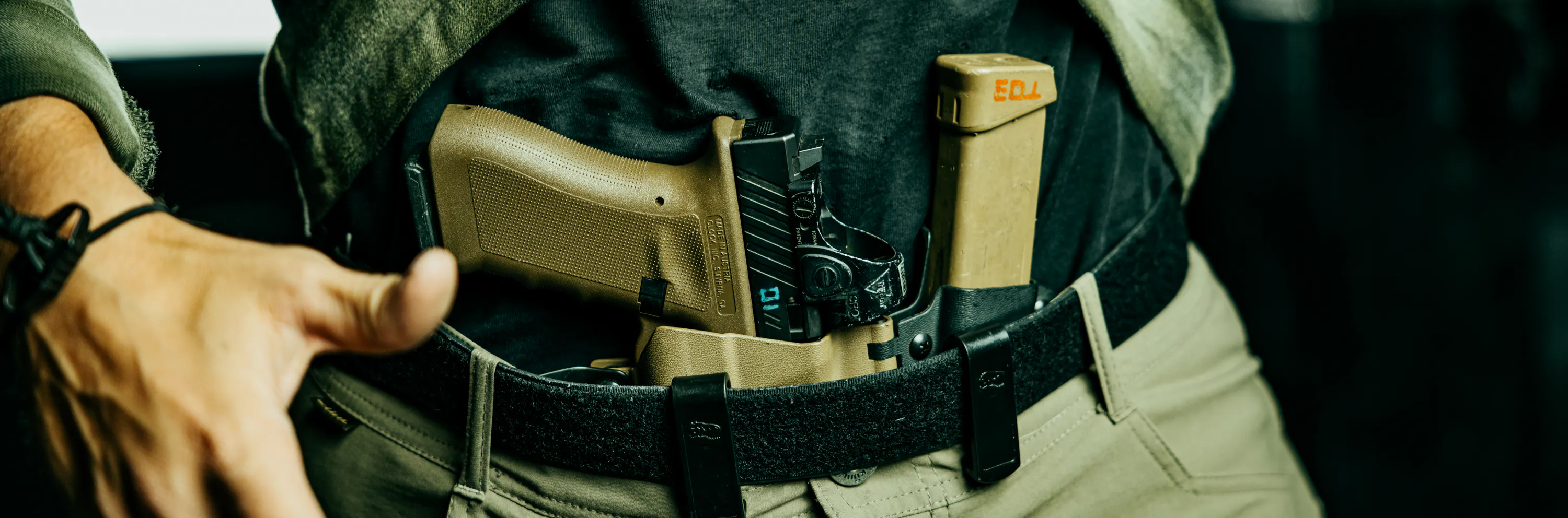
If you are carrying inside the waistband or outside the waistband but concealed under a jacket or the like, we would generally recommend a passive retention holster. The weapon is concealed under a garment, and having the ability to quickly draw your firearm without the need to defeat an active retention mechanism is very valuable and potentially the difference between life and death.
Open Carry

The conversation changes when we’re talking about open carry. There are some environments, such as a range or a shooting competition, where passive retention could still meet your needs. However, if you’re doing any physical activity or movement in difficult terrain, open carrying in crowds, or have the likelihood of getting into physical altercations, active retention becomes a necessity. The more likely your holster is to encounter interference from the environment, whether from people, objects, gravity, or your own movement, the more retention mechanisms you'll want to have on your holster.
Frequently Asked Questions
What is a Retention Holster?
An active retention holster is designed with one or more mechanical devices that must be "defeated" (i.e. disengaged) to draw the weapon. Common devices include a thumb button, thumb strap, hood, or a trigger guard latch. There can also be safety locks and latches that must be undone in order to disengage a retention mechanism.
Level 1 vs. Level 2 Holster
A Level 1 holster has only one method for retaining the gun securely in the holster. A Level 2 holster has two methods. Example: The T.REX Ragnarok is a Level 1 holster that uses a passive friction fit to secure the gun in the holster, whereas the T.REX Titan is a Level 2 holster that uses a passive friction fit and an ejection port lock mechanism that must be deactivated by a thumb button to draw the pistol.
What is a Level 1 Holster?
A Level 1 holster has one method for retaining the gun securely in the holster. This could be a passive retention friction fit or a "bucket" style holster that has 1 active retention mechanism, such as an ejection port lock that is deactivated with a thumb button.
What is a Level 2 Holster?
A Level 2 holster has two methods for retaining the gun securely in the holster and that must be overcome to draw the weapon. This can be a combination of a friction fit, ejection port lock, trigger guard lock, safety device, and/or a hood or other retention mechanism.
What is a Level 3 Holster?
A Level 3 holster has 3 methods for retaining the gun securely in the holster that must be overcome to draw the weapon. This can be a combination of a friction fit, ejection port lock, trigger guard lock, safety device, and/or a hood or other retention mechanism.