

 FM 3-34.230 ·Army ·2000
Topographic Operations
This field manual (FM) describes doctrine for topographic operations in support of the United States (US) Army's strategic, operational, and tactical missions. The Army's strategic challenge is to prepare for the rise of a major military… FM 100-44 ·Army ·1975
Army Procedures for Airspace Management in a Combat Zone (TEST)
This manual sets forth broad Army airspace management procedures and guidance for the commander and his staff in preparation for and execution of airspace management responsibilities in a combat zone. It provides the procedural basis for… FM 57-10 ·Army ·1962
Army Foces in Joint Airborne Operations
support for the execution of a tactical or strategic mission. The means employed may be any combination of airborne units, air transportable units, and transport aircraft, depending on the mission and the situation. Whenever the term… FM 57-30 ·Army ·1959
Airborne Operations
I. General a. Airborne operations consist of the movement and delivery by air, into an objective area, of combat forces and their administra- tive support for the execution of tactical and strategic missions. Such operations are normally… FM 3-04 ·Army ·2025
Army Aviation
Army Aviation is the division's and corps' most maneuverable force. Army Aviation forces are uniquely capable of rapidly and simultaneously impacting the deep, close, and rear operations of multiple echelons. Army Aviation forces provide… FM 57-1 ·Army ·1967
Doctrine for Airborne Operations
structure and base complexes may be presumed to be limited, and use of prestocked land or floating strategic bases should be considered. e. In a cold war situation, objectives may include a show of force, a rapid change in the balance of… FM 5-30 ·Army ·1959
Engineer Intelligence
1. Purpose This manual is a guide for individual soldiers, commanders and their staffs at all levels, and special engineer intelligence units concerned with responsibility and procedures for the production and dissemination of engineer… FM 30-10 ·Army ·1972
Geographic Military Intelligence
Section I. GENERAL 1—1. Purpose and Scope This manual serves as a guide in the production and use of military geographic intelligence. It de- fines military geographic intelligence and explains the process of collection, evaluation, and… FM 30-101-1 ·Army ·1962
Esperanto the Agressor language
Esperanto has been adopted as the official language of Aggres- sor, the Maneuver Enemy. It may be modified by local usage or supplanted by the language of the local area. The primary benefit of using a different language is its… FM 31-11 ·Army ·1962
Doctrine for Amphibious Operations
The purpose of this publication is to set forth the basic doctrine governing the planning for and con- duct of all amphibious operations. 002 BASIS This publication has been developed by the Navy and the Marine Corps in accordance with the… FM 1-108 ·Army ·1993
Doctrine for Army Special Operations Aviation Forces
This manual describes the organizational structure of Army Special Operations Aviation units and serves as a doctrinal and tactical guide for employing these units in combat. It also describes command and control, combat support, and… FM 30-30 ·Army ·1962
Aircraft Recognition Maual
Importance of Recognition The ultimate purpose of all military training is to mold men and weapons into effective fighting units ready for combat. Readiness implies the ability to size up a situation, make a decision, and act cor-… FM 4-7 ·Army ·1945
Tactics and Technique of Controlled Submarine Mines, Ground
oY ) enemy vessels (especially submarines, which are the _ largest vessels capable of approaching undetected by surface surveillance) from entering a protected area and, at the same time, to permit the safe passage of friendly shipping.… FM 17-27 ·Army ·1942
Armored Force Field Manual 81MM Mortar Squad and Platoon
FM 1 t2 7 ARMORED FORCE FIELD MANUAL 81-MM MORTAR SQUAD AND PLATOON SECTION I GENERAL * 1. SCOPE.-a. This manual covers the tactical employment of the mortar platoon and squad in support of tank and infantry units. It is a guide only. Each… FM 31-24I ·Army ·1986
Special Forces Air Operations
101, FM 31-24 Page 33. Figure 6-8 (Standard inverted "L" marking) is rescinded. Pages 33*34. STATIC LINE DZ MARKING PATTERNS is superseded as follows: STATIC LINE DZ MARKING PATTERNS Primary and alternate marking patterns are used to… FM 31-5 ·Army ·1941
Landing Operations on Hostile Shores
FM 31-5 BASIC FIELD MANUAL LANDING OPERATIONS ON HOSTILE SHORES CHAPTER 1 GENERAL Paragraphs Section I. General 1-8 II. Advance forces 9-12 III. Main and secondary landings 13-16 IV. Selection of landing areas 17-26 V. Time of landing .-… FM 3-09.15 ·Army ·2007
Tactics, Techniques, and Procedures for Field Artillery Meteorology
This publication provides the United States Army and United States Marine Corps (USMC) commanders, artillerymen, and meteorology (MET) crew members with tactics, techniques, and procedures for the employment of MET sections. This… FM 3-100-2 ·Army ·2000
Multiservice Procedures for Integrated Combat Airspace Command and Control (ICAC2)
1. Scope This multiservice tactics, techniques, and procedures (MTTP) publication outlines the importance of an integrated airspace control function on the battlespace and describes the organization responsible for airspace control in… FM 30-101A ·Army ·1959
Aggressor the Maneuver Enemy Esperanto Language
SECTION I INTRODUCTION 1. Purpose and Scope The purpose of this manual is to provide United States forces, portraying AGGRESSOR, with a different language, the use of which will enhance intelligence play and add realism to field exercises.… FM 30-50 ·Army ·1943
Recognition Pictorial. Manual of Naval Vessels
Recognition pictorial manual of naval vessels: silhouettes and photographs for identifying warships (1943). FM 4-6 ·Army ·1942
Coast Artillery Field Manual. Seacoast Artillery Tactics and Technique of Controlled Submarine Mines
Coast artillery field manual on seacoast artillery tactics and technique of control: fire command organization and conduct of fire (1942). FM 30-20-1 ·Army ·1966
Arial Surveillance-Recconaissance, Field Army (TEST)
location in which the direction or relative posi- tion of a station is determined by means of its emissions. e. Operational Control. The authority granted a commander to direct forces assigned so that the commander may accomplish specific… FM 100-103 ·Army ·1987
Army Air Space Command and Control in a Combat Zone
A characteristic of the US Army's warfighting doctrine is its offensive spirit. To conduct successful battles and engagements, US forces must gain the initiative and thus set the terms of battle. This requires an increased emphasis on the… FM 3-34.280 ·Army ·2004
Engineer Diving Operations
Engineer Diving Missions 1-1 Chapter 1 Engineer Diving Missions Engineer divers provide assured mobility by supporting the forward movement of troops and equipment. Divers also provide support to general engineering operations in and…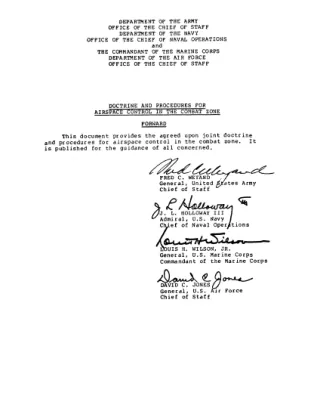 FM 100-28 ·Army ·1975
Doctrine and Procedures for Air Space Control in the Combat Zone
1-1. Purpose. The purpose of this publication is to prescribe doctrine and procedures gov erning the activities of the Armed Forces of the United States engaged in planning for and conducting airspace control in the com bat zone. 1-2.… FM 1-110 ·Army ·1966
Army Helicopter Employment
airmobile capability allocated to the ground com- mits him the widest possible latitude in the assignmander and the responsive fire support required. ment of missions to airmobile forces. Employment concepts envision armed helicopters 4.…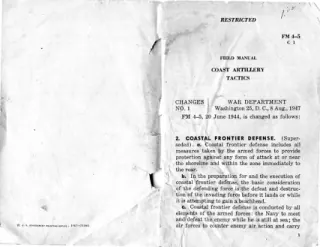 FM 4-5 ·Army ·1944
Coast Artillery Tactics (C1)
Yous. GOVERNMENT PRINTING OFFICE : 1947—751601 = RESTRICTED FM 4-5 cl FIELD MANUAL COAST ARTILLERY TACTICS CHANGES WAR DEPARTMENT NO. 1 Washington 25, D. C., 8 Aug., 1947 FM 4-5, 20 June 1944, is changed as follows: 2. COASTAK FRONTIER…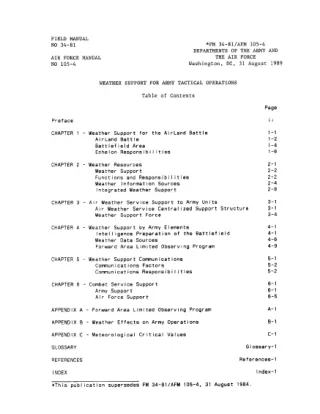 FM 34-81 ·Army ·1989
Weather Support for Tactical Operations
The AirLand Battle is an extended, integrated battle involving al! air and tand forces. Conventional, nuclear, chemical, and electronic weapons are integrated to attack enemy forces throughout the depth of their formations. Basic to the… FM 1-80 ·Army ·1962
Arial Observer Training
CHAPTER 2 BASIC PRINCIPLES Section I. GENERAL 4. Tactical Application of Aerial Observation a. Army aviation is employed by the commander to extend his observation capabilities over his area of influence and interest. Observation employing… FM 100-32 ·Army ·1975