

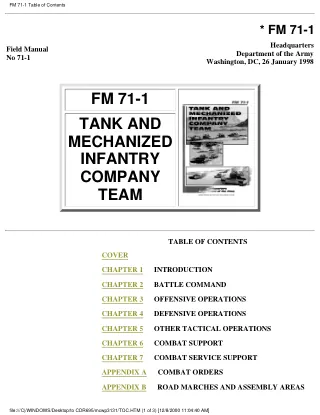
 FM 71-1 ·Army ·1998
Tank and Mechanized Infantry Combat Tem
Tank and mechanized infantry companies and company teams can fight and win engagements on any part of the battlefield in a conventional, nuclear, or chemical environment. The company team is normally task organized by the battalion task… FM 3-85 ·Army ·1960
Chemical Service Units (C1)
Supervision of Training. (Superseded) The training supervision responsibilities of the unit commander are discussed in FM 21-5. 21. Troop Safety (Superseded) For information about the protective measures and precautions that troop units… FM 7-20 ·Army ·1944
Infantry Batallion
This manual supersedes FM 7-20, Rifle Battallon, 28 September 1942, including Cl, 27 March 1943. Chapter 1 GENERAL 1. ROLE OF THE INFANTRY BATTALION. The bat- talion is the basic tactical unit of Infantry. It usually operates as an element… FM 7-1 ·Army ·2003
Battle Focused Training
Chapter 1 How the Army Trains Every day in the Army we try to do two things well—train soldiers and grow them into leaders. General Eric K. Shinseki TRAINING OVERVIEW 1-1. Field manual (FM) 7-0 establishes Army training doctrine. FM 7-1… FM 55-501 ·Army ·1999
Marine Crewmans Handbook
to Army Watercraft Army watercraft are used in the following operations: harbor, coastal, interisland, and LOTS. They are also used for other operations such as ocean towing and security patrols. This chapter addresses these operations and… FM 21-26 ·Army ·1993
Map Reading and Land Navigation
The purpose of this field manual is to provide a standardized source document for Armywide reference on map reading and land navigation. It applies to every soldier in the Army regardless of service branch, MOS, or rank. This manual… FM 25-51 ·Army ·1991
Battalion Task Force Nuclear Training
Battlefield nuclear warfare (BNW) is the requirement to conduct continuous combat operations in the environment created by the presence of any nuclear capable systems before, during, or after nuclear weapon employment by either friendly or… FM 23-35 ·Army ·1988
Combat Training with Pistols and Revolvers
Combat training with pistols and revolvers: operation and marksmanship for the M9 9-mm pistol and service revolvers (1988). FM 8-9 ·Army ·1996
NATO Handbook on the Medical Aspects of NBC Defensive Operations
AMedP-6(B) The purpose of this handbook is to provide a guide for medical officers on the medical aspects of NBC operations. The handbook is intended as a compilation of reference material and as a source of information for training. It… FM 55-65 ·Army ·1995
Strategic Deployment
In response to a military need or crisis, strategic deploy- ment is the strategic relocation and concentration of forces and their support base (manpower and logistics). Strate- gic deployment consists of the movement from CONUS into a…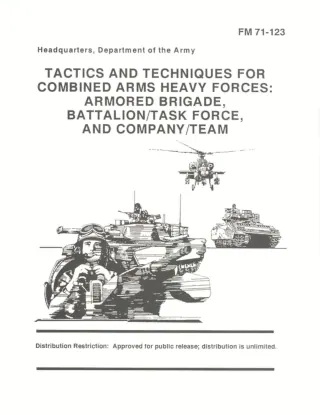 FM 71-123 ·Army ·1992
Tactics, Techniques for Combined Arms Heavy Forces
Users of this field manual must first read and understand the doctrinal field manuals: FM 71-3 (brigade), FM 71-2 (battalion), and FM 71-1 (company). This manual DOES NOT replace the doctrinal manuals; rather, it supplements them with… FM 1-116 ·Army ·1991
Air Cavalry-Reconaissance Troop
The air cavalry/reconnaissance troop is an organic element of the regimental aviation squadron, cavalry squadron, reconnaissance squadron, or air reconnaissance squadron. It is organized and equipped to perform reconnaissance and screening… FM 34-80 ·Army ·1986
Brigade and Battalion Intelligence and Electronic Warfare Operations
Brigade and battalion commanders plan and direct the close operations on the airland battlefield against enemy battalions and companies of first-echelon regiments. They must also be prepared to engage follow-on forces and first-echelon… FM 19-20 ·Army ·1985
Investigative Process
PART ONE CONDUCTING SYSTEMATIC INQUIRIES CHAPTER 1 The Investigator's Purview Military law enforcement investigations are official inquiries into crimes involving the military community. As a military investigator you will conduct… FM 31-8 ·Army ·1968
Medical Service in Joint Operations
FM 31—8/NÂVMED P-5047/AFM 160-27 CHAPTER 1 GENERAL Section I. GENERAL 1-1. Purpose The purpose of this manual is to familiarize Armed Forces command and staff officers with the general doctrine, organizations, and practices of the medical… FM 31-36 ·Army ·1968
Jungle Operations (TEST)
TO NIGHT OPERATIONS CHAPTER 1 GENERAL 1-1. Purpose The purpose of this manual is to provide in- terim doctrinal guidance for. commanders and staffs in. the employment and support of in- fantry, airborne infantry, airmobile infantry,… FM 55-30 ·Army ·1963
Motor Transportation Operations
tion of personnel, equipment, and supplies. The convoys in which elements are grouped tomodern military motor vehicle has inherent gether for adequate control. characteristics of good cargo capacity, relative- c. Unorganized Traffic.… FM 17-33 ·Army ·1949
Tank-Battalion
or around one or both flanks or the rear of the initial enemy dispositions and toward an objective in the rear. The maneuvering force moves at such a distance from the base of fire that it will be impossible to furnish it the desired fire… FM 17-42 ·Army ·1944
Armored Infantry Battalion
This manual covers the tactical employment of the armored infantry battalion, both as part of a larger force, and when acting independently. It is designed as a guide and does not prescribe a set of inflexible rules. Each tactical… FM 3-06 ·Army ·2003
Urban Operations
Doctrine provides a military organization with a common philosophy, a language, a purpose, and unity of effort. To this end, FM 3-06 discusses major Army operations in an urban environment. This environment, consisting of complex terrain,… FM 10-426 ·Army ·1997
Petroleum Supply Units
This field manual provides general data and operational information for commanders and key personnel of the following units: • Headquarters and Headquarters Detachment, Petroleum Supply Battalion, TOE 10426L. FM 8-42 ·Army ·1997
Combat Health Support in Stability Operations and Support Operations
This field manual (FM) establishes the combat health support (CHS) doctrine and provides the principles for providing CHS in stability operations and support operations. It is designed for use by personnel involved in CHS planning for… FM 12-80 ·Army ·1991
Kill or Get Killed
1. PURPOSE Fleet Marine Force Reference Publication (FMFRP) 12-80, Ki/lor Get Killed, is published to ensure the retention and dissemination of useful information which is not intended to become doctrine or to be published in Fleet Marine… FM 55-312 ·Army ·1991
Military Convoy Ooperations in the Continental United States
Small convoys of 20 vehicles or fewer can usually be sent out as one group. But, in planning any appreciable sized convoy, the basic requirement is to organize the given number of vehicles into manageable groups. When operating within… FM 19-60 ·Army ·1961
Confinement of Military Prisoners
C1, FM 19-60 marshals to provide assistance as may be re- the training of personnel of their organizaquired. Examples of such assistance are: Aid- tions who may be detailed for duty with the ining in the execution of emergency plans and… FM 31-30 ·Army ·1960
Jungle Operations
dependent upon the characteristics of the pro- posed area of operations. In general, the more undeveloped the area, the more changes will be required. Changes to be considered are the elimi- nation of wheeled vehicles and weapons not suit-… FM 7-35-TANK ·Army ·1949
Company-Infantry Regiment
Re-Security Information 56. Methods of Attack (Superseded) a. General. (1) There are three fundamental methods for employing the infantry-tank team in the attack-the tanks and infantry attack on the same axis; the tanks and infantry attack… FM 72-20 ·Army ·1944
Jungle Warfare
This manual supersedes FM 31-20, 15 December 1941, including 0 1, 26 May 1942; C 2, 3 August 19D42; and 0 S3,24 Septenmber 1942. Chapter 1 GENERAL Section I. GENERAL 1. General In jungle warfare, the soldier often fights two enemies: man… FM 4-02 C2 ·Army ·2020
Army Health System
The content of this update remains generally consistent with the 2013 publication on key topics while adopting updated terminology and concepts as necessary. Key topics include AHS, FHP, Health Service Support, ten medical functions, and… FM 3-22.9 ·Army ·2003