

 FM 6-02.72 ·Army ·2002
Tactical Radios
1. Scope This publication discusses current voice and data tactical radio systems in common use between the services. It describes recent updates to the Single-Channel Ground and Airborne Radio System (SINCGARS), including the Advanced… FM 6-2030 ·Army ·1989
Tactics, Techniques, and Procedures for Fire Support for Corps and Division Operations
Commanders must understand the spectrum of capabilities of the fire support system. Skillful integration of fire support into all facets of the AirLand Battle must take place simultaneously and continuously as close, deep, and rear… FM 101-5-2 ·Army ·1998
US Army Reports and Message Formats (DRAFT)
FM 101-5-2 is the Army's capstone manual for standardized report and message formats. It provides a standard, readily available reference from which soldiers as well as automation designers can extract report and message templates. FM… FM 3-100-2 ·Army ·2000
Multiservice Procedures for Integrated Combat Airspace Command and Control (ICAC2)
1. Scope This multiservice tactics, techniques, and procedures (MTTP) publication outlines the importance of an integrated airspace control function on the battlespace and describes the organization responsible for airspace control in… FM 7-40 ·Army ·1959
Infantry and Airborne Division Battle Groups
1. Purpose and Scope a. This manual is a guide for battle group commanders, their staffs, and subordinate unit leaders in preparing their commands for and employing them in combat. It is also a guide for commanders of supporting units and… FM 3-90 ·Army ·2001
Tactics
The Army's tactics manual: the science and art of tactics across offensive, defensive, and security operations, with common control measures and planning considerations (2001).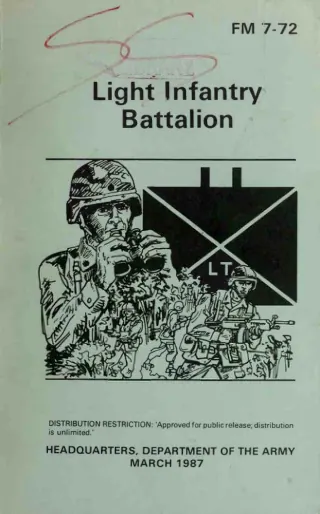 FM 7-72 ·Army ·1987
Light Infantry Battalion
Light infantry battalions are organized to fight successful operations in close terrain in the low- to mid-intensity spectrum of conflict. On the AirLand battlefield, they provide the Army versatility and strategic flexibility through… FM 3-90-1 ·Army ·2013
Offense and Defense, Volume 1
To understand FM 3-90-1, the reader must understand the doctrinal fundamentals contained in Army Doctrine Publications (ADP) 3-0 and 3-90 and Army Doctrine Reference Publications (ADRP) 3-0 and 390. The reader should understand how the… FM 1-108 ·Army ·1993
Doctrine for Army Special Operations Aviation Forces
This manual describes the organizational structure of Army Special Operations Aviation units and serves as a doctrinal and tactical guide for employing these units in combat. It also describes command and control, combat support, and… FM 3-90.1 ·Army ·2013
Tactics - Offense and Defense - FM 3-90.1 - United States Army
To understand FM 3-90-1, the reader must understand the doctrinal fundamentals contained in Army Doctrine Publications (ADP) 3-0 and 3-90 and Army Doctrine Reference Publications (ADRP) 3-0 and 390. The reader should understand how the… FM 1-110 ·Army ·1966
Army Helicopter Employment
airmobile capability allocated to the ground com- mits him the widest possible latitude in the assignmander and the responsive fire support required. ment of missions to airmobile forces. Employment concepts envision armed helicopters 4.… FM 3-052.3 ·Army ·2003
Joint Air Traffic Control LUG2003
1. Purpose This joint air traffic control (JATC) publication meets the needs of the Services by providing procedures on JATC employment and by detailing Service relationships for initial, transition, and sustained JATC operations within… FM 3-52-3 ·Army ·2003
Joint Services Air Traffic Control
1. Purpose This joint air traffic control (JATC) publication meets the needs of the Services by providing procedures on JATC employment and by detailing Service relationships for initial, transition, and sustained JATC operations within…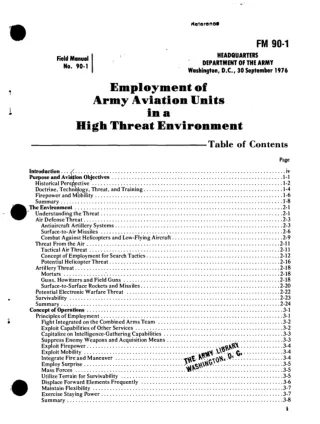 FM 90-1 ·Army ·1976
Employment of Army Aviation Unis in a High Threat Environment
FM 90-1 « m jg&fciji Purpose and Aviation Objectives In the future, Army aviation units will fight as part of the combined arms team in a high threat environment. While much has been written and said concerning how we will fight the next…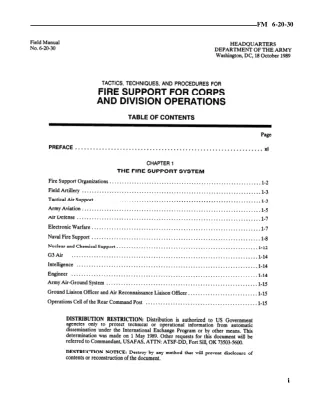 FM 6-20-30 ·Army ·Undated
Fire Support for Corps & Division Ops
Commanders must understand the spectrum of capabilities of the fire support system. Skillful integration of fire support into all facets of the AirLand Battle must take place simultaneously and continuously as close, deep, and rear… FM 71-2 ·Army ·1988
The Tank and Mechanized Infantry Battalion Task Force
Tank and mechanized infantry battalion task forces are organized to fight and win engagements on any part of the battlefield in conventional, nuclear, or chemical environments. They combine the efforts of their company teams and combat… FM 90-36 ·Army ·1997
The Joint Targeting Process and Procedures for Targeting Time-Critical Targets
procedures, guidance, and information. However, it is not intended for this publication to supplant any higher joint or combatant command directives. 3. Application This publication provides JFCs and their operational staffs unclassified… FM 6-1 ·Army ·1979
Tacfire Operations
If there is a major conflict, the United States Army will face a tough, capable, well-trained, and numerically superior force. This force can operate in a nuclear, chemical, or conventional environment. It will be equipped with high… FM 7-30 ·Army ·1965
Infantry, Airborne and Mechanized Division Brigades
Section II. MISSIONS AND ROLES OF THE INFANTRY, AIRBORNE, AND MECHANIZED DIVISION BRIGADES 3. Mission a. The Brigade. The basic combat mission of the brigade is to close with the enemy by means of fire and maneuver in order to destroy or… FM 101-5 ·Army ·1972
Staff Organization and Procedure
1-1. Purpose This manual prescribes doctrine for staff organ- ization and procedure. Its purpose is to assist commanders and staff officers in the organiza- tion and operation of headquarters. It is not a guide for employing forces or a… FM 7-20 ·Army ·1962
Infantry, Airborne Infantry, and Mechanized Infantry Battalions
3. Characteristics and Capabilities a. The infantry battalion is the infantry's basic tactical unit. The personnel, equipment and training of the battalion provide for versatility and enable it to accomplish a variety of combat missions… FM 100-42 ·Army ·1976
US Air Force US Army Airspace Management in an Area of Operations
This manual sets forth procedures and guidance jointly agreed upon for use by US Army and US Air Force commanders and staffs in preparation for and execution of airspace con- trol responsibilities and airspace management functions in an… FM 100-104 ·Army ·1999
Multiservice Procedures for Joint Air Traffic Control
1. Scope This multiservice procedures publication acts as a ready reference source for guidance on air traffic control (ATC) respcnsibilities, procedures, and employment in a joint environment. It discusses joint air traffic control (JATC)… FM 3-31-1 ·Army ·2001
Army and Marine Corps Integration in Joint Operations
1. Scope This unclassified publication addresses the hows of Army-Marine Corps Integration (AMCI) in joint operations. It describes the capabilities and limitations of selected United States Army (USA) and United States Marine Corps (USMC)… FM 31-35 ·Army ·1969
Jungle Operations
1-1. Purpose This manual provides doctrinal guidance to com- manders, staff officers, and other personnel con- cerned with tactical operations in jungle areas. 1—2. Scope a. This manual describes the common as well as the distinguishing… FM 31-30 ·Army ·1960
Jungle Operations
dependent upon the characteristics of the pro- posed area of operations. In general, the more undeveloped the area, the more changes will be required. Changes to be considered are the elimi- nation of wheeled vehicles and weapons not suit-… FM 44-8 ·Army ·1999
Combined Arms for Air Defense
Force-projection operations doctrine reflects the shift towards stronger joint operations. Army operations have evolved into a variety of choices for a battlefield framework and a wider interservice arena, allowing for the increasing… FM 1-116 ·Army ·1991
Air Cavalry-Reconaissance Troop
The air cavalry/reconnaissance troop is an organic element of the regimental aviation squadron, cavalry squadron, reconnaissance squadron, or air reconnaissance squadron. It is organized and equipped to perform reconnaissance and screening… FM 100-30 ·Army ·1971
Tactical Nuclear Operations TEST
of tactical nuclear weapons onto the battlefield neither negates the principles of war described in FM 100-5 nor causes the devel- opment of new ones. The intensity of a tactical nuclear conflict emphasizes the importance of these… FM 3-04 ·Army ·2025