

 FM 100-10 ·Army ·1995
Combat Service Support
FM 100-10 time, available resources are declining. Such changes in the national environment drive changes in national strategy. In responding to those changes, the Army has become a force projection, rather than a forward deployed, Army.… FM 5-114 ·Army ·1992
Engineer Operations Short of War
FM 5-114 Chapter 1 The Strategic Environment National Strategy Goals—Throughout our history, our national security strategy has pursued broad, consistent goals. We have always sought to protect the safety of our nation, its citizens, and… FM 16-100 ·Army ·1961
Character Guidance Manual
1. Purpose This manual provides the background, policy, procedures and objectives out of which the commander will implement the Character Guidance Program. 2. Scope This manual provides a background to support the total Character Guidance… FM 4-02-25 ·Army ·2003
Employment of Forward Surgical Teams
The forward surgical team (FST) is a 20-man team which provides far forward surgical intervention to render nontransportable patients sufficiently stable to allow for medical evacuation to a Level III hospital (combat support hospital… FM 71-101 ·Army ·1980
Infantry, Armored Mechanized and Air Assault Divisions Operations
The division is the largest U.S. Army organization that trains and fights as a team. A division is organized with varying numberk and types of combat, combat support, and combat service support units. Five types of divisions exist in the… FM 31-22 ·Army ·1981
Command, Control, and Support of Special Forces Operations
Thisfield manual provides doctrinal guid¬ ance to Special Forces (SF) command¬ ers and their staffs for command, con¬ trol, and support of SF operations. It deals with the organization, missions, and operations in support of unconventional… FM 3-6 ·Army ·1986
Field Behaviour of NBC Agents
Primary users of this manual are NBC staff officers, staff weather officers, fire support coordination personnel, artillery officers, and others involved in planning NBC operations. These soldiers must understand what effect weather and… FM 31-70 ·Army ·1968
Basic Cold Weather Manual
1-1. Purpose and Scope a. This manual is designed to prepare the individual soldier and small unit commander to conduct military operations for extended periods of time under the most severe and varying cold weather climatic conditions.… FM 30-101-1 ·Army ·1962
Esperanto the Agressor language
Esperanto has been adopted as the official language of Aggres- sor, the Maneuver Enemy. It may be modified by local usage or supplanted by the language of the local area. The primary benefit of using a different language is its… FM 4-02-12 ·Army ·2010
Army Health System Command and Control Organizations
This field manual (FM) establishes command and control (C2) doctrine for the provision of Army Health System (AHS) support in echelons above brigade (EAB). It discusses all roles of care within the theater. The AHS is the overarching… FM 3-05 ·Army ·2025
Army Special Operations
As one of the Army's five core competencies, special operations are activities or actions requiring distinct modes of employment, tactical techniques, equipment, and training, often conducted in hostile, denied, or politically or… FM 100-104 ·Army ·1999
Multiservice Procedures for Joint Air Traffic Control
1. Scope This multiservice procedures publication acts as a ready reference source for guidance on air traffic control (ATC) respcnsibilities, procedures, and employment in a joint environment. It discusses joint air traffic control (JATC)… FM 100-16 ·Army ·Undated
Army Operational Support
PART ONE Support: The Key To Operational Success As part of a joint team, Army forces are central to the theater campaign. In today's force projection Army, planning and executing major operations to support a theater campaign are… FM 3-90.12 ·Army ·2008
Combined Arms Gap-Crossing Operations
Some common abbreviations and acronyms—for example, the abbreviations for military ranks—are not spelled out; refer to the glossary. As a dual service manual, references made to the U.S. Army, Soldiers, division, and BCT are… FM 3-04.203 ·Army ·2007
Fundamentals of Flight
Aviation manual on the fundamentals of flight: theory of flight, weight and balance, and rotary-wing environmental, night, terrain, and multi-aircraft operations (2007). FM 3-04.500 ·Army ·2000
Army Aviation Maintenance
1-1 Chapter 1 THE BATTLEFIELD This chapter covers the basic doctrine fundamentals of aviation units on the battlefield. It discusses the CSS needed by aviation units to function effectively and sustain combat capability. It also discusses… FM 8-10-4 ·Army ·1990
Medical Platoon Leaders' Handbook Tactics, Techniques, and Procedures
FM 8-10-4 CHAPTER 1 COMBAT ORGANIZATION Section I. THE DIVISION 1-1. Background The division is the largest Army fixed organization that trains and fights as a tactical team. It is organized with varying numbers and types of combat, combat…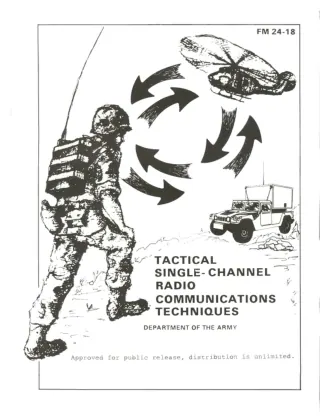 FM 24-18 ·Army ·1987
Tactical Single Channel Radio Communications Techniques
and Scope This manual provides information and guidance to all personnel who are involved with and use single-channel radio in tactical situations. To ensure your understanding of all the material presented, this manual includes a brief… FM 3-100-21 ·Army ·2003
Contractors on the Battlefield
Contractors have always accompanied our armed forces. However, the increasingly hi-tech nature of our equipment and rapid deployment requirements have significantly increased the need to properly integrate contractor support into all… FM 100-7 ·Army ·1995
Decisive Force
Chapter 1 operation's purpose, the desired end state, the degree of acceptable risk, and the method of unifying focus for all subordinate elements. The operational-level commander's intent contains the intent statement of the next senior…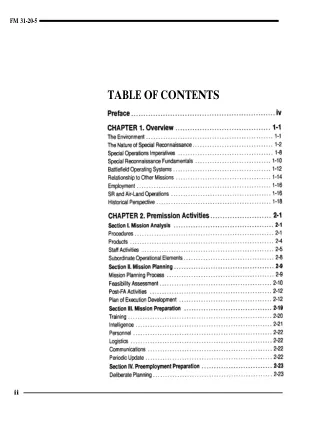 FM 31-20-5 ·Army ·1988
Special Reconnaissance Tactics, Techniques, & Procedures for Special Forces
Special reconnaissance (SR) is defined as reconnaissance and surveillance actions conducted by Special Forces (SF) to obtain or verify, by visual observation or other collection methods, information concerning the capabilities, intentions,… FM 3-34.280 ·Army ·2004
Engineer Diving Operations
Engineer Diving Missions 1-1 Chapter 1 Engineer Diving Missions Engineer divers provide assured mobility by supporting the forward movement of troops and equipment. Divers also provide support to general engineering operations in and… FM 44-63 ·Army ·1992
Air Defense Artillery-Heavy Division
FM 44-63 is the field manual for ADA in support of the heavy divisions. The purpose of this FM is to describe how current and interim FAAD and SHORAD ADA battalions are organized and how they fight in support of maneuver operations. This… FM 100-1 ·Army ·1986
The Army
From these components of the national purpose we derive US goals—the specific expressions of national purpose which provide the rationale for national security policies. The following basic goals have remained essentially unchanged since… FM 7-85 ·Army ·1987
Ranger Unit Operations
This publication contains doctrinal guidelines for the employment and training of ranger units. The intended audience is intermediate and higher level commanders, staffs of those headquarters, and newly assigned officers and NCOs of the… FM 100-17-3 ·Army ·1999
Reception, Staging, Onward Movement, and Integration (RSO&I)
Get there first, with the most men. Lt. Gen. Nathan Bedford Forrest, CSA (1821-1877) The end of the Cold War caused fundamental changes in the international security situation and US military strategy, resulting in a profound redirection… FM 100-20 ·Army ·Undated
Military Operations in Low Intensity Conflict
CHAPTER 1 F u n d a m e n t a l s o f LO W I n t e n s i t y C o n f l i c t This chapter outlines the role of military operations in low intensity conflict (LIC). It describes the environment of LIC and identifies imperatives which the… FM 63-20 ·Army ·1990
Forward Support Battalion
FM 63-20 Cavalry squadron. All these units will require CSS on a battlefield unlike any encountered in the Forward support battalion. past. The AirLand Battlefield will be characterized by fluid, nonlinear operations and Air liaison… FM 23-70 ·Army ·1942
37-mm Gun, Antitank, M3
Go ogle This is a digital copy of a book that was preserved for generations on Hbrary shelves before it was carefully scanned by Google as part of a project to make the world's books discoverable online. It has survived long enough for the… FM 3-9 ·Army ·1990