

 MCRP 3-40A.1 ·Marine Corps ·2016
Multiservice Tactics, Techniques, and Procedures for Treatment of Chemical..
This multi-Service publication provides tactics, techniques, and procedures and is designed for use as a reference for trained members of the Armed Forces Medical Services and other medically qualified personnel on the recognition and… ATP 4-25.12 C2 ·Army ·2014
Unit Field Sanitation Teams
30 April 2014 ATP 4-25.12 (INCL C2) 1-1 Chapter 1 Unit Field Sanitation Teams HISTORY 1-1. Historically, in every conflict up through World War II, in which the United States was involved, approximately 20 percent of hospital admissions… NAVEDTRA 14295 ·Navy ·2003
Hospital Corpsman
This is a self-study course. By studying this course, you can improve your professional/military knowledge, as well as prepare for the Navywide advancement-in-rate examination. It contains subject matter about dayto-day occupational… FM 8-295 ·Army ·1986
Treatment if Chemical Agent Casualties and Conventional Military Chemical Injuries
This manual serves as a guide and a reference for trained members of the Armed Forces Medical Services and other medically qualified personnel on the recognition and treatment of chemical agent casualties and conventional military chemical… ATTP 4-02 ·Army ·2011
Army Health System
This publication provides the capstone doctrine for the Army Health System (AHS) in support of the modular force. The Army Health System is the overarching concept of support for providing timely medical support to the tactical commander.… MD0152 ·Army ·Undated
Diseases of Military Importance
Throughout the history of the world, disease has been man's worst enemy. Probably the most dreadful episode in recorded history was the infamous "Black Death" epidemic of the 14th century, which was responsible for the death of one-fourth… MCTP 3-40A ·Marine Corps ·2025
Health Service Support
into the operating area, rapid movement, formation, deployment, and redeployment in forward areas. Casualty Receiving and Treatment Ships. Large-deck amphibious ships are designated for use as CRTSs. This capability is distinguished by a… ATP 4-02.55 ·Army ·2020
Army Health System Support Planning
Army Techniques Publication 4-02.55 updates Army Health System planning topics while adopting current terminology and concepts as necessary. The Army Health System is a complex system of interrelated and interdependent systems which… FM 8-51 ·Army ·1998
Combat Stress Control in a Theater of Operations
This field manual (FM) establishes medical doctrine and provides principles for conducting combat stress control (CSC) support operations from forward areas to the continental United States- (CONUS) based medical facilities. This manual… ATP 4-02.4 ·Army ·2021
Medical Platoon
This publication provides information on the structure and operation of medical platoons and sections that are organic to maneuver battalions and squadrons operating in a Role 1 capacity within a brigade combat team's area of operation. It… ATP 4-02.25 C1 ·Army ·2020
The Medical Detachment, Forward Resuscitative and Surgical
The Section One (1) of Table of Organization and Equipment 08528KA00, approved on 19 January 2017 designates this organization as a medical detachment and assigns it the title of "medical detachment, forward resuscitative and surgical."… FM 4-02-25 ·Army ·2003
Employment of Forward Surgical Teams
The forward surgical team (FST) is a 20-man team which provides far forward surgical intervention to render nontransportable patients sufficiently stable to allow for medical evacuation to a Level III hospital (combat support hospital… MD0511 ·Army ·Undated
Oral and Maxillofacial Pathology
Man's survival is constantly threatened--by bacteria, by physical or chemical injury, and a host of other agents. Although modern science and medicine have done much to cope with these harmful influences, our greatest protection is still… FM 4-02-12 ·Army ·2010
Army Health System Command and Control Organizations
This field manual (FM) establishes command and control (C2) doctrine for the provision of Army Health System (AHS) support in echelons above brigade (EAB). It discusses all roles of care within the theater. The AHS is the overarching… MD0576 ·Army ·Undated
Wound Care
In this subcourse, you will study wound healing and wound care, contaminated wounds, and burns. Information you read in this subcourse will aid you in maintaining and improving the health of soldiers. In that pursuit, do your best to… MD0575 ·Army ·Undated
Integumentary System
The skin is not just a simple thin covering which keeps the body together. The skin is a complex combination of tissues that perform functions necessary for human survival. Our skin helps maintain body temperature, receives stimuli from… IS0877 ·Army ·Undated
Self-Aid/Buddy-Aid
Interschool Subcourse 0877, Self-Aid/Buddy-Aid, contains instructions for performing self-aid/buddy-aid (first aid) tasks that all soldiers are required to know. All of the tasks within this subcourse contain important, lifesaving… FM 8-10-4 ·Army ·1990
Medical Platoon Leaders' Handbook Tactics, Techniques, and Procedures
FM 8-10-4 CHAPTER 1 COMBAT ORGANIZATION Section I. THE DIVISION 1-1. Background The division is the largest Army fixed organization that trains and fights as a tactical team. It is organized with varying numbers and types of combat, combat… NAVEDTRA 14274 ·Navy ·1999
Dental Technician, Volume 1
By enrolling in this self-study course, you have demonstrated a desire to improve yourself and the Navy. Remember, however, this self-study course is only one part of the total Navy training program. Practical experience, schools, selected…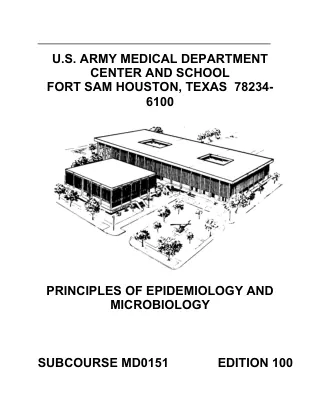 MD0151 ·Army ·Undated
Principles of Epidemiology and Microbiology
One of the important landmarks in man's struggle to conquer disease was the invention of the microscope, generally attributed to Anton van Leeuwenhoek of Holland. Leeuwenhoek described the appearance of protozoa to the Royal Society of… MD0568 ·Army ·Undated
Respiratory Diseases and Disorders
The respiratory tract has defense mechanisms that prevent most microorganisms and foreign objects from entering the lungs of a healthy person. Sometimes these defense mechanisms cannot resist invasion, and infection occurs. The person's… MD0922 ·Army ·Undated
Obstetrics and Newborn Care II
Subcourse MD0922, Obstetric and Newborn Care II, is a continuation from Subcourse MD0921, Obstetric and Newborn Care I. This subcourse will further explain the many physiological and psychological changes that a woman may experience… MCTP 3-30E ·Marine Corps ·2016
Combat and Operational Stress Control
Leaders at all levels are responsible for preserving the psychological health of their Marines, Sailors, and family members, just as they are responsible for preserving their physical health. This responsibility applies to every link in… FM 21-11 ·Army ·1988
First Aid for Soldiers
This manual meets the emergency medical training needs of individual soldiers. Because medical personnel will not always be readily available, the nonmedical soldiers will have to rely heavily on their own skills and knowledge of… TM 8-285 ·Army ·1942
Treatment of Casualties from Chemical Agents
of chemical warfare, the weapons of war depended almost entirely for their effect on the force with which they hit enemy personnel or materiel. In contrast to this, chemical warfare agents need no terminal momentum or explosive force to… MD0859 ·Army ·Undated
Mycology
In recent years there has been an increasing incidence of mycoses, diseases caused by fungi. This increase is largely due to the widespread use of antibiotic, immunosuppressive, corticosteroid, and cytotoxic drugs. Because of this… AFTTP 3-42.32 ·Air Force ·2021
Installation Medical All Hazards Response
1.1. Purpose. Major incidents can quickly overwhelm medical units at Air Force medical treatment facilities (MTFs) and can pose significant threats to Air Force installations worldwide. This publication provides guidance for medical units… ATP 4-02.10 ·Army ·2025
Army Hospitalization (Role 3)
Observations from the conflict in Eastern Europe, lessons learned from Afghanistan and Iraq, analysis of the operational medicine transformational goals, and the Army's adoption of the multidomain operations operational concept were… FM 8-10-5 ·Army ·1991
Brigade and Division Surgeons' Handbook Tactics, Techniques, and Procedures
This manual provides information pertaining to the command and staff responsibilities of the brigade and division surgeons assigned to armored, airborne, air assault, infantry, and light infantry divisions that are organized under the… FM 4-25.11 ·Army ·2002