

 FM 6-16-3 ·Army ·1982
Tables for Artillery Meteorology (Electronic and Visual) Type 2 Messages
FM 6-16-3 SECTION I GENERAL TABLES AND CHARTS FOR METEOROLOGICAL MESSAGES 2-1. Description of Tables and Charts The tables and charts in this manual are presented in sections I, II, and III as follows: a. Section I, General Tables and… FM 6-160 ·Army ·1969
Counterbattery Radar Set AN-MPQ-10A
1. Adjust the J-scope INT control with the screwdriver so that the J-scope sweep is clearly visible and the brightened portion at the top of the J-scope (the range gate) is clearly dif- ferentiated from the remainder of the sweep. 2.…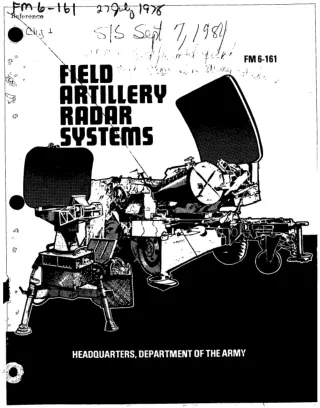 FM 6-161 ·Army ·1981
Field Artillery Radar Systems (C1)
Cl, FM 0-161 CHAPTER 1 THE THREAT Paragraph Purpose and Scope 1-1 Characteristics of Field Artillery Radars 1-2 Operations Security Indicators 1-3 Countermeasures 1-4 1-1. Purpose and Scope The purpose of this chapter is to describe the… FM 6-162 ·Army ·1969
Radar Set AN-TPS-25
CHAPTER 2 EQUIPMENT 4. Description a. The AN/TPS-25 (fig. 1) is a transporta- ble, battlefield surveillance radar set of the noncoherent Doppler type and is designed to detect and locate moving ground targets at ranges between 450 and… FM 6-2 ·Army ·1996
Tactics, Techniques and Procedures for Field Artillery Survey
Tactics, techniques, and procedures for field artillery survey: establishing common survey control for firing units (1996). FM 6-2-45 ·Army ·2004
Signal Support to Theater Operations
1-1 Chapter 1 Theater Signal Transformation The Army is transforming in response to changes in the global political, military, and technological environment and in accordance with national level strategic and political decisions on how… FM 6-2-74 ·Army ·2003
Hf-Ale
1. Purpose This consolidated reference will assist joint forces in utilizing high frequency radios as a supplement/alternative to overburdened satellite communications systems for overthe-horizon communications. 2. Scope This publication… FM 6-2-90 ·Army ·2004
Multi-Service Tactics, Techniques, and Procedures for Ultra High Frequency Tactical Satellite and Demand Assigned Multiple Access Operations
1. Scope The intent of this publication is to assist planners and users at the joint task force, Service component, and other functional components by providing an improved and unified process for planning, managing, and using ultra high… FM 6-2.72 ·Army ·2002
Tactical Radios
1. Scope This publication discusses current voice and data tactical radio systems in common use between the services. It describes recent updates to the Single-Channel Ground and Airborne Radio System (SINCGARS), including the Advanced… FM 6-20 ·Army ·1987
Fire Support in the Air-Land-Battle
This publication is the Army's capstone manual for fire support. It embodies the doctrinal tenets for the employment of fire support in the AirLand Battle. It establishes a basis for understanding fire support as an essential element of… FM 6-20-1 ·Army ·1965
Field Artillery Tactics
3. The Field Artillery System The field artillery system consists of all of those elements. that are necessary to obtain the desired effect on the target. These elements include weapons, target acquisition, survey, ballistic meteorology,… FM 6-20-10 ·Army ·1996
Tactics, Technicques and Procedures for the Targeting Process
Targeting is part of the tactical decision-making process used to focus the battlefield operating systems (BOSs) to achieve the commander's intent. The methodology used to translate the commander's intent into a plan is decide, detect,… FM 6-20-2 ·Army ·1970
Field Artillery Techniques
1-1. Purpose and Scope a. The purpose of this manual is to provide in- formation and guidance on the employment of field artillery. The manual covers the operations and techniques of employment of field artillery units to include command,… FM 6-22 C2 ·Army ·2022
Developing Leaders
Army leaders are the competitive advantage the Army possesses that neither technology nor advanced weaponry and platforms can replace. Developing leaders is a complex and complicated undertaking because it is primarily a human… FM 6-22.5 ·Army ·2000
Combat Stress
Combat Stress is the mental, emotional or physical tension, strain, or distress resulting from exposure to combat and combat-related conditions. Controlling combat stress is a command responsibility. In terms of Service members lost from… FM 6-24-8 ·Army ·2000
Tadil-J
1. Scope This publication introduces Tactical Digital Information Link (TADIL) J. It is a guide for warfighters who have limited or no experience or background in TADIL J and who need a quick orientation for supplemental or in-depth… FM 6-27 C2 ·Army ·2019
The Commander'S Handbook on the LAW of Land Warfare (Mctp 11-10C)
Commanders, staffs, and subordinates must ensure that their decisions and actions comply with applicable U.S., international, and in some cases host-nation laws and regulations. Commanders at all levels will ensure that their Soldiers or… FM 6-3 ·Army ·1963
Gun Direction Computer M16
CHAPTER 2 ORGANIZATION AND OPERATION Section I. ORGANIZATION 4. General tion of the computer and associated The gun direction computer M18 is author- equipment, such as the cables and proized for issue to the fire direction or operation… FM 6-3-1 ·Army ·1968
Operation of the Gun Direction Computer M-18 Application
FM 6-3-1 Section II. FIRE DIRECTION ORGANIZATION 1-4. General a requirement exists for a manual system to supplement the gun direction computer. The The 3M18 gun direction computer (fig. 1-1) is manual system is substantially the same as… FM 6-3-2 ·Army ·1967
Operation of the Gun Direction Computer M-18 Rocket Application
The proper emplacement of the generator. (2) Starting, stopping, and monitoring the operation of the generator on a standby basis. (3) Insuring that the generator is providing the proper current. (4) Performing operator maintenance and… FM 6-30 ·Army ·1980
The Field Artillery Observer (C1)
Cl. FM 6-30 doctrine requires team members to operate with a sense of urgency and continually strive to reduce the time required to execute an effective fire mission. a. Observer. The observer serves as the eyes of all indirect fire… FM 6-300 ·Army ·1993
Army Ephemeris, 1993-97
This manual is a compilation of tables and charts for use in computing astronomical azimuths for the field artillery. These tables and charts are used for computing azimuth of the Sun or selected stars by either the altitude or Artillery… FM 6-40 ·Army ·1999
Tactics, Techniques, and Procedures for Field Artillery Manual Cannon Gunnery
C1, FM 6-40/MCWP 3-1.6.19 Change HEADQUARTERS No.1 DEPARTMENT OF THE ARMY Washington, DC, 1 October 1999 Tactics, Techniques, and Procedures for FIELD ARTILLERY MANUAL CANNON GUNNERY FM 6-40/MCWP 3-16.4, April 1996, is changed as follows:… FM 6-40-1 ·Army ·1972
Field Artillery Honest John-Little John Rocket Gunnery (C1)
Section I. GENERAL 1—1. Purpose This manual explains the field artillery Honest John gunnery problem and presents a practical solution to that problem. It is a guide for Honest John unit commanders and members of their staffs on field… FM 6-40-3 ·Army ·1970
Operation of the Gun Direction Computer M18, Cannon Gunnery Application (C3)
The M18 gun direction computer (FADAC) is the primary means by which a cannon bat- talion or battery fire direction center solves the gunnery problem. Use of this high-speed digital computer significantly increases accuracy and flexibility… FM 6-40-4 ·Army ·1982
Field Artillery Lance Missile Gunnery
FM 6-40-4 FIELD ARTILLERY LANCE MISSILE GUNNERY Summary The primary means of determining firing data for Lance missions is to use the field artillery digital automatic computer/Ml8 gun direction computer (FADAC) and the associated Lance…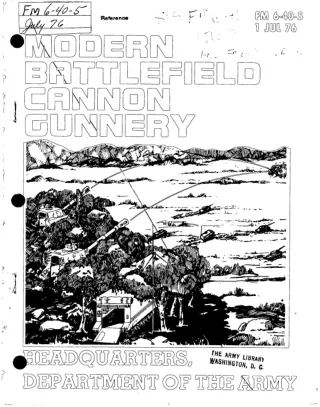 FM 6-40-5 ·Army ·1976
Modern Battlefield Cannon Gunnery
FM 6-40-5 2-1. Threat to Maneuver Forces a. The enemy will field a large, well- trained, hard-hitting combined arms team equipped with the most modern weapons. His tanks and motorized units will attack our maneuver forces with direct fire… FM 6-5 ·Army ·1939
Field Artillery Field Manual
4-6 ORGANIZATION AND DRILL SECTION II ORGANIZATION · 4. GENERAL.-For command and administrative purposes, the Field Artillery is organized into batteries, battalions, regiments, and brigades, and for ammunition supply purposes into… FM 6-50 ·Army ·1996
TTP for the Field Artillery Cannon Gunnery
Tactics, techniques, and procedures for the field artillery cannon battery: mission, organization, key personnel, and battery operations (1996). FM 6-54 ·Army ·1964