

 FM 55-9 ·Army ·1994
Unit Air Movement Planning
Air movement is initially the primary transportation method used during crisis response. World situations that call for a rapid response by the armed forces use airlift to quickly move to an area of operations. Air movement of units… FM 57-1 ·Army ·1967
Doctrine for Airborne Operations
structure and base complexes may be presumed to be limited, and use of prestocked land or floating strategic bases should be considered. e. In a cold war situation, objectives may include a show of force, a rapid change in the balance of… FM 57-10 ·Army ·1962
Army Foces in Joint Airborne Operations
support for the execution of a tactical or strategic mission. The means employed may be any combination of airborne units, air transportable units, and transport aircraft, depending on the mission and the situation. Whenever the term…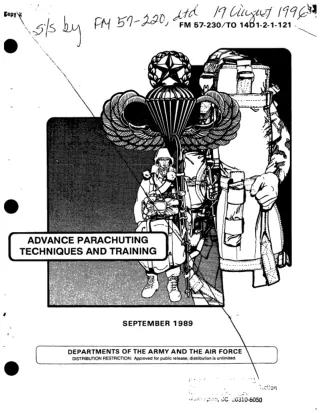 FM 57-230 ·Army ·1989
Advance Parachuting Technique and Training
Field manual on advanced parachuting techniques and training (1989). FM 57-30 ·Army ·1959
Airborne Operations
I. General a. Airborne operations consist of the movement and delivery by air, into an objective area, of combat forces and their administra- tive support for the execution of tactical and strategic missions. Such operations are normally… FM 57-35 ·Army ·1971
Airmobile Operations
The revised FM 57-35 incorporates the latest combat-proven doctrine on airmobile operations. It was compiled as a coordinated dffort between the USACDC Infantry Agency and the CON ARC Infantry School to keep the manual abreast of rapid… FM 57-38 ·Army ·1968
Pathfinder Operations
1. General a. The material contained in this appendix illustrates the techniques, procedures, and equipment required for developing and main- taining proficiency in rappelling from the UH—1 series helicopters (fig 38). h. This appendix… FM 6 ·Army ·2003
Mission Command Comand and Control of Army Forces
[email protected]. Follow the DA Form 2028 format or submit an electronic DA Form 2028. The glossary contains referents of acronyms and definitions of terms not defined in JP 1-02 and FM 101-5-1 (1-02). It does not list… FM 6-0 ·Army ·2022
Commander and Staff Organization and Operations
Command and control (C2)—the exercise of authority and direction by a properly designated commander over assigned and attached forces—is fundamental to the art and science of warfare. No single specialized military function, either by… FM 6-01-1 ·Army ·2008
Knowledge Management Section
This manual provides doctrine for the organization and operations of the knowledge management (KM) section. It establishes the doctrinal principles, tactics, techniques, and procedures necessary to effectively integrate KM into the… FM 6-02-40 ·Army ·2009
Visual Information Operations
Unless this publication states otherwise, masculine nouns and pronouns do not refer exclusively to men. FM 6-02-43 ·Army ·2009
Signal Soldier's Guide
The Army has decentralized most of its signal capabilities. Corps, divisions, brigade combat teams, and support brigades now have signal forces organic to the units who own, operate, train, and maintain their unique signal forces. Corps… FM 6-02-90 ·Army ·2004
MTTP for Ultra High Frequency Tactical Satellite and Demand Assigned Multiple Access Operations
1. Scope The intent of this publication is to assist planners and users at the joint task force, Service component, and other functional components by providing an improved and unified process for planning, managing, and using ultra high… FM 6-02.45 ·Army ·2004
Signal Support to Theater Operations
1-1 Chapter 1 Theater Signal Transformation The Army is transforming in response to changes in the global political, military, and technological environment and in accordance with national level strategic and political decisions on how… FM 6-02.53 ·Army ·2009
Tactical Radio Operations
of the tactical radio deployment throughout the Army to include BCTs and joint operations. THEATER/ARMY 1-6. The theater/Army level is supported by signal companies within BCTs or expeditionary signal battalions (ESBs) depending on their… FM 6-02.70 ·Army ·2010
Army Electromagnetic Spectrum Operations
This manual provides an overview of electromagnetic spectrum operations for the Army at the strategic, operational, and tactical levels. This manual also provides direction, guidance, and techniques necessary to meet the needs of Army… FM 6-02.72 ·Army ·2002
Tactical Radios
1. Scope This publication discusses current voice and data tactical radio systems in common use between the services. It describes recent updates to the Single-Channel Ground and Airborne Radio System (SINCGARS), including the Advanced… FM 6-1 ·Army ·1979
Tacfire Operations
If there is a major conflict, the United States Army will face a tough, capable, well-trained, and numerically superior force. This force can operate in a nuclear, chemical, or conventional environment. It will be equipped with high… FM 6-10 ·Army ·1975
Field Artillery Communications
1-1. Purpose and Scope This manual is a guide for commanders, staff officers, and personnel concerned with field ar- tillery communications. The purpose of the manual is to provide, in a detailed but non- technical explanation, the basic… FM 6-121 ·Army ·1980
Field Artillery Target Acquisition
Our capability to acquire targets is a product of the knowledge and understanding of those who participate in the effort. WHAT □ This introduction describes: 1. p 2. s 3. target audience, and 4. changes or comments. Purpose This manual… FM 6-122 ·Army ·1979
Artillery Sound Ranging and Flash Ranging
FM 6-122 PART ONE Sound/Flash Ranging Organization, Missions, and Installations CHARTER 1 General 1-1. Purpose and Scope WHY □ Efficient use of a unit is based on an understanding of how it is employed. WHAT □ This chapter describes: □… FM 6-125 ·Army ·1972
Qualification Tests for Specialists Field Artillery
FM 6-125 CHAPTER 1 GENERAL 1—1. Purpose and Scope a. This field manual prescribes tests to be used in determining the relative proficiency and quali- fications of individual specialists assigned to the field artillery. The tests are… FM 6-130 ·Army ·1940
Field Artillery Reference Data
Über dieses Buch Dies ist ein digitales Exemplar eines Buches, das seit Generationen in den Regalen der Bibliotheken aufbewahrt wurde, bevor es von Google im Rahmen eines Projekts, mit dem die Bücher dieser Welt online verfügbar gemacht… FM 6-135 ·Army ·1969
Adjustment of Artillery Fire by the Combat Soldier
The purpose of the conduct of fire is to place effective fire on the target by adjusting the fire with data derived from bursts previously ob- served. The fire can be considered as being ad- justed on the target when rounds or fragments… FM 6-140 ·Army ·1973
Field Artillery Organizations
FM 6-140 T Section II. FIELD ARTILLERY ORGANIZATION 1—3. General The organization of all field artillery units and headquarters is shown in detail in the appropri- ate tables of organization and equipment (TOE). 1—4. Classification… FM 6-141-1 ·Army ·1975
Field Artillery Target Analysis and Weapons Emplyment Nonnuclear
FM 6-141-1 administrative problems when material is declassified; and to assist in cross-referencing. 6. The above referenced manuals cover the concepts of employment and effectiveness of non- nuclear field artillery weapon systems. FM 6-… FM 6-15 ·Army ·1970
Artillery Meterology (C1)
1. Purpose and Scope tions and equipment. The material presented herea. Purpose. This manual is concerned with the in is applicable without modification to both numeteorological needs of the artillery. It describes clear and nonnuclear… FM 6-150 ·Army ·1944
Organic Field Artillery Air Observation
The primary mission of organic field artillery air observation is to supplement ground observation by: (1) Locating appropriate targets. (2) Adjusting artillery fire. b. Secondary missions include: (1) Reconnaissance of position areas and…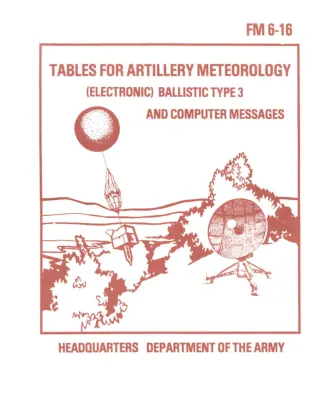 FM 6-16 ·Army ·1982
Tables for Artillery Meteorology-Electronic Ballistic Type 3 and Computer Messages (C1)
FM 6-16 CHAPTER 2 METEOROLOGICAL TABLES AND CHARTS SECTION I. GENERAL TABLES AND CHARTS FOR METEOROLOGICAL MESSAGES 2-1. GENERAL The tables and charts included in this chapter are used for computing general meteorological data for all…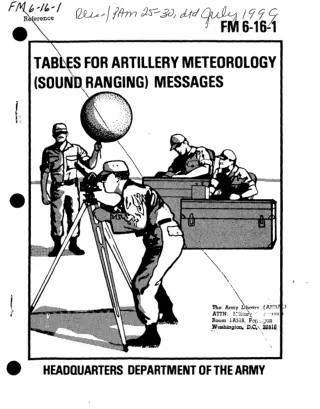 FM 6-16-1 ·Army ·1979