

 MCRP 2-10A.9 ·Marine Corps ·2021
Air Intelligence
and Philosophy Marine air intelligence is the combination of all-source intelligence, training, personnel, and techniques that assesses the weather, adversary, and terrain impacts to the air domain. While the primary customer of air… MCDP 1-3 ·Marine Corps ·2018
Tactics
This publication is about winning in combat. Winning requires many things: excellence in techniques, an appreciation of the enemy, exemplary leadership, battlefield judgment, and focused combat power. Yet these factors by themselves do not… STP 21-24-SMCT ·Army ·2003
Skill Level 2, 3, 4
vii reproducible forms. Where online access is not available, the soldier's unit must obtain hard copies of these forms SPECIAL NOTE FROM THE STAFF CONCERNING THE REVISED SMCT Experienced trainers will notice that, in addition to numerous… FM 3-1 ·Army ·1970
Chemical, Biological and Radiological (CBR) Support
FM 3-2 CHAPTER 2 OPERATIONAL CONSIDERATIONS 2-1. General a. Agent CS is used in combat operations to temporarily reduce the effectiveness of enemy personnel. Its major advantages in tactical opera- tions are its greater area coverage and… FM 3-2 ·Army ·1970
Tactical Employment of Riot Control Agent CS
FM 3-2 CHAPTER 2 OPERATIONAL CONSIDERATIONS 2-1. General a. Agent CS is used in combat operations to temporarily reduce the effectiveness of enemy personnel. Its major advantages in tactical opera- tions are its greater area coverage and… MCRP 3-31-1A ·Marine Corps ·Undated
Employment of Landing Craft Air Cushion (LCAC)
NWP 3-02.12 MCRP 3-31.1A Februrary 1997 PUBLICATION NOTICE ROUTING 1. NWP 3-02.12/MCRP 3-31.1A, Employment of Landing Craft Air Cushion (LCAC), is available in the Naval Warfare Publications Library. It is effective upon receipt. 2.… JP 3-01 ·Joint ·2017
Countering Air and Missile Threats
1. Scope This publication provides doctrine for joint operations to counter air and missile threats. 2. Purpose This publication has been prepared under the direction of the Chairman of the Joint Chiefs of Staff (CJCS). It sets forth joint… MCRP 6-12C ·Marine Corps ·2004
The Commander's Handbook for Religious Ministry Support
The Commander's Handbook for Religious Ministry Support is a guide for all Marine commanders, especially those with chaplains assigned to their units. Navy chaplains have been directly assigned to Marine units since World War I, and have… FM 6-99 ·Army ·2021
U.S. Army Report and Message Formats
While U.S. forces are among the most technologically advanced forces in the world, the need for redundancy and interoperability between joint and multinational forces requires the continued use of analog communication systems. Other…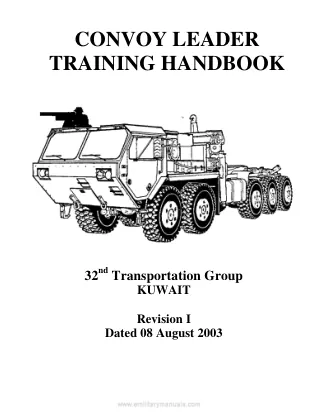 Convoy Leader Training Handbook ·Army ·2003
Convoy Leader Training Handbook
The purpose of this handbook is to provide a field guide for convoy leaders conducting long haul operations in support of Operation Iraqi Freedom. The focus is on planning, preparing and executing operations to counter level I and II… MCWP 5-4 ·Marine Corps ·1995
Small Wars
Intent. The purpose of this master's project was to write the coordinating draft for Marine Corps Warfighting Publication (MCWP) 5-4 on Small Wars or, as the Joint community refers to them, Military Operations Other Than War (MOOTW). To do… JP 3-02 ·Joint ·2019
Amphibious Operations
1. Scope This publication provides fundamental principles and guidance for planning, conducting, and assessing amphibious operations. 2. Purpose This publication has been prepared under the direction of the Chairman of the Joint Chiefs of… MCTP 3-20G ·Marine Corps ·2018
Air Reconnaissance
DEPARTMENT OF THE NAVY Headquarters United States Marine Corps Washington, D.C. 20350-3000 4 April 2018 CHANGE 1 to MCTP 3-20G Air Reconnaissance 1. This publication has been edited to ensure gender neutrality of all applicable and… ATTP 4-15 ·Army ·2011
Army Water Transport Operations
of combat power and the continued sustainment of the force – enabling options across the operational themes from peacetime military engagement to major combat operations. THE FOUR STRATEGIC THREAT CHALLENGE AREAS 1-10. The National… JP 2-01.3 ·Joint ·2009
Joint Intelligence Preparation of the Operational Environment
This publication provides doctrine for conducting joint intelligence preparation of the operational environment. It describes the process in which the adversary and other relevant aspects of the operational environment are analyzed to… ADRP 3-90 ·Army ·2012
Offense and Defense
To understand ADRP 3-90, the reader must understand the operational art, the principles of war, and the links between the operational and tactical levels of war described in JP 1, JP 3-0, ADP 3-0, and ADRP 3-0. The reader should understand… MCDP 7 ·Marine Corps ·2020
Learning
The purpose of this publication is to describe the Marine Corps' learning philosophy and explain why learning is critically important to the profession of arms. While many of the concepts in this publication have been passed on by Marine… ADRP 3-37 ·Army ·2012
Protection
ADRP 3-37 is a new publication that expands on the protection principles found in ADP 3-37. The doctrine described in this publication is nested within ADRP 3-0 and describes protection as a continuing activity and a warfighting function.… TM 4-14.21 ·Army ·2015
Rail Safety
Throughout history the ability to move forces and cargo by rail has proven to be a valuable asset. The successful use of a railway system can dramatically reduce the logistical footprint and be a source of cost savings. Even a small train… ATTP 3-34-39 ·Army ·2010
Camouflage, Concealment, and Decoys
26 November 2010 ATTP 3-34.39/MCRP 3-17.6A 1-1 Chapter 1 Basics CCD is the use of materials and techniques to hide, blend, disguise, decoy, or disrupt the appearance of military targets and/or their backgrounds. CCD helps prevent an enemy… FM 31-1-1 ·Army ·1994
Psychological Operations (PSYOPS) Techniques and Procedures
This field manual (FM) sets forth techniques and procedures for implementing United States (U.S.) Army psychological operations (PSYOP) doctrine contained in FM 33-1. It provides general guidance for commanders and planners who must… CALL ·Army ·1994
Civil Disturbances. Incorporating Non-Lethal Technology; Tactics, Technique and Procedures
his newsletter addresses new non-lethal weapons that have been developed based on the latest technologies available today and how to apply them at the unit level. Studies dealing with non-lethal weapons and technologies can be grouped into… FM 31-1-1-PSYCHOLOGICAL ·Army ·1994
Operations (PSYOPS) Techniques and Procedures
This field manual (FM) sets forth techniques and procedures for implementing United States (U.S.) Army psychological operations (PSYOP) doctrine contained in FM 33-1. It provides general guidance for commanders and planners who must… FM 19-60 ·Army ·Undated
Confinement and Correctional Treatment of US Military Prisoners
Chapter 1 The Army Correctional System The Army provides for the differing correctional needs of persons held for short, medium, and long periods of confinement by maintaining a three-tiered correctional system. Although the mission at all… FM 90-7-C1 ·Army ·2003
Combined Arms Obstacle Integration
Field Manual (FM) 90-7 is intended for the combined arms commander and staff. It encompasses doctrine established in FMs 5-100, 6-20 series, 71-100, 100-5, and 100-7. The doctrine presented in the following chapters seeks to develop the… FM 5-142 ·Army ·1964
Nondivisional Engineer Combat Units
ated; and the destruction of enemy emplacements by demolition or other means. (11) Engineer reconnaissance. This mis- sion is continuous and is a responsi- bility of all engineers, not just those personnel designated for the task. In… FM 30-55 ·Army ·1941
Military Intelligence. Identification of German Naval Ships
FM 30-55 BASIC FIELD MANUAL MILITARY INTELLIGENCE IDENTIFICATION OF GERMAN NAVAL SHIPS The material contained in this manual has been secured from many sources. It is the best material available, but may be incomplete and, in some… NDP 2 ·Navy ·1994
Naval Intelligence
As in the past, naval intelligence is on watch today, supporting U.S. Navy and Marine Corps forces deployed around the world. Naval intelligence provides vital threat information on the location, dispo sition, capabilities, and intentions… FM 4-119 ·Army ·1943
Antiaircraft Artillery Gunnery, Examination for Gunners
14-17 ANTIAIRCRAFT ARTILLERY FIELD MANUAL CHAPTER 3 SCOPE OF EXAMINATION Section I GENERAL @ 14. GeneraL.—The examination taken by officers, warrant officers, and enlisted men who are candidates for gunners will be that prescribed for the… MCWP 3-35.6 ·Marine Corps ·2004