

 FM 6-150 ·Army ·1944
Organic Field Artillery Air Observation
The primary mission of organic field artillery air observation is to supplement ground observation by: (1) Locating appropriate targets. (2) Adjusting artillery fire. b. Secondary missions include: (1) Reconnaissance of position areas and… MCWP 3-16-1 ·Marine Corps ·2002
Artillery Operations
Marine Corps Warfighting Publication (MCWP) 3-16.1, Artillery Operations, provides an overview of fundamentals, organization, support requirements, and tactical considerations used by Marine artillery regiments, battalions, and batteries… MCWP 3-16.6 ·Marine Corps ·1998
Supporting Arms Observer, Spotter and Controller
1. PURPOSE Marine Corps Warfighting Publication (MCWP) 3-16.6, Supporting Arms Observer, Spotter, and Controller, provides the techniques and procedures for requesting and adjusting supporting arms. 2. SCOPE This publication provides… FM 6-140 ·Army ·1973
Field Artillery Organizations
FM 6-140 T Section II. FIELD ARTILLERY ORGANIZATION 1—3. General The organization of all field artillery units and headquarters is shown in detail in the appropri- ate tables of organization and equipment (TOE). 1—4. Classification… FM 4-5 ·Army ·1940
Coast Artillery Field Manual Seacoast Artillery Organization and Tactics
FM 4-5 DECLASSIFIED RESOVD COAST ARTILLERY FIELD MANUAL SEACOAST ARTILLERY ORGANIZATION AND TACTICS (The matter contained herein supersedes part one, Coast Artillery Field Manual, volume I, January 3, 1933.) PART ONE ORGANIZATION CHAPTER 1… FM 44-2 ·Army ·1966
Air Defense Artillery Employment (Automatic Weapons)
Minimum midpoint tracking range. maximum horizontal range is 8,664 This is the shortest midpoint range at meters. which the weapon can track a target. * (2) Mobility. The 40mm gun motor carIt is dependent upon target speed and riage M42… FM 6-121 ·Army ·1967
Field Artillery Target Acquisition
for the purpose of conducting atmospheric soundings and disseminating current meteoro- logical data. Each division artillery has one meteorological section; and the corps FAT AB has two. Thus, a 12-division, three-corps field army has at… JP 3-01.1 ·Joint ·1996
Aerospace Defense of North America
i 1. Scope This publication provides the guidance necessary to plan, coordinate, and execute joint aerospace defense of North America. It provides the doctrinal basis for how joint forces approach the air defense, ballistic missile… FM 6-20 ·Army ·1973
Field Artillery Tactics and Operations
FM 6-20 CHAPTER 2 FIELD ARTILLERY CHARACTERISTICS Section I. CLASSIFICATION OF FIELD ARTILLERY WEAPONS 2—1. Classification by Weapon Field artillery weapons are classified as cannons, missiles, and aerial field artillery. a. Field… MCWP 3-16-6-DRAFT ·Marine Corps ·1998
Supporting Arms Observer, Spotter, and Controller
1. PURPOSE Marine Corps Warfighting Publication (MCWP) 3-16.6, Supporting Arms Observer, Spotter, and Controller, provides the techniques and procedures for requesting and adjusting supporting arms. 2. SCOPE This publication provides… FM 6-20-2 ·Army ·1970
Field Artillery Techniques
1-1. Purpose and Scope a. The purpose of this manual is to provide in- formation and guidance on the employment of field artillery. The manual covers the operations and techniques of employment of field artillery units to include command,… FM 4-6 ·Army ·1942
Coast Artillery Field Manual. Seacoast Artillery Tactics and Technique of Controlled Submarine Mines
Coast artillery field manual on seacoast artillery tactics and technique of control: fire command organization and conduct of fire (1942). FM 6-40-3 ·Army ·1970
Operation of the Gun Direction Computer M18, Cannon Gunnery Application (C3)
The M18 gun direction computer (FADAC) is the primary means by which a cannon bat- talion or battery fire direction center solves the gunnery problem. Use of this high-speed digital computer significantly increases accuracy and flexibility… FM 6-50 ·Army ·1996
TTP for the Field Artillery Cannon Gunnery
Tactics, techniques, and procedures for the field artillery cannon battery: mission, organization, key personnel, and battery operations (1996). MCWP 3-16.3 ·Marine Corps ·1996
Tactics, Techniques, and Procedures for the Field Artillery Cannon Battery
How-to-train reference (with FM 6-50) presenting tactics, techniques, and procedures for field artillery cannon gunnery at the cannon battery level, covering duties of key personnel, gunnery doctrine, and standardized procedures for… FM 90-36 ·Army ·1997
The Joint Targeting Process and Procedures for Targeting Time-Critical Targets
procedures, guidance, and information. However, it is not intended for this publication to supplant any higher joint or combatant command directives. 3. Application This publication provides JFCs and their operational staffs unclassified… JP 3-01.4 ·Joint ·1995
JTTP for Joint Suppression of Enemy Air Defenses (J-SEAD)
i 1. Scope This publication focuses on the responsibilities and procedures for joint suppression of enemy air defenses (J-SEAD). This publication defines J-SEAD and describes J-SEAD planning, coordination, and command and control… JP 3-01 ·Joint ·2017
Countering Air and Missile Threats
1. Scope This publication provides doctrine for joint operations to counter air and missile threats. 2. Purpose This publication has been prepared under the direction of the Chairman of the Joint Chiefs of Staff (CJCS). It sets forth joint… FM 6-99 ·Army ·2021
U.S. Army Report and Message Formats
While U.S. forces are among the most technologically advanced forces in the world, the need for redundancy and interoperability between joint and multinational forces requires the continued use of analog communication systems. Other… FM 4-119 ·Army ·1943
Antiaircraft Artillery Gunnery, Examination for Gunners
14-17 ANTIAIRCRAFT ARTILLERY FIELD MANUAL CHAPTER 3 SCOPE OF EXAMINATION Section I GENERAL @ 14. GeneraL.—The examination taken by officers, warrant officers, and enlisted men who are candidates for gunners will be that prescribed for the… MCTP 3-31B ·Marine Corps ·2025
Marine Air-Ground Task Force Targeting
Marine air-ground task force (MAGTF) fires and effects is the coordinated and collective employment of fires, information capabilities, and systems to create desired effects throughout the battlespace to achieve objectives. Under the… FM 6-135 ·Army ·1969
Adjustment of Artillery Fire by the Combat Soldier
The purpose of the conduct of fire is to place effective fire on the target by adjusting the fire with data derived from bursts previously ob- served. The fire can be considered as being ad- justed on the target when rounds or fragments… FM 4-103 ·Army ·1943
Antiaircraft Artillery Field Manual. Employment of Antiaircraft Artillery with Airborne Forces
RESTRICTED FM 4-103 _ WAR DEPARTMENT -ANTIAIRCRAFT ARTILLERY FIELD MANUAL 2 EMPLOYMENT OF ANTIAIRCRAFT ARTILLERY WITH AIRBORNE FORCES 30 September 1943 Dissemination of ‘restricted niatier—-The information conisined in restricted documents…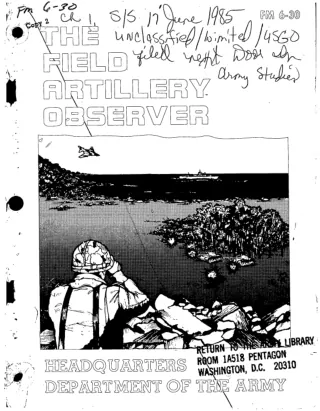 FM 6-30 ·Army ·1980
The Field Artillery Observer (C1)
Cl. FM 6-30 doctrine requires team members to operate with a sense of urgency and continually strive to reduce the time required to execute an effective fire mission. a. Observer. The observer serves as the eyes of all indirect fire… FM 6-24-8 ·Army ·2000
Tadil-J
1. Scope This publication introduces Tactical Digital Information Link (TADIL) J. It is a guide for warfighters who have limited or no experience or background in TADIL J and who need a quick orientation for supplemental or in-depth… JP 3-27 ·Joint ·2018
Homeland Defense
1. Scope This publication provides joint doctrine for homeland defense. 2. Purpose This publication has been prepared under the direction of the Chairman of the Joint Chiefs of Staff (CJCS). It sets forth joint doctrine to govern the… JP 3-01.5 ·Joint ·1996
Doctrine for Joint Theater Missile Defense
i 1. Scope This publication provides doctrine for the integration of theater missile defense capabilities to support execution of the joint force commander's operation order or campaign plan. The focus is to protect against theater missile… FM 6-20-1 ·Army ·1965
Field Artillery Tactics
3. The Field Artillery System The field artillery system consists of all of those elements. that are necessary to obtain the desired effect on the target. These elements include weapons, target acquisition, survey, ballistic meteorology,… FM 6-162 ·Army ·1969
Radar Set AN-TPS-25
CHAPTER 2 EQUIPMENT 4. Description a. The AN/TPS-25 (fig. 1) is a transporta- ble, battlefield surveillance radar set of the noncoherent Doppler type and is designed to detect and locate moving ground targets at ranges between 450 and… MCTP 3-01D ·Marine Corps ·2019