

 TM 3-34.84 ·Army ·2015
Swift Water Diving Operations
Supervisors and divers must be thoroughly familiar with the risks associated with swift/fast water diving operations. Train-ups, rehearsals, and unit standard operating procedures should be used when planning and conducting diving…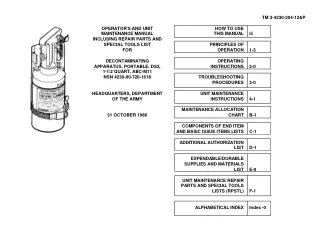 TM 3-4230-204-12 ·Army ·Undated
Decontaminating Apparatus, Portable, DS2, 1-1/2 Quart, ABC-M11
Become familiar with the entire manual before using the equipment. Everything you need to know to operate the equipment and to do preventive maintenance is found in this book. Location of the mounting bracket is the responsibility of the…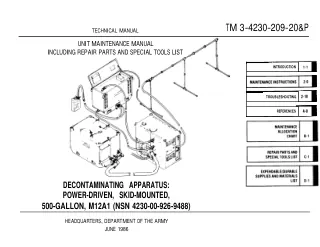 TM 3-4230-209-20 ·Army ·Undated
Decontaminating Apparatus: Power-Driven, Skid-Mounted, 500-Gallon, M12A1
If possible, do not operate the water heater in an enclosed area. The heater must be placed outside the enclosed area or the exhaust gases must be vented outside to prevent carbon monoxide poisoning. Wearing the field protective mask does… TM 3-4230-216-10 ·Army ·Undated
Decontaminating Kit, Skin: M258A1 and Training Aid, Skin Decontaminating: M58A1
Weight (filled): 3.2 oz (90.72 g) d. Operating Temperature: (0°C) to +110°F (43°C) NOTE • Although the normal operating temperature of the M258A1 is between and + 110ºF, the wipes will detoxify chemical agents at teperatures below and can… TM 3-4240-202-14 ·Army ·1971
Operator's, Organizational, DS, and GS Maintenance Manual: Mask, Chemical-Biological: Field, ABC-M17 and Accessories
EYELENS OUTSERTS Figure 1. Section III. 5. General a. ABC-M17 masks are issued in three sizes, small, medium, and large. The size of the mask can be identified by the markings on the forehead section of the daceblank and on the inside of… TM 3-4240-202-15 ·Army ·1962
Operator, Organizational, Field, and Depot Maintenance Manual: Mask, Protective, Field, M17
Section GENERAL 1. Scope ‘ This manual describes the M17 field protective mask and explains its use and method of functioning. It also provides instructions for the fitting, care and inspection, shipment and storage, and demolition of the… TM 3-4240-241-12 ·Army ·Undated
Filter Unit, Gas-Particulate, GED 300 CFM, ABC-M6A1 and EMD 300 CFM, ABC-M6A1
1. Scope This appendix lists basic issue items and items troop installed or authorized required by the crew or operator for operation of the ABC-M6AI GED and EMD filter units. 2. General This basic issue items and items troop installed or… TM 3-4240-279-20 ·Army ·1975
Organizational Maintenance Manual: Mask, Chemical-Biological: Field, ABC-M17/M17A1 and Accessories
Organizational maintenance, including repair parts and special tools list, for Mask, Chemical-Biological: Field, ABC-M17/M17A1 and accessories.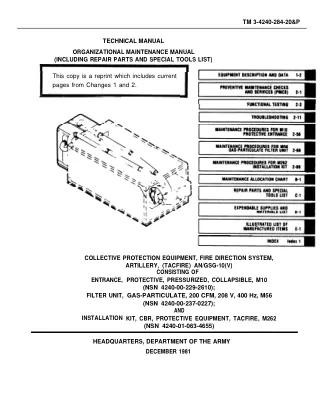 TM 3-4240-284-20 ·Army ·Undated
Collective Protection Equipment, Fire Direction System, Artillery (TACFIRE) AN/GSG-10(V)
TM 3-4240-284-20&P 1-7. 1-8. Section II. EQUIPMENT EQUIPMENT CHARACTERISTICS, CAPABILITIES, AND FEATURES. Characteristics The CPE is designed to operate in a chemicdbiological agent contaminated zone. The filter unit provides filtered air…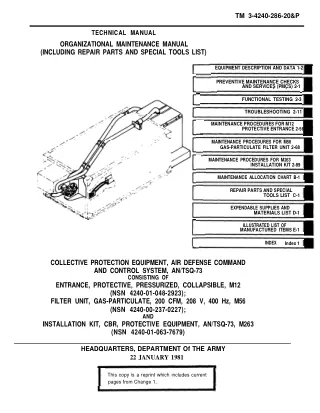 TM 3-4240-286-20 ·Army ·Undated
Collective Protection Equipment, Air Defense Command and Control System AN/TSQ-73
TM 3-4240-286-20&P Section II. EQUIPMENT DESCRIPTION AND DATA 1-7. 1-8. EQUIPMENT CHARACTERISTICS, CAPABILITIES, AND FEATURES. Characteristics The CPE is designed to operate in a chemical/biological agent contaminated zone. The filter unit… TM 3-4310-100-20 ·Army ·1977
Compressor Unit Reciprocating Technical Manual Tm 3-4310-100-20&P
Organizational maintenance, including repair parts and special tools list, for the power-driven flamethrower Compressor Unit, Reciprocating, 3-1/4 CFM, AN-M4, AN-M4B, AN-M4C, and AN-M4D. chemical-mustard-gas ·Army ·2002
Mustard Gas: Guidelines for Action in the Event of a Suspected Deliberate Release
1 Background 1.1 Introduction Mustard gas is a vesicant i.e. it is a blister- forming agent and may cause damage to skin, eyes and the respiratory system. Sulphur mustard is the chemical warfare agent that is normally referred to as… em1110-1-3500 chem grouting ·Army ·1995
Chemical Grouting
1-1. Purpose This manual provides information and guidance for the investigation and selection of materials, equipment, and methods to be used in chemical grouting in connection with construction projects. Elements discussed include types… em1110-1-4012 prec floc coag ·Army ·2001
Precipitation/Coagulation/Flocculation
1-1. Background. Chemical precipitation is the most common technique used for treatment of metal-contaminated waters (Patterson and Minear 1975, EPA 625/8-80-003, EPA 600/8-80042c, Peters et al. 1985, Patterson 1988). Chemical… em385-1-80 radiation protection ·Army ·1997
Radiation Protection Manual
U.S. Army Corps of Engineers radiation protection manual (EM 385-1-80): dose limits and ALARA, working with radiation, and radio-frequency safety (1997). JP 3-11 ·Joint ·2018
Operations in CBRN Environments
This publication provides doctrine for planning, conducting, and assessing military operations in chemical, biological, radiological, and nuclear environments. JP 3-41 ·Joint ·2016
CBRN Response
1. Scope This publication provides joint doctrine for military domestic or international response to minimize the effects of a chemical, biological, radiological, or nuclear incident. 2. Purpose This publication has been prepared under the… JP 3-72 ·Joint ·2019
Joint Nuclear Operations
1. Scope This publication provides fundamental principles and guidance to plan, execute, and assess nuclear operations, 2. Purpose This publication has been prepared under the direction of the Chairman of the Joint Chiefs of Staff (CICS).… MCRP 10-10E ·Marine Corps ·2013
Chemical, Bacteriological, Radiological, Nuclear Reconnaissance and Surveillance - MCRP 10-10E.7
This publication has been prepared under our direction for use by our respective commands and other commands as appropriate. MCRP 10-10E.1 ·Marine Corps ·2010
Multi-Service Tactics, Techniques, and Procedures for Chemical, Biological,..
This publication has been prepared under our direction for use by our respective commands and oth er commands as appropriate. LESLIE C. SMITH MCRP 10-10E.10 ·Marine Corps ·2021
Multi-Service Tactics, Techniques, and Procedures for Domestic Chemical,..
ATP 3-11.42/MCRP 10-10E.10/NTTP 3-11.38 provides doctrinal guidance for executing domestic CBRN response operations under the auspices of DSCA and describes Department of Defense (DOD) roles and responsibilities in conducting domestic CBRN… MCRP 10-10E.6 ·Marine Corps ·2008
Multiservice Tactics, Techniques, and Procedures for Chemical,biological,..
The purpose of this publication is to provide commanders, staffs, key agencies, and military members with a key reference for planning and conducting CBRN CM. It provides the tools for CBRN responders to effectively manage the consequences… MCRP 10-10E.7 ·Marine Corps ·2013
Multiservice Tactics, Techniques, and Procedures for Nuclear Biological And..
This publication has been prepared under our direction for use by our respective commands and other commands as appropriate. MCRP 3-37.1A ·Marine Corps ·2004
Nuclear, Biological, and Chemical Vulnerability Assessment
This publication has been prepared under our direction for use by our respective commands and other commands as appropriate. MCRP 3-37.1B ·Marine Corps ·2005
Potential Military Chemical Biological Agents and Compounds
This publication has been prepared under our direction for use by our respective commands and other commands as appropriate. MCRP 3-37.1C ·Marine Corps ·2004
Multiservice Tactics, Techniques, and Procedures for Biological Surveillance
1. Scope This multiservice operations publication provides tactics, techniques, and procedures (TTP) for planning and conducting biological-surveillance operations to monitor, detect, sample, identify, report, and evacuate samples of… MCRP 3-37.2C ·Marine Corps ·2001
Nuclear, Biological, and Chemical Aspects of Concequence Management
This publication has been prepared under our direction for use by our respective commands and other commands as appropriate. MCWP 3-3.7.1 ·Marine Corps ·Undated
Principles of NBC Defence // FM 3-100/MCWP 3-3.7.1, Chapter 4
FM 3-100/MCWP 3-3.7.1 normally degrade force effectiveness and erode combat power. To restore combat power commanders decontaminate as early as possible. Immediate decon supports individual survival. Operational decon allows temporary… MCWP 3-37 ·Marine Corps ·1998
MAGTF, Nuclear, Chemical, Biological Defense Operations
Marine Corps Warfighting Publication (MCWP) 3-37, MAGTF Nuclear, Biological, and Chemical Defense Operations, addresses the planning and execution of NBC defense operations within the Marine air-ground task force (MAGTF). It sets forth the… MCWP 3-37.2 ·Marine Corps ·2003