

 FM 17-97 ·Army ·1995
Cavalry Troop
Although FM 17-97 does not specifically address the TOE of the Light Division Cavalry Troop or the troops of a Separate Heavy or Light Brigade, the tactics, techniques, and procedures outlined in this publication still apply.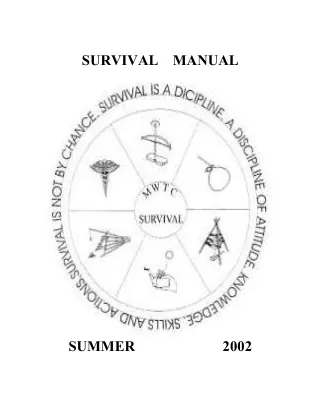 US Marine Corps - MWTC Summer Survival Course Handbook ·Army ·2002
Summer Survival Course Handbook
UNITED STATES MARINE CORPS Mountain Warfare Training Center Bridgeport, California 93517-5001 MSVX.02.01 02/06/05 STUDENT HANDOUT REQUIREMENTS FOR SURVIVAL TERMINAL LEARNING OBJECTIVE In a survival situation, and given a survival kit,…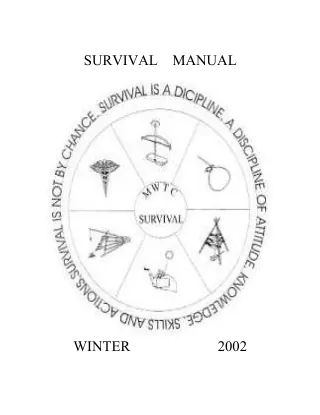 US Marine Corps - MWTC Winter Survival Course Handbook ·Army ·2002
Winter Survival Course Handbook
UNITED STATES MARINE CORPS Mountain Warfare Training Center Bridgeport, California 93517-5001 WSVX 02.01 02/06/05 STUDENT HANDOUT REQUIREMENTS FOR SURVIVAL TERMINAL LEARNING OBJECTIVE In a cold weather mountainous environment, apply the… FM 7-20 ·Army ·2000
The Infantry Battalion
AirLand Battle doctrine has produced great changes in the Army. It has affected everything from equipment to the way we fight. Commanders need to understand these concepts and how they affect the employment of an infantry battalion. This… MCRP 5-12C ·Marine Corps ·1998
Marine Corps Supplement to the Department of Defense Dictionary of Military and Associated Terms
 ATP 2-01 ·Army ·2014
Collection Management
ATP 2-01 establishes doctrine for the specific functions under planning requirements and assessing collection. It expands on the principles in FM 3-55. ATP 2-01 should be used in conjunction with FM 3-55 and with FM 2-0. It outlines the… MCRP 6-11D ·Marine Corps ·1999
Sustaining the Transformation
Our Corps does two things for America: we make Marines and we win our nation's battles. Our ability to successfully accomplish the latter, of course, depends upon how well we do the former. We make Marines through a process called… FM 5-170 ·Army ·1998
Engineer Recconaissance (C1)
Field Manual (FM) 5-170 describes how engineer recon teams support and augment a maneuver battalion or brigade's recon effort. It is designed as an engineer extension of FMs 17-95 and 17-98. This manual serves as a guide for both brigade… ATP 3-39-12 ·Army ·2013
Law Enforcement Investigations
Whether supporting LE activities in support of bases and base camps; maintaining and restoring order in an effort to stabilize an area of operations (AO); providing training and support to HN police; or supporting humanitarian relief… MCWP 3-25-3 ·Marine Corps ·1997
Marine Air Command and Control System Handbook
The Marine air command and control system (MACCS) provides the Marine aviation combat element commander with the means to exercise command and control of organic and nonorganic aviation assets necessary to support Marine air-ground task… FM 71-1 ·Army ·1998
Tank and Mechanized Infantry Combat Tem
Tank and mechanized infantry companies and company teams can fight and win engagements on any part of the battlefield in a conventional, nuclear, or chemical environment. The company team is normally task organized by the battalion task… FM 2-22 ·Army ·2006
Human Intelligence Collector Operations
FM 2-22.3 differ, the handling and treatment of sources must be accomplished in accordance with applicable law and policy. Applicable law and policy include US law; the law of war; relevant international law; relevant directives including… FM 23-25 ·Army ·1994
Light Antiarmor Weapons
This chapter provides information common to the light antiarmor weapons discussed in this manual. Topics include care and handling, destruction and decontamination procedures, and operating temperatures. Light antiarmor weapons are used… FM 3-90-2 ·Army ·2013
Reconnaissance, Security, and Tactical Enabling Tasks, Volume 2
To understand FM 3-90-2, the reader must understand the doctrinal fundamentals contained in Army Doctrine Publication (ADP) 3-0 and ADP 3-90 and Army Doctrine Reference Publication (ADRP) 3-0 and ADRP 3-90. The reader should understand how… FM 3-90 ·Army ·2001
Tactics
The Army's tactics manual: the science and art of tactics across offensive, defensive, and security operations, with common control measures and planning considerations (2001).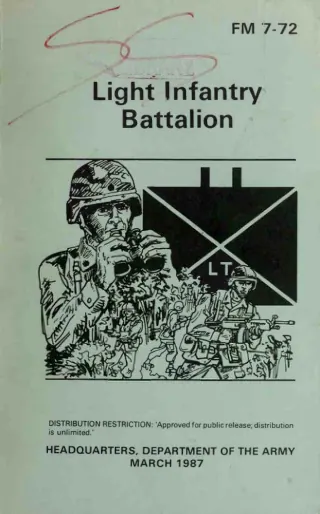 FM 7-72 ·Army ·1987
Light Infantry Battalion
Light infantry battalions are organized to fight successful operations in close terrain in the low- to mid-intensity spectrum of conflict. On the AirLand battlefield, they provide the Army versatility and strategic flexibility through… FM 3-97.6 ·Army ·2000
Mountain Operations
FM 3-97.6 describes the tactics, techniques, and procedures that the United States (US) Army uses to fight in mountainous regions. It is directly linked to doctrinal principles found in FM 3-0 and FM 3-100.40 and should be used in… FM 3-06.11 ·Army ·2002
Combined Arms Operations in Urban Terrain
Worldwide urban growth and the shift of populations from rural to urban areas have affected Army operations. Urban areas will most probably constitute future battlefields. All major Army operations most likely include urban operations (UO)… ATTP 3-06-11 ·Army ·2011
Combined Arms Operations in Urban Terrain
Army Tactics, Techniques, and Procedures (ATTP) 3-06.11 establishes doctrine for combined arms operations in urban terrain for the brigade combat team (BCT) and battalion/squadron commanders and staffs, company/troop commanders, small-unit…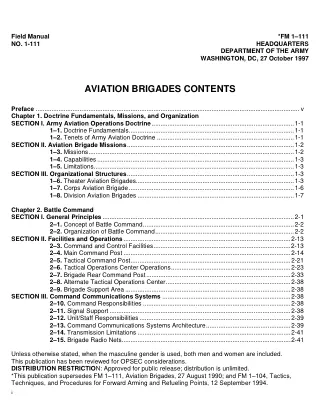 FM 1-111 ·Army ·1997
Aviation Brigades
The operational concepts in this manual are based on Army doctrine as established in FM 100-5, Operations, and FM 1-100, Army Aviation Operations. FM 1-111 is a doctrinal guide for employing aviation brigades in combat operations and… FM 17-95 ·Army ·1996
Cavalry Operations
"Altogether, cavalry operations are exceedingly difficult, knowledge of the country is absolutely necessary, and ability to comprehend the situation at a glance, and an audacious spirit, are everything. " Maurice de Saxe Mes Reveries, 1732… NAVEDTRA 14235 ·Army ·1996
Seabee Combat Handbook, Volume 2
By enrolling in this self-study course, you have demonstrated a desire to improve yourself and the Navy. Remember, however, this self-study course is only one part of the total Navy training program. Practical experience, schools, selected… FM 3-55.93 ·Army ·2009
Long-Range Surveillance Unit Operations
E-Mail [email protected] Office/Fax (706) 544-6448/-6421 (DSN 834) US Mail Commander, Ranger Training Brigade ATTN: ATSH-RB/Edmunds 10850 Schneider Rd, Bldg 5024 Ft Benning, GA 31905 Unless this publication states otherwise,… FM 7-93 ·Army ·1995
Long-Range Surveillance Unit Operations
Combat forces need accurate and timely intelligence about enemy forces, terrain, and weather. Commanders must make fast and accurate decisions to have the right combat force at the right place and time. Their decisions are partly based on…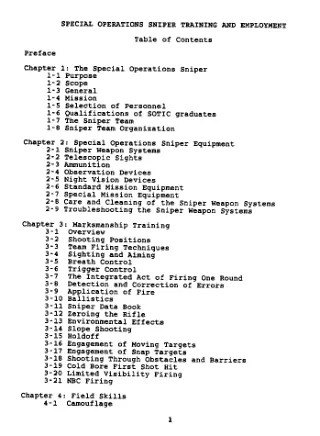 Special Operations Sniper Training and Employment ·Army ·Undated
Special Operations Sniper Training and Employment
Chapter 1 THE SPECIAL OPERATIONS SNIPER 1-1. PURPOSE The purpose of this manual is to provide doctrinal guidance on the mission, selection of personnel, organization, equipment, training, skills, and employment of the Special Operations… FM 3-21.71 ·Army ·2002
Mechanized Infantry Platoon and Squad (Bradley)
FM 3-21.71(FM 7-7J) 1-1 CHAPTER 1 THE ROLE OF THE MECHANIZED INFANTRY RIFLE PLATOON (BRADLEY FIGHTING VEHICLE) The mission of the mechanized infantry is to close with the enemy using fire and movement to defeat or capture him, or to repel…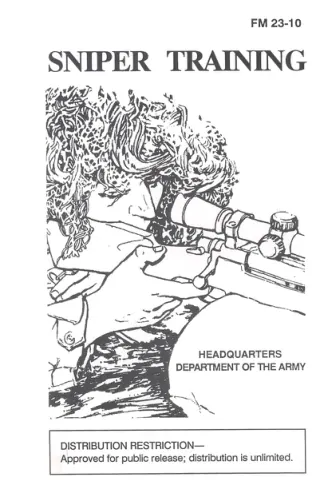 FM 23-10 ·Army ·1994
Sniper Training
The sniper has special abilities, training and equipment. His job is to deliver discriminatory highly accurate rifle fire against enemy targets, which cannot be engaged successfully by the rifleman because of range, size, location,… FM 71-123 ·Army ·1992
Tactics, Techniques for Combined Arms Heavy Forces
Users of this field manual must first read and understand the doctrinal field manuals: FM 71-3 (brigade), FM 71-2 (battalion), and FM 71-1 (company). This manual DOES NOT replace the doctrinal manuals; rather, it supplements them with… FM 34-1 ·Army ·1987
Intelligence and Electronic Warfare Operations
CHAPTER 1 The Mission Armies that maintain coherence and con- fidence and can concentrate superior com- bat power at decisive times and places are the winners of battles and campaigns. While there are no simple formulas for win- ning,…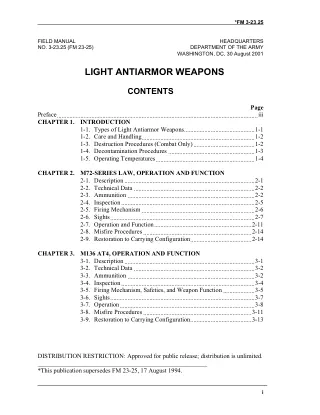 FM 3-23.25 ·Army ·2001