

 FM 100-23 ·Army ·1994
Peace Operations
FM 100-23 the 1960s. Since 1988, the number of peace operations has more than doubled, with each succeeding one being more complex than the last. The UN's peacekeeping operation in Cambodia in 1993, for example, included 22,000 military,… FM 100-23-1 ·Army ·1994
Multiservice Procedures for Humanitarian Assistance Operations
This publication provides military forces, civilians, and volunteer organizations with information pertaining to humanitarian assistance (HA) operations where the size or extent of the assistance requires the formulation of a US military… FM 100-30 ·Army ·1996
Nuclear Operations
In the past, Soviet-styled armored echeloned formations were the primary threat to the United States (US). In response to this threat the US designed and stockpiled tactical nuclear weapons. Today's threats consist of regional…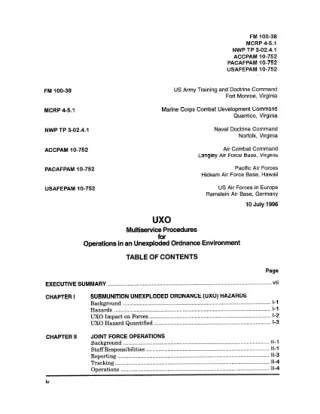 FM 100-38 ·Army ·1996
UXO Multiservice Procedures for Operations in an Unexploded Ordnance Environment
Appendix A UXO OBSTACLE NUMBERING UXO hazard areas are integrated into the standard obstacle numbering system using the procedures described below. Army and Marine Corps use the same numbering system. Army units are used for example only.… FM 100-5 ·Army ·2004
The Fundamentals of Army Operations
Excerpts from FM 100-5, Operations, covering the foundations of Army operations: the principles of war, tenets of Army operations, dynamics of combat power, and combat functions (web archive capture). FM 100-50 ·Army ·1980
Operations for Nuclear-Capable Units
This manual prescribes procedures, techniques, and standards for units with a nuclear mission operating under combat conditions. It also provides guidance to commanders and staffs for functions peculiar to nuclear missions and… FM 100-6 ·Army ·1996
Information Operations
This manual addresses the operational context of information operations (IO), relevant terminology, and the environment of information operations. It supports battle command and provides guidelines for commanders that conduct IO to support… FM 100-60 ·Army ·1997
Armor- And Mechanized-Based Opposing Force
The primary purpose of the field manuals in the 100-60 series is to provide the basis for a realistic and versatile OPFOR to meet U.S. military training requirements. They can support training in the field, in classrooms, or in automated…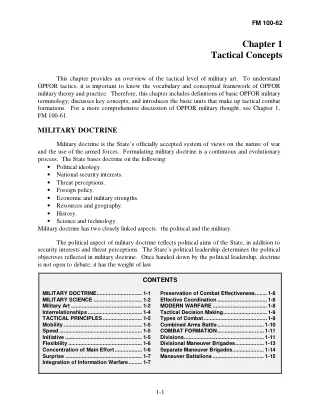 FM 100-62 ·Army ·Undated
OPFOR
The military aspect of doctrine conforms to the State's political aims. It encompasses the following elements that directly pertain to the OPFOR: • Organizational development. • Training. • Combat readiness. • Equipment types and numbers.…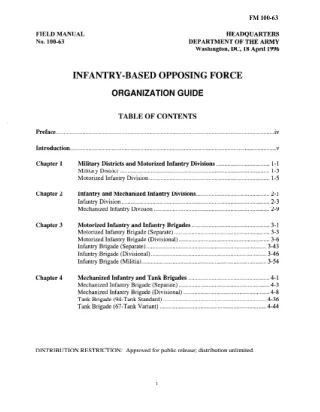 FM 100-63 ·Army ·1996
Infantry-Based Opposing Force Organiisation Guide
Organization guide for the infantry-based Opposing Force (OPFOR) used to portray realistic threat forces in U.S. Army training (1996). FM 100-7 ·Army ·1995
Decisive Force
Chapter 1 operation's purpose, the desired end state, the degree of acceptable risk, and the method of unifying focus for all subordinate elements. The operational-level commander's intent contains the intent statement of the next senior… FM 100-8 ·Army ·1997
The Army in Multinational Operations
This manual is a guide for Army commanders and staffs operating in a multinational environment across the full range of military operations. This doctrine for multinational operations takes into account each type of operation and varying… FM 100-9 ·Army ·1992
Reconstitution
This manual provides guidance on reconstitution. It defines reconstitution; describes the planning, training, decision making, and execution processes; and establishes responsibilities. The intent is to provide commanders facing… FM 100171 ·Army ·1992
Mobilization, Deployment, Redeployment, Demobilization
The transformation from a forward-deployed Army to a power-projection total force presents many challenges and changes to the way we prepare for the battlefield. Operations Just Cause, Desert Shield, and Desert Storm have shown that… FM 101-10-1 ·Army ·1987
Organization, Technical, and Logistical Data-Organzatorial, Logistical and Technical Data Vol 1
This volume is to be used as a planning guide only. Detailed reference data are found in TOEs, field manuals (FMs), technical manuals (TMs), technical bulletins, and supply bulletins as outlined in the DA Pamphlet 310-series. The… FM 101-10-1-2 ·Army ·1987
Organization, Technical, and Logistical Data-Data Planning Factors
This chapter contains engineer planning data for specialized tasks in each of the major engineer mission areas (mobility, countermobility, survivability, general engineering, and 1-2. TASKS. Mobility support includes those tasks which… FM 101-20 ·Army ·1984
Aviation Planning Manual
This manual is published in accordance with the provisions of AR contains official U.S. Army aviation factors datàxin a single-source docu- ment to be used as a planning guide ONLY. The. factors, when used with otlrer Army prográm… FM 101-31-1 ·Army ·1986
Nuclear Weapons Employment Doctrine and Procedures
This manual provides the planning and employment guidance for nuclear weapons in combat operations against targets on or near the earth's surface. It describes operational doctrine for integrating nuclear fire support into the concept of… FM 101-4 ·Army ·1999
Multiservice Procedures for Joint Task Force-Information Management
4. Implementation Plan Participating Service command offices of primary responsibility (OPRs) will review this publication, validate the information, and reference and incorporate it in Service manuals, regulations, and curricula as…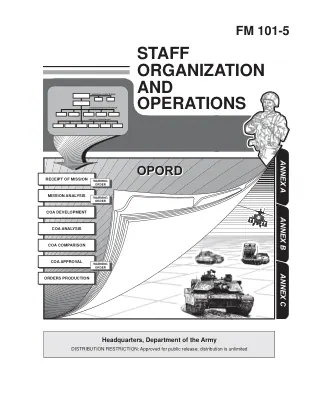 FM 101-5 ·Army ·1984
Staff Organization and Operations
Chapter 1 COMMAND AND STAFF RELATIONSHIPS Staffs exist to help the commander make and implement decisions. No command decision is more important, or more difficult to make, than that which risks the lives of soldiers to impose the nation's… FM 101-5-1 ·Army ·1997
Operational Terms and Graphics
This manual sets forth procedures for the United States Army and the United States Marine Corps in the use of land-based warfighting symbology. An extensive set of symbols for the Air Force and Navy is found in Military Standard 2525A. The… FM 101-5-2 ·Army ·1998
US Army Reports and Message Formats (DRAFT)
FM 101-5-2 is the Army's capstone manual for standardized report and message formats. It provides a standard, readily available reference from which soldiers as well as automation designers can extract report and message templates. FM… FM 105001 ·Army ·1986
Airdrop Support Operations in a Theater of Operations
Combat units carry only the supplies and equipment they will need until they can be resupplied. Airdrop planning and coordination must be continuous so that supplies and equipment are available for the supported units. Equally important is… FM 11-1 ·Army ·1996
Talk II-SINCGARS Multiservice Communications Procedures for the Single-channel Ground and Airborne Radio System
Chapter I EQUIPMENT AND OPERATIONS 1. Background Air, land, and sea forces all require effective communications for command and control. Single-channel (SC) very high frequency (VHF) frequency modulation (FM) combat net radio systems… FM 11-25 ·Army ·1985
Signal Troposcatter Company
1-1. Purpose This manual provides doctrinal guidance for the employment and operations of the Signal Troposcatter (Tropo) Companies (Light and Heavy) at echelons above corps (EAC) in a theater of operations. The manual is oriented toward… FM 11-30 ·Army ·1991
MSE Comunications in the Corps-Division
This chapter covers what AirLand Battle (ALB) doctrine means, how it affects the business of warfare, the impact it has on the Signal Corps, and the impact the Signal Corps has on the ALB concept. 1-2. ALB Doctrine The term AirLand…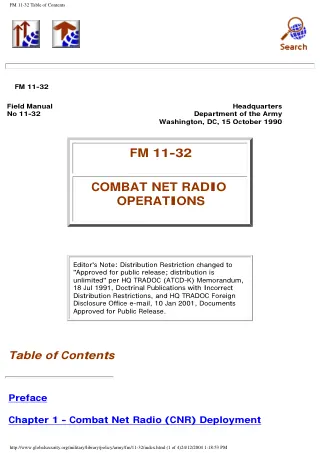 FM 11-32 ·Army ·1990
Combat Net Radio Operations
Table of Contents Preface Chapter 1 - Combat Net Radio (CNR) Deployment http://www.globalsecurity.org/military/library/policy/army/fm/11-32/index.html (1 of 4)24/12/2004 1:18:53 PM FM 11-43 ·Army ·1995
The Signal Leader's Guide
Successfully supporting the commander with reliable and redundant communications is a direct result of detailed planning. Planning signal support operations should not occur in a vacuum or just among signalers. For communications to… FM 11-45 ·Army ·1999
Signal Support to Theater Operations
This manual serves as a basis for signal support to theater Army (TA)/echelons above corps (EAC) doctrine and training. It is to be used in conjunction with FM 24-1 and the Joint Publication 6 series for the planning, installation,… FM 11-55 ·Army ·1999