

 FM 31-20 ·Army ·1990
Doctrine for Special Forces Operations
Field Manual (FM) 31-20 is the Special Forces (SF) principles manual. It is directly linked to and must be used in conjunction with the doctrinal principles found in FMs 100-5 and 100-20 and the projected FM 100-25. It describes SF roles,…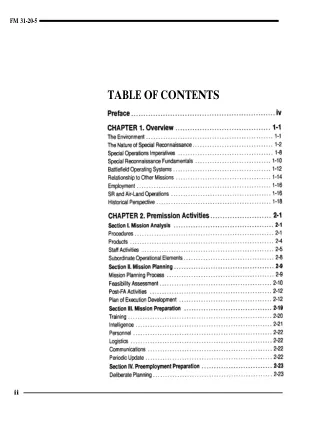 FM 31-20-5 ·Army ·1988
Special Reconnaissance Tactics, Techniques, & Procedures for Special Forces
Special reconnaissance (SR) is defined as reconnaissance and surveillance actions conducted by Special Forces (SF) to obtain or verify, by visual observation or other collection methods, information concerning the capabilities, intentions,… FM 31-22 ·Army ·1981
Command, Control, and Support of Special Forces Operations
Thisfield manual provides doctrinal guid¬ ance to Special Forces (SF) command¬ ers and their staffs for command, con¬ trol, and support of SF operations. It deals with the organization, missions, and operations in support of unconventional… FM 31-23 ·Army ·1998
Special Forces Mounted Operations, Tactics, Techniques, and Procedures
Until the mid 1980's, the United States (U.S.) Army did not have a dedicated mounted special operations 2 (SO) capability. Major General Guest (then Colonel), 5th Special Forces Group (Airborne ) (SFG[A]), 3 realized this shortcoming. He… FM 31-24I ·Army ·1986
Special Forces Air Operations
101, FM 31-24 Page 33. Figure 6-8 (Standard inverted "L" marking) is rescinded. Pages 33*34. STATIC LINE DZ MARKING PATTERNS is superseded as follows: STATIC LINE DZ MARKING PATTERNS Primary and alternate marking patterns are used to… FM 31-27 ·Army ·1998
Pack Animals in Support of Special Operations (Draft)
Draft field manual on pack animals in support of special operations: care, loading, and employment of pack animals in austere environments (1998). The archived scan is largely illegible. FM 31-82 ·Army ·Undated
Base Development
FM 31-82 planning factors required for base construction (FM 101-10-1). g. Standards of Construction— Level of quality of facilities which influences materially the level and amount of construction to be accomplished. Standards are based… FM 33-1 ·Army ·1993
Psychological Operations
FM 33-1 Chapter 1 O v e r v i e w Psychological operations are conducted across the operational continuum. The purpose of PSYOP is to induce or reinforce attitudes and behavior favorable to U.S. national goals in selected foreign target… FM 33-1-1 ·Army ·1994
Psychological Operations Techniques and Procedures
This field manual (FM) sets forth techniques and procedures for implementing United States (U.S.) Army psychological operations (PSYOP) doctrine contained in FM 33-1. It provides general guidance for commanders and planners who must… FM 34-1 ·Army ·1994
Intelligence and Electronic Warfare Operations
Field Manual 34-1 is the Army's capstone manual for military intelligence (MI) doctrine. It is consistent with and expands doctrine contained in FM 100-5, the Army's operations doctrine. It describes the Intelligence Battlefield Operating… FM 34-10 ·Army ·1986
Division Intelligence and Electronic Warfare Operations
CHAPTER 1 The Intelligence and Electronic Warfare Mission The division commander directs, coordinates, and supports subordinate unit operations against enemy first-echelon regiments in support of the division's close operations.… FM 34-11 ·Army ·1981
Ground Surveillance Company, Mititary Intelligence Battalion (Combat Electronic Warfare Intelligence) (Division)
CHAPTER 1 THE BATTLE CONTENTS Page THE DIRECT FIRE BATTLE 1-1 THE BRIGADE BATTLE 1-6 THE DIVISION BATTLE 1-8 GSR SUPPORT 1-9 Today's battlefields entail extreme vio- lence and lethality combined with rapid, con- tinuous combat. To win… FM 34-130 ·Army ·1994
Intelligence Preparation of the Battlefield
If I always appear prepared, it is because before entering on an undertaking, I have meditated for long and foreseen what may occur. — Napoleon Bonaparte, 1831 IPB is the best process we have for understanding the battlefield and the… FM 34-2 ·Army ·1994
Collection Management and Synchronization Planning
Normally, the greatest challenge for commanders is to focus the intelligence effort, and to gain dissemination of intelligence to the right place in time for key decisions. —FM 100-5 This manual provides the doctrinal framework for… FM 34-2-1 ·Army ·1991
Reconaissance and Surveillance and Intelligence Support to Counterreconaissance
Throughout history, military leaders have recognized the importance of R&S. Gaining and maintaining contact with the enemy is essential to win the battle. Our own military history contains many examples where our knowledge of the enemy, or…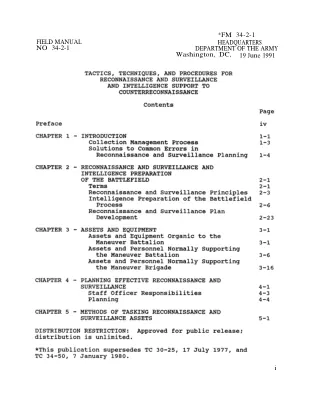 FM 34-2-1-RECONNAISANCE ·Army ·1991
Surveillance and Intelligence S
Throughout history, military leaders have recognized the importance of R&S. Gaining and maintaining contact with the enemy is essential to win the battle. Our own military history contains many examples where our knowledge of the enemy, or… FM 34-25 ·Army ·1987
Corps Intelligence and Electronic Warfare Operations
FM 34-25 CHAPTER 1 CHALLENGES FOR CORPS INTELLIGENCE AND ELECTRONIC WARFARE CORPS ROLE Corps, the Army's largest tactical unit, is the instrument with which higher echelons of command conduct maneuver at the operational level. A corps is… FM 34-3 ·Army ·1990
Intelligence Analysis
Intelligence is a key element of combined arms operations. It enables commanders to use their combat power effectively to win the decisive battles and it helps them identify and attack high payoff targets (HPTs). Intelligence is an… FM 34-35 ·Army ·1990
Armored Cavalry Regiment and Separate Brigade Intelligence and Electronic Warfare Operations
CHAPTER l THE INTELLIGENCE AND ELECTRONIC WARFARE MISSION enemy to the main body. Security defend. The ACR and separate brigade are two of the most versatile organizations on the modern battlefield. To successfully accomplish their…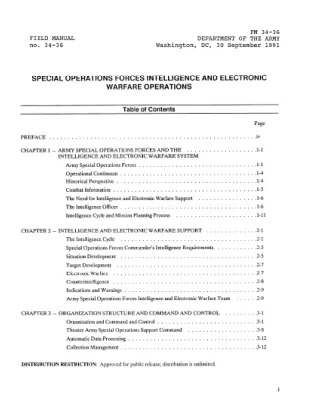 FM 34-36 ·Army ·1991
Special Operations Forces Inteligence and Electronic Warfare Operations
FM 34-36 CHAPTER 1 ARMY SPECIAL OPERATIONS FORCES AND THE INTELLIGENCE AND ELECTRONIC WARFARE SYSTEM This chapter introduces ARSOF units and the IEW with the IEW requirements of conventional combat units. system that supports them. It…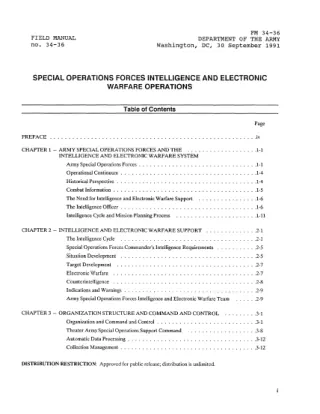 FM 34-36-SPECIAL ·Army ·1991
Operations Forces Inteligence and Electronic Warfare Oper
FM 34-36 CHAPTER 1 ARMY SPECIAL OPERATIONS FORCES AND THE INTELLIGENCE AND ELECTRONIC WARFARE SYSTEM This chapter introduces ARSOF units and the IEW with the IEW requirements of conventional combat units. system that supports them. It…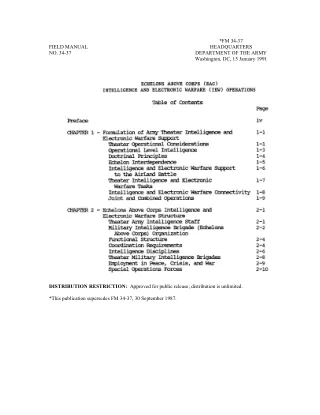 FM 34-37 ·Army ·1991
Echelons Above Corps (EAC) Intelligence and Electronic Warfare (IEW) Operations
In the mid-seventies, two events created a void in echelons above corps (EAC) intelligence doctrine and force structure: the transition of Army doctrine from field Army to EAC and the implementation of decisions resulting from the… FM 34-40-2 ·Army ·1990
Basic Cryptanalysis
This manual presents the basic principles and techniques of cryptanalysts and their relation to cryptography. Cryptography concerns the various ways of protecting messages from being understood by anyone except those for whom the messages… FM 34-40-7 ·Army ·1992
Communications Jamming Handbook
This manual explains how to employ the effective jamming techniques referenced in FM 34-1. Instructions are presented to the mission planner for calculating the minimum jammer power output requirements and the maximum distance a jammer can… FM 34-40-9 ·Army ·1991
Direction Finding Operations
Direction finding (DF) involves determining the direction of arrival of a radio wave. Since the conception of signals intelligence (SIGINT) gathering, direction finding has been an important part of the intelligence cycle. Direction… FM 34-45 ·Army ·2000
Tactics, Techniques, and Procedures for Electronic Attack
The purpose of this manual is to • Address the deployment and employment of electronic attack (EA) assets at division and brigade. • Discuss concepts and principles unique to EA. • Describe how to integrate EA into the targeting effort. •… FM 34-52 ·Army ·1992
Intelligence Interrogation
This manual provides doctrinal guidance, techniques, and procedures governing employment of interrogators as human intelligence (HUMINT) collection assets in support of the commander's intelligence needs. It outlines the interrogator's… FM 34-54 ·Army ·2014
Technical Intelligence
This field manual provides guidance to commanders and staffs of military intelligence (MI) and other units responsible for technical intelligence (TECHINT) or having an association with TECHINT. It provides general guidance and identifies…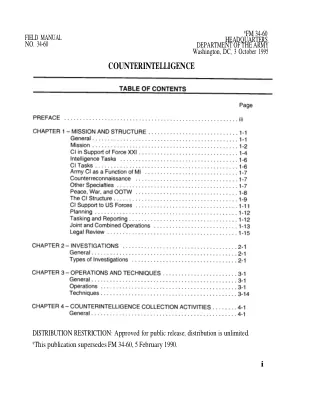 FM 34-60 ·Army ·1995
Counterintelligence
This field manual (FM) provides guidance to commanders, counterintelligence (CI) agents, and analysts. The first four chapters provide information to the commander and staff while the remainder provides the tactics, techniques, and… FM 34-7 ·Army ·1993