

 FM 3-90 ·Army ·2001
Tactics
The Army's tactics manual: the science and art of tactics across offensive, defensive, and security operations, with common control measures and planning considerations (2001). FM 3-90-1 ·Army ·2013
Offense and Defense, Volume 1
To understand FM 3-90-1, the reader must understand the doctrinal fundamentals contained in Army Doctrine Publications (ADP) 3-0 and 3-90 and Army Doctrine Reference Publications (ADRP) 3-0 and 390. The reader should understand how the… FM 3-90-2 ·Army ·2013
Reconnaissance, Security, and Tactical Enabling Tasks, Volume 2
To understand FM 3-90-2, the reader must understand the doctrinal fundamentals contained in Army Doctrine Publication (ADP) 3-0 and ADP 3-90 and Army Doctrine Reference Publication (ADRP) 3-0 and ADRP 3-90. The reader should understand how… FM 3-90-31 ·Army ·2009
Maneuver Enhancement Brigade Operations
Doctrine provides a military organization with unity of effort and a common philosophy, language, and purpose. This field manual (FM) provides doctrine for the tactical employment and operations of the maneuver enhancement brigade (MEB).… FM 3-90-6 ·Army ·2010
Brigade Combat Team
Field manual 3-90.6 provides the commander and staff of the Brigade Combat Team (BCT) and subordinate units with doctrine relevant to Army and joint operations. It applies to the Heavy Brigade Combat Team (HBCT), the Infantry Brigade… FM 3-90.1 ·Army ·2013
Tactics - Offense and Defense - FM 3-90.1 - United States Army
To understand FM 3-90-1, the reader must understand the doctrinal fundamentals contained in Army Doctrine Publications (ADP) 3-0 and 3-90 and Army Doctrine Reference Publications (ADRP) 3-0 and 390. The reader should understand how the… FM 3-90.12 ·Army ·2008
Combined Arms Gap-Crossing Operations
Some common abbreviations and acronyms—for example, the abbreviations for military ranks—are not spelled out; refer to the glossary. As a dual service manual, references made to the U.S. Army, Soldiers, division, and BCT are… FM 3-92 ·Army ·2010
Corps Operations
This manual provides direction for the corps headquarters: what it looks like, how it is organized, how its staff operates, how it is commanded and controlled, and how it operates in full spectrum operations. This publication replaces the… FM 3-93 ·Army ·2011
Theater Army Operations
Doctrine provides a military organization with unity of effort and a common philosophy, language, and purpose. This manual discusses the organization and operations of the theater army headquarters, including its role as the Army Service… FM 3-97-61 ·Army ·2002
Military Mountaineering (C1)
Commanders must consider the effects terrain and weather will have on their operations, mainly on their troops and logistics efforts. Weather and terrain combine to challenge efforts in moving supplies to forward areas. Spring storms,… FM 3-97.6 ·Army ·2000
Mountain Operations
FM 3-97.6 describes the tactics, techniques, and procedures that the United States (US) Army uses to fight in mountainous regions. It is directly linked to doctrinal principles found in FM 3-0 and FM 3-100.40 and should be used in… FM 3-97.61 ·Army ·2002
Military Mountaineering
Commanders must consider the effects terrain and weather will have on their operations, mainly on their troops and logistics efforts. Weather and terrain combine to challenge efforts in moving supplies to forward areas. Spring storms,… FM 31-1-1 ·Army ·1994
Psychological Operations (PSYOPS) Techniques and Procedures
This field manual (FM) sets forth techniques and procedures for implementing United States (U.S.) Army psychological operations (PSYOP) doctrine contained in FM 33-1. It provides general guidance for commanders and planners who must… FM 31-1-1-PSYCHOLOGICAL ·Army ·1994
Operations (PSYOPS) Techniques and Procedures
This field manual (FM) sets forth techniques and procedures for implementing United States (U.S.) Army psychological operations (PSYOP) doctrine contained in FM 33-1. It provides general guidance for commanders and planners who must… FM 31-19 ·Army ·1993
Military Free-Fall Parachuting Tactics, Techniques, and Procedures
This field manual (FM) presents a series of concise, proven techniques and guidelines that are essential to safe, successful military free-fall (MFF) operations. The techniques and guidelines prescribed herein are generic in nature, and… FM 31-20 ·Army ·1990
Doctrine for Special Forces Operations
Field Manual (FM) 31-20 is the Special Forces (SF) principles manual. It is directly linked to and must be used in conjunction with the doctrinal principles found in FMs 100-5 and 100-20 and the projected FM 100-25. It describes SF roles,…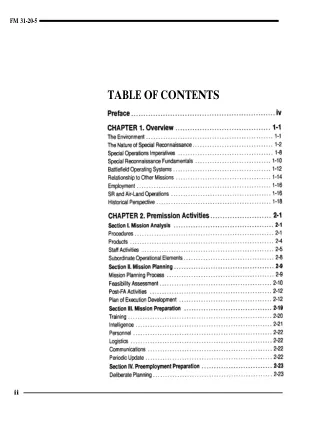 FM 31-20-5 ·Army ·1988
Special Reconnaissance Tactics, Techniques, & Procedures for Special Forces
Special reconnaissance (SR) is defined as reconnaissance and surveillance actions conducted by Special Forces (SF) to obtain or verify, by visual observation or other collection methods, information concerning the capabilities, intentions,… FM 31-22 ·Army ·1981
Command, Control, and Support of Special Forces Operations
Thisfield manual provides doctrinal guid¬ ance to Special Forces (SF) command¬ ers and their staffs for command, con¬ trol, and support of SF operations. It deals with the organization, missions, and operations in support of unconventional… FM 31-23 ·Army ·1998
Special Forces Mounted Operations, Tactics, Techniques, and Procedures
Until the mid 1980's, the United States (U.S.) Army did not have a dedicated mounted special operations 2 (SO) capability. Major General Guest (then Colonel), 5th Special Forces Group (Airborne ) (SFG[A]), 3 realized this shortcoming. He… FM 31-24I ·Army ·1986
Special Forces Air Operations
101, FM 31-24 Page 33. Figure 6-8 (Standard inverted "L" marking) is rescinded. Pages 33*34. STATIC LINE DZ MARKING PATTERNS is superseded as follows: STATIC LINE DZ MARKING PATTERNS Primary and alternate marking patterns are used to… FM 31-27 ·Army ·1998
Pack Animals in Support of Special Operations (Draft)
Draft field manual on pack animals in support of special operations: care, loading, and employment of pack animals in austere environments (1998). The archived scan is largely illegible. FM 31-82 ·Army ·Undated
Base Development
FM 31-82 planning factors required for base construction (FM 101-10-1). g. Standards of Construction— Level of quality of facilities which influences materially the level and amount of construction to be accomplished. Standards are based… FM 33-1 ·Army ·1993
Psychological Operations
FM 33-1 Chapter 1 O v e r v i e w Psychological operations are conducted across the operational continuum. The purpose of PSYOP is to induce or reinforce attitudes and behavior favorable to U.S. national goals in selected foreign target… FM 33-1-1 ·Army ·1994
Psychological Operations Techniques and Procedures
This field manual (FM) sets forth techniques and procedures for implementing United States (U.S.) Army psychological operations (PSYOP) doctrine contained in FM 33-1. It provides general guidance for commanders and planners who must…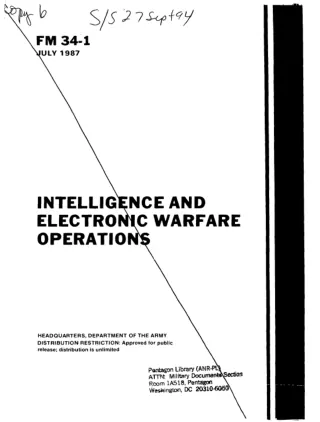 FM 34-1 ·Army ·1987
Intelligence and Electronic Warfare Operations
CHAPTER 1 The Mission Armies that maintain coherence and con- fidence and can concentrate superior com- bat power at decisive times and places are the winners of battles and campaigns. While there are no simple formulas for win- ning,… FM 34-130 ·Army ·1994
Intelligence Preparation of the Battlefield
If I always appear prepared, it is because before entering on an undertaking, I have meditated for long and foreseen what may occur. — Napoleon Bonaparte, 1831 IPB is the best process we have for understanding the battlefield and the… FM 34-2 ·Army ·1994
Collection Management and Synchronization Planning
Normally, the greatest challenge for commanders is to focus the intelligence effort, and to gain dissemination of intelligence to the right place in time for key decisions. —FM 100-5 This manual provides the doctrinal framework for… FM 34-2-1 ·Army ·1991
Reconaissance and Surveillance and Intelligence Support to Counterreconaissance
Throughout history, military leaders have recognized the importance of R&S. Gaining and maintaining contact with the enemy is essential to win the battle. Our own military history contains many examples where our knowledge of the enemy, or…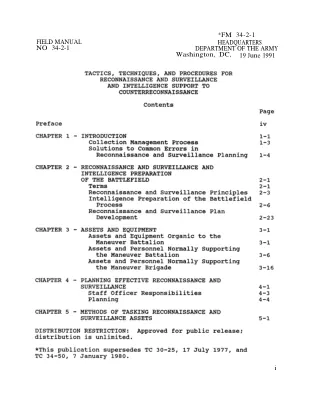 FM 34-2-1-RECONNAISANCE ·Army ·1991
Surveillance and Intelligence S
Throughout history, military leaders have recognized the importance of R&S. Gaining and maintaining contact with the enemy is essential to win the battle. Our own military history contains many examples where our knowledge of the enemy, or… FM 34-3 ·Army ·1990