

 MCRP 8-10B.2 ·Marine Corps ·2016
Rifle Marksmanship
to Rifle Marksmanship All Marines share a common warfighting belief: Every Marine a rifleman. This simple credo reinforces the belief that all Marines are forged from a common experience, share a common set of values, and are trained as… MCRP 8-10B.3 ·Marine Corps ·2016
Pistol Marksmanship
CHAPTER 1 THE M9 SERVICE PISTOL The Marine Corps' uses the M9 service pistol as a defensive weapon. It is a semiautomatic, magazine-fed, recoil-operated, double-action pistol. The M9 service pistol's magazine holds 15 rounds and is… FM 3-22.9C1 ·Army ·2011
Rifle Marksmanship: M16-/M4-Series Weapons
(page F-1). Also, a portion of the appendix has been added to address marking 25-meter zero offsets for 200 meters (beginning with paragraph F-3 on page F-9). In Table F-1 (page F-7), the zero offset for the M16A4 MWS with the M68…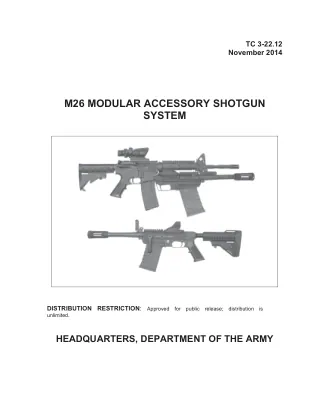 TC 3-22.12 ·Army ·2014
M26 Modular Accessory Shotgun System
Training Circular (TC) 3-22.12 provides technical information, training strategy, and employment techniques for the M26 Modular Accessory Shotgun System (MASS). It details training requirements and considerations for lethal and nonlethal… TC 3-20.40 C1 ·Army ·2019
Training and Qualification - Individual Weapons
Training and qualification standards for individual weapons: progressive marksmanship tables from preliminary instruction through qualification (2019, change 1). TC 3-21.75 ·Army ·2013
The Warrior Ethos and Soldier Combat Skills
Duty, honor, country: Those three hallowed words reverently dictate what you ought to be, what you can be, and what you will be. They are your rallying point to build courage when courage seems to fail, to regain faith when there seems to… ATP 3-37.15 C1 ·Army ·2020
Foreign Security Force Threats
A foreign security force threat is the potential for violence posed by foreign security forces (FSFs) working with, or granted access to, U.S. Service members, civilians, or contractors. Previously referred to as green-on-blue attacks,… TC 90-1 ·Army ·2008
Training for Urban Operations
Fort Benning, GA 31905-5593 Uniforms shown in this manual were drawn without camouflage for clarity of the illustration. Unless this publication states otherwise, masculine nouns and pronouns may refer to either men or women. MCDP 7 ·Marine Corps ·2020
Learning
The purpose of this publication is to describe the Marine Corps' learning philosophy and explain why learning is critically important to the profession of arms. While many of the concepts in this publication have been passed on by Marine… MCTP 3-03D ·Marine Corps ·2025
Security Cooperation
CHAPTER 1. UNDERSTANDING SECURITY COOPERATION IN A STRATEGIC CONTEXT SECURITY COOPERATION AS AN ENABLER OF STRATEGY The increasingly complex security environment, defined by strategic competition and state and non-state adversaries using… MCRP 7-20A.2 ·Marine Corps ·2023
Event and Exercise Design
Marine Corps Reference Publication (MCRP) 7-20A.2, Event and Exercise Design, provides guidance for Marine leaders and trainers on how to create standards-based unit training events and exercises. This publication reinforces the… TC 3-22.9 C3 ·Army ·2016
Rifle and Carbine
Rifle and carbine employment for the M4- and M16-series weapons: function, ballistics, employment, and marksmanship. Supersedes FM 3-22.9 (2016, change 3). MCTP 8-10B ·Marine Corps ·2018
How to Conduct Training
Marine Corps Reference Publication (MCRP) 3-0B, How to Conduct Training, provides guidance to assist units on how to conduct Marine Corps training. This publication deals primarily with training's implementation phase. It also explains how… ATP 6-02.40 C1 ·Army ·2019
Techniques for Visual Information Operations
ATP 6-02.40 28 April 2021 Acknowledgements Assorted photos from https://www.dvidshub.net/ are courtesy of the United States Defense Visual Information Distribution Service. Assorted photos from https://catalog.archives.gov/ are courtesy of… MCTP 7-20A ·Marine Corps ·2023
Unit Training Guide
Marine Corps Tactical Publication (MCTP) 7-20A, Unit Training Guide, contains guidance for Marine leaders at all levels on how to plan, conduct, and evaluate Marine Corps training. This publication provides a description of training… FMFRP 12-15 ·Marine Corps ·1990
Small Wars Manual
Reprint of the 1940 Small Wars Manual (NAVMC 2890): the Marine Corps' experience in small wars — organization, operations, intervention, and withdrawal — retained as a historical reference. MCTP 3-30D ·Marine Corps ·2023
Religious Ministry in the United States Marine Corps
Chaplains and religious program specialists provide comprehensive command religious programs of the highest quality to Marines, Sailors and their families. From combat against the Barbary Pirates in the early 1800s to our most recent… MCRP 1-10.2 ·Marine Corps ·2020
Marine Corps Supplement to the DOD Dictionary of Military and Associated Terms
Marine Corps alignment with joint terminology resulted in the following changes to Marine Corps doctrine and terminology: The term "competition continuum" replaces "conflict continuum." The term "range of military operations" may be used… FM 7-0 ·Army ·2021
Training
Training, expands on the fundamental concepts of the Army's training doctrine introduced in ADP 7-0. This publication applies to all Army leaders and the three components of the Total Army: the Regular Army, the Army National Guard, and… TC 3-21.76 ·Army ·2025
Ranger Handbook
The Ranger Handbook: condensed leadership, patrolling, battle drills, and fieldcraft reference carried by small-unit leaders. Supersedes the 2017 edition (2025). ATP 3-01.8 ·Army ·2016
Techniques for Combined Arms for Air Defense
ATP 3-01.8, focuses on how a combined arms force protects themselves from an adversary's air attack. Aerial threats include Unmanned Aircraft Systems (UAS); fixed- and rotary-wing aircraft; rockets, artillery, and mortars (RAM); ballistic… MCRP 7-20B.1 ·Marine Corps ·2021
Operational Training Ranges Required Capabilities
Marine Corps operational training ranges consist of a complex infrastructure with multiple geographic locations possessing a wide array of capabilities. These training ranges must support a broad spectrum of mission-essential warfighter… MCDP 1-3 ·Marine Corps ·2018
Tactics
This publication is about winning in combat. Winning requires many things: excellence in techniques, an appreciation of the enemy, exemplary leadership, battlefield judgment, and focused combat power. Yet these factors by themselves do not… MCTP 6-10A ·Marine Corps ·2024
Sustaining the Transformation
Since our 31st Commandant, General Charles C. Krulak, first published Marine Corps Reference Publication 6-11D, Sustaining the Transformation, in 1999, the Marine Corps has continued our proud tradition of making Marines, winning battles,… ATP 3-24.3 ·Army ·2015
Cultural and Situational Understanding
Understanding culture is essential in conducting irregular warfare. Irregular warfare requires a deliberate application of an understanding of culture due to the need to understand a populated operational environment, what specifically is… TC 4-15.51 ·Army ·2018
Marine Crewman'S Handbook
Marine crewman's handbook for Army watercraft: seamanship, deck operations, and crew duties (2018). ATP 3-07.5 ·Army ·2012
Stability Techniques
31 August 2012 ATP 3-07.5 (INCL C1) 1-1 Chapter 1 Stability Framework This chapter examines the various contexts in which Army units conduct stability efforts. It first discusses stabilization. This discussion covers the range of military… JP 3-07.4 ·Joint ·1998
Joint Counterdrug Operations
i 1. Scope This publication is designed to consolidate some of the existing information on counterdrug (CD) operations, but it is not intended as an all encompassing, single-source CD document. Other publications provide information for… AR 350-1 ·Army ·2025
Army Training and Leader Development
Section I Overview 1–1. Purpose This regulation prescribes policies, procedures, and responsibilities for developing, managing, and conducting Army training and leader development. 1–2. References, forms, and explanation of abbreviations… MCWP 3-10 ·Marine Corps ·2018