

 FM 5-0 ·Army ·2024
Planning and Orders Production
Planning—the art and science of understanding a situation, envisioning a desired future, and determining effective ways of bringing that future about—is a key activity of the operations process. While planning may start an iteration of the… FM 6-0 ·Army ·2022
Commander and Staff Organization and Operations
Command and control (C2)—the exercise of authority and direction by a properly designated commander over assigned and attached forces—is fundamental to the art and science of warfare. No single specialized military function, either by… FM 6-22 C2 ·Army ·2022
Developing Leaders
Army leaders are the competitive advantage the Army possesses that neither technology nor advanced weaponry and platforms can replace. Developing leaders is a complex and complicated undertaking because it is primarily a human… FM 6-27 C2 ·Army ·2019
The Commander'S Handbook on the LAW of Land Warfare (Mctp 11-10C)
Commanders, staffs, and subordinates must ensure that their decisions and actions comply with applicable U.S., international, and in some cases host-nation laws and regulations. Commanders at all levels will ensure that their Soldiers or… FM 6-99 ·Army ·2021
U.S. Army Report and Message Formats
While U.S. forces are among the most technologically advanced forces in the world, the need for redundancy and interoperability between joint and multinational forces requires the continued use of analog communication systems. Other… FM 7-0 ·Army ·2021
Training
Training, expands on the fundamental concepts of the Army's training doctrine introduced in ADP 7-0. This publication applies to all Army leaders and the three components of the Total Army: the Regular Army, the Army National Guard, and… FM 7-100.1 ·Army ·2004
Opposing Force Operations
In today's complicated and uncertain world, it is impossible to predict the exact nature of future conflict that might involve the U.S. Army. So the Army must be ready to meet the challenges of any type of conflict, in all kinds of places,… FM 7-22 C1 ·Army ·2020
Holistic Health and Fitness
+Acknowledgements The copyright owners listed here have granted permission to reproduce material from their work. The Source Notes lists other sources of information. Photos developed by the U.S. Army Center for Initial Military Training… TC 1-19.10 ·Army ·2024
Army Ceremonial Music Performance
TC 1-19.10, Army Ceremonial Music Performance, is the primary ceremonial music training publication of Army Bands. TC 1-19.10 defines, updates, adds, or changes movements unique to marching bands, such as marching style, the performance of… TC 1-19.30 ·Army ·2025
Percussion Techniques
TC 1-19.30 is a reference guide for MOS percussionists (MOS 42R, with the ASI of 9M) and auxiliary percussionists (MOS 42R, with the ASI of 9H, 9K, 9N, 9T, 9U, 9V, and 9X). This revision of TC 1-19.30 reorganizes the content for better… TC 1-19.50 ·Army ·2023
The Army Drum Major
TC 1-19.50 is designed to be a practical guide for Army Musicians who have little, to no, drum major experience. It provides those Soldiers with materials to help them develop the fundamental skills required to succeed as a drum major in a… TC 1-19.51 ·Army ·2022
The Army Ceremonial Conductor
TC 1-19.51 is designed to be a practical guide for Army Musicians who have little, to no, conducting experience. It provides those Soldiers with materials to help them develop the fundamental skills required to succeed as a conductor in a… TC 1-19.52 ·Army ·2021
Army Bands Leader Development
TC 1-19.52, Army Bands Leader Development, is the primary leadership training publication of the Army Bands program. It replaces TC 12-44, Army Band Section Leader Handbook. TC 1-19.52 makes numerous changes from TC 12-44. The most… TC 2-91.4 ·Army ·2015
Intelligence Support to Urban Operations
With the continuing growth in the world's urban areas and increasing population concentrations in urban areas, the probability that Army forces will conduct operations in urban environments is ever more likely. As urbanization has changed… TC 21-24 ·Army ·2025
Tower and Aircraft Rappelling
to rappelling is taught on a static tower (see figure 1-1). Using the building block approach to training, Soldiers systematically progress to more demanding platforms including taller static towers and helicopters. The static tower used… TC 21-3 ·Army ·2025
Soldier`s Handbook for Individual Operations and Survival in Cold-Weather Areas
to Cold-Weather Operations DIFFERENT TYPES OF COLD CONDITIONS 1-1. There are different types of cold found throughout the world and each presents its own challenges. For Soldiers to be effective in a cold-weather environment, it is… TC 21-305 C1 ·Army ·1996
Training Program for Wheeled Vehicle Accident Avoidance
More than tanks, aircraft, training, weapons, and war, AMV and POV accidents continue to be the major killer of soldiers. Despite seatbelts, airbags, anti-lock brakes, built-in steel reinforcement and shock absorbing bumpers, and dozens of… TC 21-305-20 ·Army ·2016
Manual for the Wheeled Vehicle Operator {afman 24-306(I)}
12 January 2016 TC 21-305-20/AFMAN 24-306(I) 1-1 Chapter 1 Basic Regulation and Responsibilities 1-1. Military and civilian vehicle operators must meet specific qualifications to be certified. He/She must know his/her responsibilities and… TC 21-306 ·Army ·2025
Tracked Combat Vehicle Driver Training
Leaders must emphasize driver training within their organizations because of the length, width, and high ground pressure of tracked combat vehicles, the terrain tracked combat vehicles are required to operate in, and the numerous blind…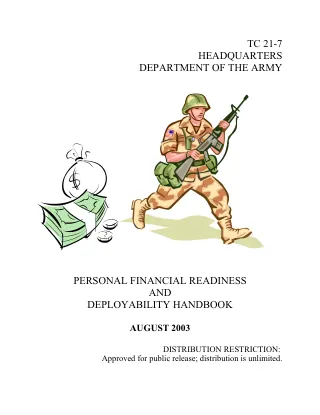 TC 21-7 ·Army ·2003
Personal Financial Readiness and Deployability Handbook
This training circular is designed for soldiers in the active component (AC) and the reserve component (RC) (which includes the Army National Guard (ARNG) and the United States Army Reserve (USAR). It explains the Army's pay system and… TC 3-01.80 ·Army ·2017
Visual Aircraft Recognition
There is little discussion about the depth and breadth of the automation of weapons and weapon systems in the United States (US) Military. Soldiers rely heavily on the use of these systems to employ their will on the battlefield and defeat… TC 3-01.81 ·Army ·2025
Counter-Small Unmanned Aircraft Systems (C-SUAS) Gunnery Program
This proponent publication provides trainers and commanders with gunnery qualification requirements and is a guide to reach published goals and sustain unit and crew proficiency. Training will replicate real world situations and potential… TC 3-04.1-4 ·Army ·2026
Fundamentals of Flight
Training circular on the fundamentals of flight for Army aviation: aerodynamics and flight theory. Supersedes TC 3-04.4 (2026). TC 3-04.10 ·Army ·2019
Aviation Life Support Maintenance
This TC and Army Techniques Publication (ATP) 3-04.7 provide techniques and procedures for aviation maintenance as the foundation for commanders, aviation life support equipment officers (ALSOs), aviation life support equipment… TC 3-04.11 ·Army ·2022
Commander'S Aviation Training and Standardization Program
TC 3-04.11, in conjunction with AR 95-1, provides requirements for the United States Army aircrew training program (ATP). Aviation units will use the guidance of TC 3-04.11 to build and sustain proficiency in aviation skills to improve… TC 3-04.12 ·Army ·2022
Aviation Mission Planning Forms
TC 3-04.12 provides rated aviators and unmanned aircraft crewmembers with the required and optional forms that assist in the mission planning process. The instructions for the forms located within this publication are meant to serve as… TC 3-04.15 ·Army ·2019
Air Traffic Control Facility Operations, Training, Maintenance, and Standardization
To understand TC 3-04.15, the reader must understand the fundamentals contained in AR 95-2, Federal Aviation Administration Orders (FAAO) 7210.3 and 7220.1. The reader should also be familiar with the requirements contained in FAAO 7110.65… TC 3-04.5 ·Army ·2024
Instrument Flight for Army Aviators
Instrument flight for Army aviators: instrument procedures, navigation, and weather flying. Supersedes the 2017 edition (2024). TC 3-04.93 C1 ·Army ·2018
Aeromedical Training for Flight Personnel
In order to keep pace with the current operating environment, the development of more sophisticated aircraft, and improvements in weapons systems, Army crewmembers must be capable of operating these systems for extended periods of time, in… TC 3-09.81 ·Army ·2016