

 FM 71-100-3 ·Army ·1996
Air Assault Division Operations: Tactics, Techniques, and Procedures
The air assault (AASLT) division is unique. It provides the warfighting commanders-in-chiefs (CINCs) an operational ground force capable of attacking directly into the enemy's vulnerable rear areas. It fights according to the proven tenets… FM 71-101 ·Army ·1980
Infantry, Armored Mechanized and Air Assault Divisions Operations
The division is the largest U.S. Army organization that trains and fights as a team. A division is organized with varying numberk and types of combat, combat support, and combat service support units. Five types of divisions exist in the…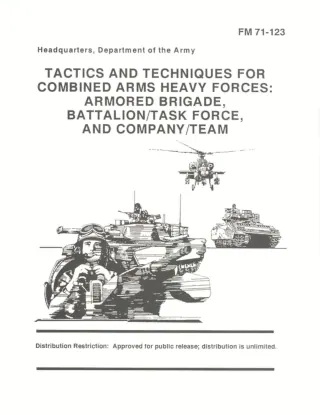 FM 71-123 ·Army ·1992
Tactics, Techniques for Combined Arms Heavy Forces
Users of this field manual must first read and understand the doctrinal field manuals: FM 71-3 (brigade), FM 71-2 (battalion), and FM 71-1 (company). This manual DOES NOT replace the doctrinal manuals; rather, it supplements them with… FM 71-2 ·Army ·1988
The Tank and Mechanized Infantry Battalion Task Force
Tank and mechanized infantry battalion task forces are organized to fight and win engagements on any part of the battlefield in conventional, nuclear, or chemical environments. They combine the efforts of their company teams and combat… FM 71-3 ·Army ·1996
The Armored and Mechanized Infantry Brigade
Armored and mechanized brigades are organized to fight successful engagements in conventional and various operations other than war (OOTW) activities. They are subordinate commands of a division and corps and perform major tactical… FM 710-27 ·Army ·1989
Logistics Inventory Management
to Inventory Control. The subject of inventory control is prevalent throughout all aspects of the military logistics system. Attaining the most effective and efficient inventory control is a primary objective in the materiel support… FM 711002 ·Army ·Undated
Fm 711002
The mission of light, air assault, and airborne infantry divisions is to close with and destroy the enemy as well as to control land areas, including population and resources. These divisions make optimum use of offensive, decentralized,… FM 711003 ·Army ·1996
Air Assault Division Operations: Tactics, Techniques, and Procedures
The Evolution of the Air Assault Division Air assault operations arose from the "airborne idea," one of several solutions suggested to break the brutal trench deadlock of World War I's (WWI) Western Front. In simplest terms, the airborne… FM 72-20 ·Army ·1944
Jungle Warfare
This manual supersedes FM 31-20, 15 December 1941, including 0 1, 26 May 1942; C 2, 3 August 19D42; and 0 S3,24 Septenmber 1942. Chapter 1 GENERAL Section I. GENERAL 1. General In jungle warfare, the soldier often fights two enemies: man… FM 750-80 ·Army ·1991
Army Wholesale Maintenance Mangement
1—1. Purpose and Scope. The purpose of this manual is to establish wholesale materiel maintenance management doctrine. Logistics doc- trine is a collection of the best thinking the Army has to offer on how to perform a particular combat… FM 770-78 ·Army ·1979
System Engineering
« u * r i. A - 1-1. Purpose and Scope a. This manual describes a system engineering process and presents guidelines for system engineer- ing management which will satisfy those regulations, directives, and standards which contain policy… FM 8-10 ·Army ·2000
~1
Modernization of Army forces and combat doctrine requires that HSS doctrine evolve to meet changing needs. Medical Force 2000 (MF2K) is the Army Medical Department's (AMEDD) initiative to provide effective HSS to the Army of the… FM 8-10-1 ·Army ·1994
The Medical Company Tactics, Techniques, and Procedures
When amendment, revision, or cancellation of this publication is proposed which will affect or violate the international agreements concerned, the preparing agency will take appropriate reconciliatory action through international… FM 8-10-18 ·Army ·1997
Veterinary Service-Tactics, Techniques, and Procedures
This publication outlines the functions and operations of each veterinarian element within an area of operations (AO). It provides tactics, techniques, and procedures for veterinary support. The information provided in this publication… FM 8-10-19 ·Army ·2000
Dental Service Support in a Theater of Operations
Modernization of Army forces and combat doctrine requires that HSS doctrine evolve to meet changing needs. Medical Force 2000 (MF2K) is the Army Medical Department's (AMEDD) initiative to provide effective HSS to the Army of the… FM 8-10-24 ·Army ·1993
1993 : Area Support Medical Battalion Tactics, Techniques, and Procedures
 FM 8-10-3 ·Army ·1996
Division Medical Operations Center Tactics, Techniques and Procedures
Page 1 of 1 PREFACE This publication provides information on the structure and operation of the division medical operations center (DMOC), division support command (DISCOM). It is directed toward the chic E anti staff members of the DMOC… FM 8-10-4 ·Army ·1990
Medical Platoon Leaders' Handbook Tactics, Techniques, and Procedures
FM 8-10-4 CHAPTER 1 COMBAT ORGANIZATION Section I. THE DIVISION 1-1. Background The division is the largest Army fixed organization that trains and fights as a tactical team. It is organized with varying numbers and types of combat, combat… FM 8-10-5 ·Army ·1991
Brigade and Division Surgeons' Handbook Tactics, Techniques, and Procedures
This manual provides information pertaining to the command and staff responsibilities of the brigade and division surgeons assigned to armored, airborne, air assault, infantry, and light infantry divisions that are organized under the… FM 8-10-6 ·Army ·2000
Medical Evacuation in a Theater of Operations
This field manual (FM) provides the philosophy of and doctrine for medical evacuation in a theater of operations (TO). Tactics, techniques, and procedures for accomplishing the medical evacuation of sick, injured, or wounded soldiers are… FM 8-10-7 ·Army ·1993
Health Service Support in a Nuclear, Biological, and Chemical Environment
FM 8-10-7 CHAPTER 1 MEDICAL THREAT AND NUCLEAR, BIOLOGICAL, AND CHEMICAL WARFARE 1-1. General a. Since World War II, the Soviet Union has represented the principal threat to the national security interests of the US. During this period,… FM 8-10-8 ·Army ·1989
Medical Intelligence in a Theater of Operations
of certain diseases such as African Swine Fever into Europe from Africa or the Iberian Peninsula could devastate the swine industry in Northern Europe. Some countries have very strict regulations and quarantine procedures concerning… FM 8-15 ·Army ·1961
Medical Service in Divisions, Separate Brigades and the Armored Cavaltry Regiment
Section I. GENERAL 1-1. Purpose and Scope (2) STANAG 2128, Medical and Dental a. This manual is a guide for commanders, Supply Procedures. staffs, subordinate leaders, and troops of the (3) STANAG 2075 (SOLOG 74) (SEAArmy Medical Service… FM 8-283 ·Army ·2000
Treatment of Nuclear Warfare Casualties and Minor Radiation Injuries
This publication serves as a guide and a reference for trained members of the Armed Forces Medical Services and other medically qualified personnel on the recognition and treatment of nuclear warfare casualties and low-level radiation… FM 8-284 ·Army ·2000
Treatment of Biological Warfare Agent Casualties
vii FM 8-284/NAVMED P-5042/AFMAN (I) 44-156/MCRP 4-11.1C (BW) agent casualties. Information contained in this publication may also be relevant for the diagnosis and treatment of patients with naturally acquired diseases or illnesses due to… FM 8-285 ·Army ·1995
Treatment of Chemical Agent Casualties and Conventional Military Chemical Injuries
This manual serves as a guide and a reference for trained members of the Armed Forces Medical Services and other medically qualified personnel on the recognition and treatment of chemical agent casualties and conventional military chemical… FM 8-295 ·Army ·1986
Treatment of Chemical Agent Casualties and Conventional Military Chemical Injuries
This manual serves as a guide and a reference for trained members of the Armed Forces Medical Services and other medically qualified personnel on the recognition and treatment of chemical agent casualties and conventional military chemical… FM 8-34 ·Army ·1983
Food Sanitation for the Supervisor
Diseases and the Military Entire armies have been defeated by such disease outbreaks as dysentery, typhoid, yellow fever, plague, and malaria. Mishandling of food and food-related waste has been responsible for some of the diseases.… FM 8-35 ·Army ·1966
Transportation of the Sick and Wounded
4. Handling the Patient some situations, manual transportation is necessary to save a life. Careful and correct handling of the patient is of primary importance in the evacuation and a. Some of the carries discussed in this… FM 8-36 ·Army ·1973