

 Gas warfare. Part III, Methods of training in defensive measures ·Army ·1918
Gas Warfare. Part III, Methods of Training in Defensive Measures
 Manual of gas warfare ·Army ·Undated
Manual of Gas Warfare
 Notes on gas as a weapon in modern warfare ·Army ·1917
Notes on Gas as a Weapon in Modern Warfare
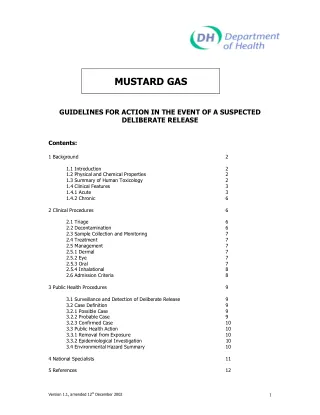 chemical-mustard-gas ·Army ·2002
Mustard Gas: Guidelines for Action in the Event of a Suspected Deliberate Release
1 Background 1.1 Introduction Mustard gas is a vesicant i.e. it is a blister- forming agent and may cause damage to skin, eyes and the respiratory system. Sulphur mustard is the chemical warfare agent that is normally referred to as… em1110-1-3500 chem grouting ·Army ·1995
Chemical Grouting
1-1. Purpose This manual provides information and guidance for the investigation and selection of materials, equipment, and methods to be used in chemical grouting in connection with construction projects. Elements discussed include types… em1110-1-4012 prec floc coag ·Army ·2001
Precipitation/Coagulation/Flocculation
1-1. Background. Chemical precipitation is the most common technique used for treatment of metal-contaminated waters (Patterson and Minear 1975, EPA 625/8-80-003, EPA 600/8-80042c, Peters et al. 1985, Patterson 1988). Chemical… em385-1-80 radiation protection ·Army ·1997
Radiation Protection Manual
U.S. Army Corps of Engineers radiation protection manual (EM 385-1-80): dose limits and ALARA, working with radiation, and radio-frequency safety (1997). JP 3-11 ·Joint ·2018
Operations in CBRN Environments
This publication provides doctrine for planning, conducting, and assessing military operations in chemical, biological, radiological, and nuclear environments. JP 3-41 ·Joint ·2016
CBRN Response
1. Scope This publication provides joint doctrine for military domestic or international response to minimize the effects of a chemical, biological, radiological, or nuclear incident. 2. Purpose This publication has been prepared under the… JP 3-72 ·Joint ·2019
Joint Nuclear Operations
1. Scope This publication provides fundamental principles and guidance to plan, execute, and assess nuclear operations, 2. Purpose This publication has been prepared under the direction of the Chairman of the Joint Chiefs of Staff (CICS).… MCRP 10-10E ·Marine Corps ·2013
Chemical, Bacteriological, Radiological, Nuclear Reconnaissance and Surveillance - MCRP 10-10E.7
This publication has been prepared under our direction for use by our respective commands and other commands as appropriate. MCRP 10-10E.1 ·Marine Corps ·2010
Multi-Service Tactics, Techniques, and Procedures for Chemical, Biological,..
This publication has been prepared under our direction for use by our respective commands and oth er commands as appropriate. LESLIE C. SMITH MCRP 10-10E.10 ·Marine Corps ·2021
Multi-Service Tactics, Techniques, and Procedures for Domestic Chemical,..
ATP 3-11.42/MCRP 10-10E.10/NTTP 3-11.38 provides doctrinal guidance for executing domestic CBRN response operations under the auspices of DSCA and describes Department of Defense (DOD) roles and responsibilities in conducting domestic CBRN… MCRP 10-10E.6 ·Marine Corps ·2008
Multiservice Tactics, Techniques, and Procedures for Chemical,biological,..
The purpose of this publication is to provide commanders, staffs, key agencies, and military members with a key reference for planning and conducting CBRN CM. It provides the tools for CBRN responders to effectively manage the consequences… MCRP 10-10E.7 ·Marine Corps ·2013
Multiservice Tactics, Techniques, and Procedures for Nuclear Biological And..
This publication has been prepared under our direction for use by our respective commands and other commands as appropriate. MCRP 3-37.1A ·Marine Corps ·2004
Nuclear, Biological, and Chemical Vulnerability Assessment
This publication has been prepared under our direction for use by our respective commands and other commands as appropriate. MCRP 3-37.1B ·Marine Corps ·2005
Potential Military Chemical Biological Agents and Compounds
This publication has been prepared under our direction for use by our respective commands and other commands as appropriate. MCRP 3-37.1C ·Marine Corps ·2004
Multiservice Tactics, Techniques, and Procedures for Biological Surveillance
1. Scope This multiservice operations publication provides tactics, techniques, and procedures (TTP) for planning and conducting biological-surveillance operations to monitor, detect, sample, identify, report, and evacuate samples of… MCRP 3-37.2C ·Marine Corps ·2001
Nuclear, Biological, and Chemical Aspects of Concequence Management
This publication has been prepared under our direction for use by our respective commands and other commands as appropriate.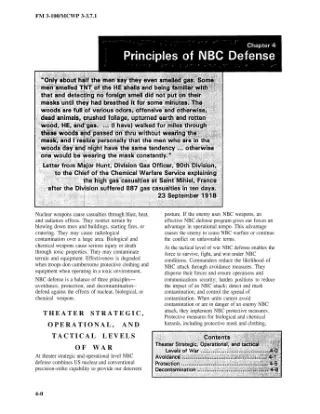 MCWP 3-3.7.1 ·Marine Corps ·Undated
Principles of NBC Defence // FM 3-100/MCWP 3-3.7.1, Chapter 4
FM 3-100/MCWP 3-3.7.1 normally degrade force effectiveness and erode combat power. To restore combat power commanders decontaminate as early as possible. Immediate decon supports individual survival. Operational decon allows temporary… MCWP 3-37 ·Marine Corps ·1998
MAGTF, Nuclear, Chemical, Biological Defense Operations
Marine Corps Warfighting Publication (MCWP) 3-37, MAGTF Nuclear, Biological, and Chemical Defense Operations, addresses the planning and execution of NBC defense operations within the Marine air-ground task force (MAGTF). It sets forth the… MCWP 3-37.2 ·Marine Corps ·2003
Nuclear, Biological, and Chemical (NBC) Protection
This publication has been prepared under our direction for use by our respective commands and other commands as appropriate. MCWP 3-37.3wch1 ·Marine Corps ·2002
NBC Decontamination
FM 3-5 integrates the nuclear, biological, and chemical (NBC) fundamentals published in FM 3-100 and implements Standardized North Atlantic Treaty Organization Agreement (STANAG) 2426. The extent and timing of decon depends on the tactical… MCWP 3-37.4 ·Marine Corps ·2004