

 MM2598 ·Army ·Undated
Identifying Ammunition
In the preceding subcourse (MM2597), you learned how to interpret ammunition markings and color codes. Now suppose, for example, a using unit turns in ammunition that has been removed from its original containers and there are no markings… NAVEDTRA 14234 ·Army ·1993
Seabee Combat Handbook, Volume 1
By enrolling in this self-study course, you have demonstrated a desire to improve yourself and the Navy. Remember, however, this self-study course is only one part of the total Navy training program. Practical experience, schools, selected… NAVEDTRA 14235 ·Army ·1996
Seabee Combat Handbook, Volume 2
By enrolling in this self-study course, you have demonstrated a desire to improve yourself and the Navy. Remember, however, this self-study course is only one part of the total Navy training program. Practical experience, schools, selected… OD1615 ·Army ·Undated
Introduction to the High Mobility Multipurpose Wheeled Vehicle (HMMWV)
TO THE HIGH MOBILITY MULTI-PURPOSE WHEELED VEHICLE (HMMWV) SUBCOURSE NO. OD1615 US Army Correspondence Course Program 6 Credit Hours GENERAL The purpose of this subcourse is to introduce the high mobility multipurpose wheeled vehicle… Report R-1896 ·Army ·1968
Silencers: Principles and Evaluations
Throughout the history of firearms, gun noise has been of considerable concern to the military. Prior to firing, anticipation of the ear shattering effects tends to make the gunner flinch, resulting in a consequent deterioration of his… SH 21-76 ·Army ·2011
Ranger Handbook
The MCOE SH 21-76 (Ranger Handbook) is mainly written for U.S. Army Rangers and other light Infantry units, however it should also serve as a handy reference for other U.S. military units. It covers how Infantry squad- and platoon-sized… SS0029 ·Army ·1994
Plan Tactical Telephone Systems
Today, the Army uses many different types of telephones and switchboards. The mission involved and units employed will determine the equipment requirements and their reconfigurations. 1. Types of telephones. We can divide the tactical… ST 17-33 ·Army ·1949
Tank Battalion
Special text on the tank battalion: organization and tactical employment in the early postwar Army (1949). ST 2-22.7 ·Army ·2002
Tactical Human Intelligence and Counterintelligence Operations
ST 2-22.7 (FM 34-7-1) APRIL 2002 Chapter 1 Tactical Human Intelligence Collection Assets Timely and accurate intelligence derived from human intelligence (HUMINT) and counterintelligence (CI) assets is critical to the military… ST 2-50.4 ·Army ·2001
Combat Commanders Handbook on Intelligence
Combat commanders need timely and accurate intelligence. In order to drive intelligence as a part of the intelligence operating system, commanders must understand what intelligence can do, how to focus it on specific requirements, and how… ST 30-5-1 ·Army ·1955
Combat Intelligence
This text is published for the use and guidance of ail concerned with combat intelligence at division. 2. SCOPE a. For these echelons this text describes the organization which produces in telligence, the production of intelligence from…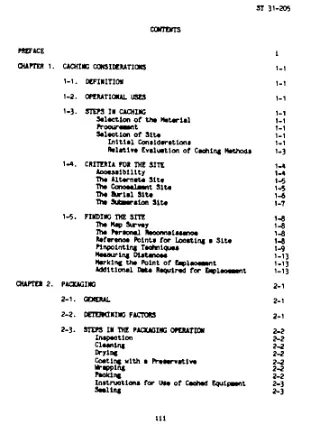 ST 31-205 ·Army ·Undated
Special Forces Caching Techniques
CHAPTER 1 CACHING CONSIDERATIONS Jet. DEFINITION Caching is the process of hiding equipment or materials in a secure storage place with the view to future recovery for operational use. 1-2. OPERATIONAL USES Caches have utility in a variety… ST 31-91B ·Army ·1982
U.S. Army Special Forces Medical Handbook
Tnis book is designed to serve as a ready reference and review for Special Forces medics. it covers diseases and medical problems that SF medics may encounter in various areas of the world. It does not, however, take the place or eliminate… STP 21-1-SMCT ·Army ·2003
Skill Level 1
vii SPECIAL NOTES CONCERNING THE AUGUST 2003 SMCT 5" X 7" Format. Beginning with the August 2003 revisions, both the STP 21-1-SMCT and STP 21-24-SMCT are printed in 5"x7" format, following the very favorable acceptance of previous skill… STP 21-24-SMCT ·Army ·2003
Skill Level 2, 3, 4
vii reproducible forms. Where online access is not available, the soldier's unit must obtain hard copies of these forms SPECIAL NOTE FROM THE STAFF CONCERNING THE REVISED SMCT Experienced trainers will notice that, in addition to numerous… STP 7-11B1-SM-TG ·Army ·2004
Soldier's Manual and Trainer's Guide, MOS 11B, Infantry, Skill Level 1
This publication is for Skill Level 1 soldiers holding the military occupational specialty 11B. It contains standardized training objectives, in the form of task summaries, to train on critical tasks that support unit missions during… STP 7-11B24-SM-TG ·Army ·2004
Soldier's Manual and Trainer's Guide, MOS 11B, Infantry, Skill Levels 2, 3 and 4
This publication is for Skill Levels 2 through 4 soldiers holding the military occupational specialty 11B. It contains standardized training objectives in the form of task summaries, to train critical tasks that support unit missions…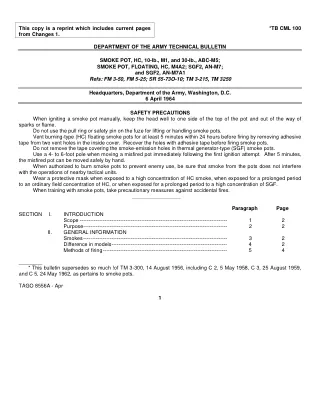 TB CML 100 ·Army ·1964
Smoke Pot, HC, 10-lb., M1, and 30-lb., ABC-M5; Smoke Pot, Floating, HC, M4A2; SGF2, AN-M7; and SGF2, AN-M7A1
smoke pots lies in the ratio of total bulk of the smoke pot to bulk of smoke-producing agent. Floating smoke pots are not completely filled with agent; voids in the container permit the pots to float in water. b. For ease of presentation,… TC 1-19.10 ·Army ·2024
Army Ceremonial Music Performance
TC 1-19.10, Army Ceremonial Music Performance, is the primary ceremonial music training publication of Army Bands. TC 1-19.10 defines, updates, adds, or changes movements unique to marching bands, such as marching style, the performance of… TC 1-19.30 ·Army ·2025
Percussion Techniques
TC 1-19.30 is a reference guide for MOS percussionists (MOS 42R, with the ASI of 9M) and auxiliary percussionists (MOS 42R, with the ASI of 9H, 9K, 9N, 9T, 9U, 9V, and 9X). This revision of TC 1-19.30 reorganizes the content for better… TC 1-19.50 ·Army ·2023
The Army Drum Major
TC 1-19.50 is designed to be a practical guide for Army Musicians who have little, to no, drum major experience. It provides those Soldiers with materials to help them develop the fundamental skills required to succeed as a drum major in a… TC 1-19.51 ·Army ·2022
The Army Ceremonial Conductor
TC 1-19.51 is designed to be a practical guide for Army Musicians who have little, to no, conducting experience. It provides those Soldiers with materials to help them develop the fundamental skills required to succeed as a conductor in a… TC 1-19.52 ·Army ·2021
Army Bands Leader Development
TC 1-19.52, Army Bands Leader Development, is the primary leadership training publication of the Army Bands program. It replaces TC 12-44, Army Band Section Leader Handbook. TC 1-19.52 makes numerous changes from TC 12-44. The most… TC 2-19.01 ·Army ·2021
Military Intelligence (MI) Company and Platoon Reference Guide
09 March 2021 TC 2-19.01 1-1 Chapter 1 Intelligence and Operations Throughout modern history, intelligence has been and remains an inherent part of military operations. From national and Department of Defense (DOD) levels down to the Army… TC 2-91.4 ·Army ·2015
Intelligence Support to Urban Operations
With the continuing growth in the world's urban areas and increasing population concentrations in urban areas, the probability that Army forces will conduct operations in urban environments is ever more likely. As urbanization has changed… TC 21-24 ·Army ·2025
Tower and Aircraft Rappelling
to rappelling is taught on a static tower (see figure 1-1). Using the building block approach to training, Soldiers systematically progress to more demanding platforms including taller static towers and helicopters. The static tower used… TC 21-24 ·Army ·1997
Rappelling
This circular provides basic rappelling techniques to soldiers and leaders for the conduct of rappelling operations. It serves as the primary reference for both resident and nonresident instruction presented to cadets, officer candidates,… TC 21-3 ·Army ·2025
Soldier`s Handbook for Individual Operations and Survival in Cold-Weather Areas
to Cold-Weather Operations DIFFERENT TYPES OF COLD CONDITIONS 1-1. There are different types of cold found throughout the world and each presents its own challenges. For Soldiers to be effective in a cold-weather environment, it is… TC 21-305 C1 ·Army ·1996
Training Program for Wheeled Vehicle Accident Avoidance
More than tanks, aircraft, training, weapons, and war, AMV and POV accidents continue to be the major killer of soldiers. Despite seatbelts, airbags, anti-lock brakes, built-in steel reinforcement and shock absorbing bumpers, and dozens of… TC 21-305-1 ·Army ·1995