

 FM 55-509-1-INTRODUCTION ·Army ·1994
To Marine Elect
Successfully completing everyday activities depends on safe execution. Preparation and conduct during these activities reflects on performance. In no other field is this more significant than in the marine field. Safety is an encompassing… FM 55-65 ·Army ·1995
Strategic Deployment
In response to a military need or crisis, strategic deploy- ment is the strategic relocation and concentration of forces and their support base (manpower and logistics). Strate- gic deployment consists of the movement from CONUS into a… FM 55-80 ·Army ·1997
Army Container Operations
TO INTERMODALISM 1-1. BACKGROUND. The DOD relies on commercial sealift to move 85 percent of cargo during contingency operations. The US and world merchant fleets are dominated by large, fast containerships with supporting corporate… FM 55-9 ·Army ·1994
Unit Air Movement Planning
Air movement is initially the primary transportation method used during crisis response. World situations that call for a rapid response by the armed forces use airlift to quickly move to an area of operations. Air movement of units… FM 57-230 ·Army ·1989
Advance Parachuting Technique and Training
Field manual on advanced parachuting techniques and training (1989). FM 57-38 ·Army ·1993
Pathfinder Operations
Army pathfinders primarily provide navigational assistance and advisory services to military aircraft in areas designated by supported unit commanders. Their secondary missions include providing advice and limited assistance to units… FM 571100 ·Army ·Undated
Division Engineer Combat Operations
FM 5-71-100 CHAPTER 1 Engineer Operations and the Division Battlefield The division is the US Army's largest, fixed organization that trains and fights as a tactical team. It is organized with various combat, combat support (CS), and… FM 6 ·Army ·2003
Mission Command Comand and Control of Army Forces
[email protected]. Follow the DA Form 2028 format or submit an electronic DA Form 2028. The glossary contains referents of acronyms and definitions of terms not defined in JP 1-02 and FM 101-5-1 (1-02). It does not list… FM 6-01-1 ·Army ·2008
Knowledge Management Section
This manual provides doctrine for the organization and operations of the knowledge management (KM) section. It establishes the doctrinal principles, tactics, techniques, and procedures necessary to effectively integrate KM into the… FM 6-02-40 ·Army ·2009
Visual Information Operations
Unless this publication states otherwise, masculine nouns and pronouns do not refer exclusively to men. FM 6-02-43 ·Army ·2009
Signal Soldier's Guide
The Army has decentralized most of its signal capabilities. Corps, divisions, brigade combat teams, and support brigades now have signal forces organic to the units who own, operate, train, and maintain their unique signal forces. Corps… FM 6-02-90 ·Army ·2004
MTTP for Ultra High Frequency Tactical Satellite and Demand Assigned Multiple Access Operations
1. Scope The intent of this publication is to assist planners and users at the joint task force, Service component, and other functional components by providing an improved and unified process for planning, managing, and using ultra high… FM 6-02.45 ·Army ·2004
Signal Support to Theater Operations
1-1 Chapter 1 Theater Signal Transformation The Army is transforming in response to changes in the global political, military, and technological environment and in accordance with national level strategic and political decisions on how… FM 6-02.53 ·Army ·2009
Tactical Radio Operations
of the tactical radio deployment throughout the Army to include BCTs and joint operations. THEATER/ARMY 1-6. The theater/Army level is supported by signal companies within BCTs or expeditionary signal battalions (ESBs) depending on their… FM 6-02.70 ·Army ·2010
Army Electromagnetic Spectrum Operations
This manual provides an overview of electromagnetic spectrum operations for the Army at the strategic, operational, and tactical levels. This manual also provides direction, guidance, and techniques necessary to meet the needs of Army…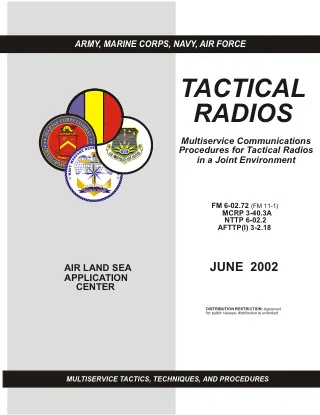 FM 6-02.72 ·Army ·2002
Tactical Radios
1. Scope This publication discusses current voice and data tactical radio systems in common use between the services. It describes recent updates to the Single-Channel Ground and Airborne Radio System (SINCGARS), including the Advanced…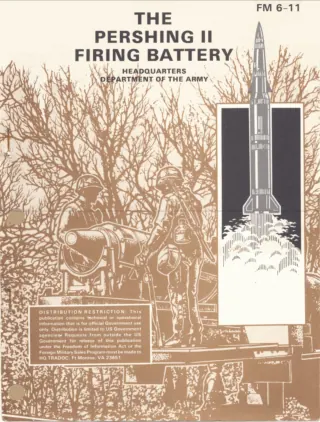 FM 6-11 ·Army ·1985
The Pershing II Firing Battery
CHAPTER 1 SYSTEM DESCRIPTION Pershing I1 (PII) is a ground-mobile, surface-to-surface, nuclear weapon system. It is a solid-propellant missile with ground support equipment (GSE) mounted on wheeled vehicles. The missile may be launched… FM 6-121 ·Army ·1990
Tactics, Techniques, and Procedures for Fire Support for Corps and Division Operations Field Artillery Target Acquisition
This publication describes the doctrine, organization, tactics, techniques, and procedures for the management of field artillery target acquisition (TA) equipment, personnel, and systems. It combines information formerly in FM 6-121, Field…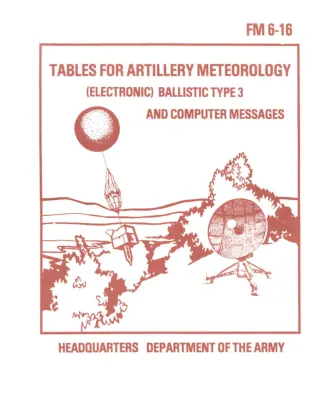 FM 6-16 ·Army ·1982
Tables for Artillery Meteorology-Electronic Ballistic Type 3 and Computer Messages (C1)
FM 6-16 CHAPTER 2 METEOROLOGICAL TABLES AND CHARTS SECTION I. GENERAL TABLES AND CHARTS FOR METEOROLOGICAL MESSAGES 2-1. GENERAL The tables and charts included in this chapter are used for computing general meteorological data for all… FM 6-16-3 ·Army ·1982
Tables for Artillery Meteorology (Electronic and Visual) Type 2 Messages
FM 6-16-3 SECTION I GENERAL TABLES AND CHARTS FOR METEOROLOGICAL MESSAGES 2-1. Description of Tables and Charts The tables and charts in this manual are presented in sections I, II, and III as follows: a. Section I, General Tables and…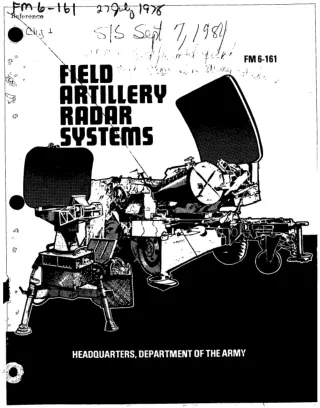 FM 6-161 ·Army ·1981
Field Artillery Radar Systems (C1)
Cl, FM 0-161 CHAPTER 1 THE THREAT Paragraph Purpose and Scope 1-1 Characteristics of Field Artillery Radars 1-2 Operations Security Indicators 1-3 Countermeasures 1-4 1-1. Purpose and Scope The purpose of this chapter is to describe the… FM 6-2 ·Army ·1996
Tactics, Techniques and Procedures for Field Artillery Survey
Tactics, techniques, and procedures for field artillery survey: establishing common survey control for firing units (1996). FM 6-2-45 ·Army ·2004
Signal Support to Theater Operations
1-1 Chapter 1 Theater Signal Transformation The Army is transforming in response to changes in the global political, military, and technological environment and in accordance with national level strategic and political decisions on how… FM 6-2-74 ·Army ·2003
Hf-Ale
1. Purpose This consolidated reference will assist joint forces in utilizing high frequency radios as a supplement/alternative to overburdened satellite communications systems for overthe-horizon communications. 2. Scope This publication… FM 6-2-90 ·Army ·2004
Multi-Service Tactics, Techniques, and Procedures for Ultra High Frequency Tactical Satellite and Demand Assigned Multiple Access Operations
1. Scope The intent of this publication is to assist planners and users at the joint task force, Service component, and other functional components by providing an improved and unified process for planning, managing, and using ultra high… FM 6-2.72 ·Army ·2002
Tactical Radios
1. Scope This publication discusses current voice and data tactical radio systems in common use between the services. It describes recent updates to the Single-Channel Ground and Airborne Radio System (SINCGARS), including the Advanced… FM 6-20 ·Army ·1987
Fire Support in the Air-Land-Battle
This publication is the Army's capstone manual for fire support. It embodies the doctrinal tenets for the employment of fire support in the AirLand Battle. It establishes a basis for understanding fire support as an essential element of… FM 6-20-10 ·Army ·1996
Tactics, Technicques and Procedures for the Targeting Process
Targeting is part of the tactical decision-making process used to focus the battlefield operating systems (BOSs) to achieve the commander's intent. The methodology used to translate the commander's intent into a plan is decide, detect,… FM 6-20-20 ·Army ·1991
Fire Support at Battalion Task Force and below
TO FIRE SUPPORT SECTION FIELD ARTILLERY MISSIONS 4-1. ROLES OF FIELD ARTILLERY a. Close Support. Close support fires are fires used to engage enemy troops, weapons, or positions that are threatening the supported force. Close support…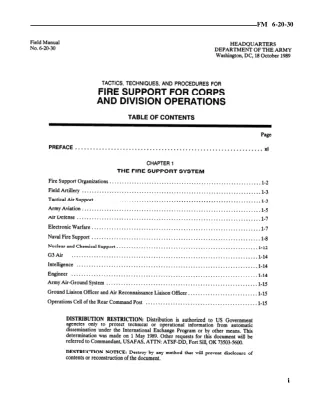 FM 6-20-30 ·Army ·Undated