

 FM 3-22.9C1 ·Army ·2011
Rifle Marksmanship: M16-/M4-Series Weapons
(page F-1). Also, a portion of the appendix has been added to address marking 25-meter zero offsets for 200 meters (beginning with paragraph F-3 on page F-9). In Table F-1 (page F-7), the zero offset for the M16A4 MWS with the M68…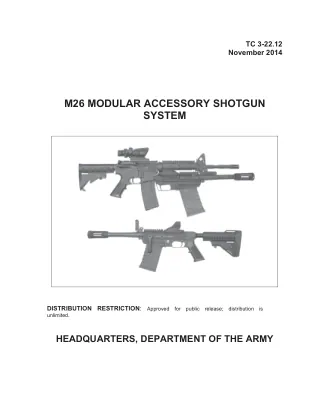 TC 3-22.12 ·Army ·2014
M26 Modular Accessory Shotgun System
Training Circular (TC) 3-22.12 provides technical information, training strategy, and employment techniques for the M26 Modular Accessory Shotgun System (MASS). It details training requirements and considerations for lethal and nonlethal… TC 7-21.10 ·Army ·2009
Infantry and Weapons Company Guide to Training Aids, Devices, Simulators, and Simulations
Today's broad range of missions and the unpredictable nature of the contemporary operational environment (COE) cause personnel turbulence, high operating tempo (OPTEMPO), and new equipment and systems. Time is an inflexible resource—there… TC 3-20.40 C1 ·Army ·2019
Training and Qualification - Individual Weapons
Training and qualification standards for individual weapons: progressive marksmanship tables from preliminary instruction through qualification (2019, change 1). TC 3-21.75 ·Army ·2013
The Warrior Ethos and Soldier Combat Skills
Duty, honor, country: Those three hallowed words reverently dictate what you ought to be, what you can be, and what you will be. They are your rallying point to build courage when courage seems to fail, to regain faith when there seems to… TC 7-9 C1 ·Army ·1993
Infantry Live-Fire Training
This publication bridges the gap between individual and collective marksmanship training. It addresses both fire and maneuver with emphasis on LFXs for dismounted infantry. This publication is for use by all leaders of infantry units and… TC 3-20.0 ·Army ·2019
Integrated Weapons Training Strategy (Iwts)
The principal audience for TC 3-20.0 is commanders, planners, trainers, and master gunners of maneuver units. It provides the details of the Integrated Weapons Training Strategy, known as IWTS, and structure for the maneuver brigade combat… ATP 3-37.15 C1 ·Army ·2020
Foreign Security Force Threats
A foreign security force threat is the potential for violence posed by foreign security forces (FSFs) working with, or granted access to, U.S. Service members, civilians, or contractors. Previously referred to as green-on-blue attacks,… TC 90-1 ·Army ·2008
Training for Urban Operations
Fort Benning, GA 31905-5593 Uniforms shown in this manual were drawn without camouflage for clarity of the illustration. Unless this publication states otherwise, masculine nouns and pronouns may refer to either men or women. TC 3-09.8 C1 ·Army ·2020
Fire Support and Field Artillery Certification and Qualification
This Training Circular (TC) provides the standards for implementing a Field Artillery (FA) Certification and Qualification Program which incorporates all components of the FA System within each FA formation at Battalion (BN) and below to… TC 3-22.9 C3 ·Army ·2016
Rifle and Carbine
Rifle and carbine employment for the M4- and M16-series weapons: function, ballistics, employment, and marksmanship. Supersedes FM 3-22.9 (2016, change 3). ATP 6-02.40 C1 ·Army ·2019
Techniques for Visual Information Operations
ATP 6-02.40 28 April 2021 Acknowledgements Assorted photos from https://www.dvidshub.net/ are courtesy of the United States Defense Visual Information Distribution Service. Assorted photos from https://catalog.archives.gov/ are courtesy of… ATP 4-32.3 C1 ·Army ·2017
Explosive Ordnance Disposal (EOD) Company, Platoon, and Team Operations
ATP 4-32.3 discusses and articulates the roles of the company, platoon, and team operations. ATP 4-32.3 addresses the adapted changes to the organizational structure from the approved EOD force design update. ATP 4-32.3 expands on company,… TC 3-20.11 ·Army ·2021
Training to Proficiency Maneuver Company and Troop
The principal audience for TC 3-20.11 is commanders, planners, trainers, and master gunners of maneuver units. TC 3-20.11 provides the details of the integrated weapons training strategy (known as IWTS) structure specifically designed for… ATP 3-24.2 ·Army ·2025
Techniques in Counterinsurgency
Counterinsurgency (COIN) is a complex subset of warfare that encompasses all military, paramilitary, political, economic, psychological, and civic actions taken by a government to defeat an insurgency at the company, battalion, and brigade… ATP 3-07.10 ·Army ·2023
Multi-Service Tactics, Techniques, and Procedures for Advising Foreign Security Forces (Mcrp 3-03D.1, Nttp 3-07.5, Afttp 3-2.76)
15 JUN 2023 ATP 3-07.10/MCRP 3-03D.1/NTTP 3-07.5/AFTTP 3-2.76 i PREFACE 1. Purpose This multi-Service tactics, techniques, and procedures (MTTP) publication assists in advising foreign security forces (FSF). It serves as a reference to… FM 3-50 ·Army ·2014
Army Personnel Recovery
This publication is organized into six chapters: Chapter 1 describes personnel recovery. It defines Army personnel recovery and discusses the foundations of personnel recovery. It explains Army personnel recovery components and concludes… FM 7-0 ·Army ·2021
Training
Training, expands on the fundamental concepts of the Army's training doctrine introduced in ADP 7-0. This publication applies to all Army leaders and the three components of the Total Army: the Regular Army, the Army National Guard, and… TC 3-21.76 ·Army ·2025
Ranger Handbook
The Ranger Handbook: condensed leadership, patrolling, battle drills, and fieldcraft reference carried by small-unit leaders. Supersedes the 2017 edition (2025). ATP 3-01.8 ·Army ·2016
Techniques for Combined Arms for Air Defense
ATP 3-01.8, focuses on how a combined arms force protects themselves from an adversary's air attack. Aerial threats include Unmanned Aircraft Systems (UAS); fixed- and rotary-wing aircraft; rockets, artillery, and mortars (RAM); ballistic… ATP 3-24.3 ·Army ·2015
Cultural and Situational Understanding
Understanding culture is essential in conducting irregular warfare. Irregular warfare requires a deliberate application of an understanding of culture due to the need to understand a populated operational environment, what specifically is… TC 4-15.51 ·Army ·2018
Marine Crewman'S Handbook
Marine crewman's handbook for Army watercraft: seamanship, deck operations, and crew duties (2018). ATP 3-07.5 ·Army ·2012
Stability Techniques
31 August 2012 ATP 3-07.5 (INCL C1) 1-1 Chapter 1 Stability Framework This chapter examines the various contexts in which Army units conduct stability efforts. It first discusses stabilization. This discussion covers the range of military… AR 350-1 ·Army ·2025
Army Training and Leader Development
Section I Overview 1–1. Purpose This regulation prescribes policies, procedures, and responsibilities for developing, managing, and conducting Army training and leader development. 1–2. References, forms, and explanation of abbreviations… FM 12-75E ·Army ·Undated
Personnel Actions Specialist
SLi The Enlisted Personnel Management System (EPMS) The Enlisted Personnel Management System (EPMS) is a combination of policies related to training, evaluation, classification, and promotion. EPMS has been developed to help every soldier… ATP 6-22.5 ·Army ·2016
A Leader's Guide to Soldier Health and Fitness
Current combat operations and a U.S. Army transformation resulted in an institutional shift in how leaders view, approach, and manage the effects of Soldier health, readiness, and resilience. Commanders are responsible to establish and… TC 7-100.2 ·Army ·2011
Opposing Force Tactics
This training circular (TC), as part of the TC 7-100 series, describes an opposing force (OPFOR) that exists for the purpose of training U.S. forces for potential combat operations. This OPFOR reflects a composite of the characteristics of… TC 3-04.93 C1 ·Army ·2018
Aeromedical Training for Flight Personnel
In order to keep pace with the current operating environment, the development of more sophisticated aircraft, and improvements in weapons systems, Army crewmembers must be capable of operating these systems for extended periods of time, in… ATP 4-25.12 C2 ·Army ·2014
Unit Field Sanitation Teams
30 April 2014 ATP 4-25.12 (INCL C2) 1-1 Chapter 1 Unit Field Sanitation Teams HISTORY 1-1. Historically, in every conflict up through World War II, in which the United States was involved, approximately 20 percent of hospital admissions… FM 3-61 C1 ·Army ·2022