

 ADP 1 ·Army ·2019
The Army
ADP 1 and ADP 3-0, Operations, are the two Army capstone doctrinal manuals that serve as the foundation of our professional body of knowledge. It explains our Army's historical significance in the formation and preservation of our Nation… ADP 1-01 ·Army ·2019
Doctrine Primer
Doctrine is dynamic and changing. It is based on lessons learned in current operations and training, from adaptive enemies, and after changes in force structure, technology, and social values. This publication provides the basic… ADP 3-0 ·Army ·2025
Operations
ADP 3-0 describes how the Army, in multidomain operations, contributes to the joint operational concept of unified action to synchronize, coordinate, and integrate military activities designed to overcome the challenges posed by peer… ADP 3-05 C1 ·Army ·2019
Army Special Operations
ADP 3-05 provides the strategic context for employment of Army special operations forces and defines special operations. It describes the role of Army special operations formations. A role is the broad and enduring purpose for which the… ADP 3-07 ·Army ·2019
Stability
Throughout U.S. history, the U.S. Army has learned that military force alone cannot secure sustainable peace. U.S. forces can only achieve sustainable peace through a comprehensive approach in which military objectives nest in a larger… ADP 3-13 ·Army ·2023
Information
Information is central to everything we do—it is the basis of intelligence, a fundamental element of command and control, and the foundation for communicating thoughts, opinions, and ideas. As a dynamic of combat power, Army forces fight… ADP 3-19 ·Army ·2019
Fires
Success in large-scale combat operations is dependent on the Army's ability to employ fires. Fires enable maneuver. Over the past two decades, potential peer threats have invested heavily in long-range fires and integrated air defense… ADP 3-28 ·Army ·2019
Defense Support of Civil Authorities
ADP 3-28 clarifies similarities and differences between defense support of civil authorities (DSCA) and other elements of decisive action. DSCA and stability operations are similar in many ways. Both revolve around helping partners on the… ADP 3-37 ·Army ·2026
Protection
Protection is the preservation of the effectiveness and survivability of mission-related military and nonmilitary personnel, equipment, facilities, information, and infrastructure deployed or located within or outside the boundaries of a… ADP 3-90 ·Army ·2019
Offense and Defense
ADP 3-90, Offense and Defense, articulates how Army forces conduct the offense and defense. It contains the fundamental tactics related to the execution of these elements of decisive action. Tactics employs, orders arrangement of, and… ADP 4-0 ·Army ·2026
Sustainment
In just a few years, the number of conflicts globally has increased in number and intensity. Insights gained from observing these conflicts will shape how the joint force utilizes advancements in military technology to sustain and conduct… ADP 5-0 ·Army ·2019
The Operations Process
Military operations are human endeavors conducted in dynamic and uncertain operational environments to achieve a political purpose. Army forces, as part of a joint team, conduct unified land operations to shape operational environments,… ADP 6-0 ·Army ·2019
Mission Command: Command and Control of Army Forces
Acknowledgements vi ADP 6-0 31 July 2019 Quote reprinted courtesy Erin Johnson, "Schwarzkopf Speaks of Leadership at Symposium," The Daily Universe, 21 October 2001. Online… ADP 6-22 C2 ·Army ·2019
Army Leadership and the Profession
31 July 2019 ADP 6-22 (INCL C2) ix ADP 6-22 establishes and describes the Army profession and the associated ethic that serve as the basis for a shared professional identity. It establishes and describes what leaders should be and do.… ADP 7-0 ·Army ·2024
Training
ADP 7-0, Training, provides Army leaders with a common, practical framework to effectively train Soldiers and units to conduct multidomain operations. ADP 7-0 establishes the principles and concepts of training. It introduces the Army's… ADRP 1-03 ·Army ·2009
The Army Universal Task List
The Army Universal Task List (AUTL) describes what well-trained, well-led, and well-equipped Soldiers do for the Nation. While focused on the land dimension, abilities of Army forces complement abilities of other Services. The ability of…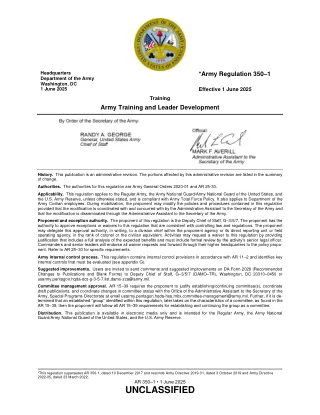 AR 350-1 ·Army ·2025
Army Training and Leader Development
Section I Overview 1–1. Purpose This regulation prescribes policies, procedures, and responsibilities for developing, managing, and conducting Army training and leader development. 1–2. References, forms, and explanation of abbreviations… AR 380-5 ·Army ·2022
Army Information Security Program
Provide program management through issuance of policy and operating guidance. c. Ensure DA commands adequately resource the program and meet established policies and procedures. d. Ensure all DA commands integrate security education,… AR 385-10 ·Army ·2023
The Army Safety and Occupational Health Program
a. The ASOHP consists of 14 functional areas structured for mishap prevention in Army operations. It provides for public safety incidental to Army operations and activities. The ASOHP functional areas are necessary for sustaining…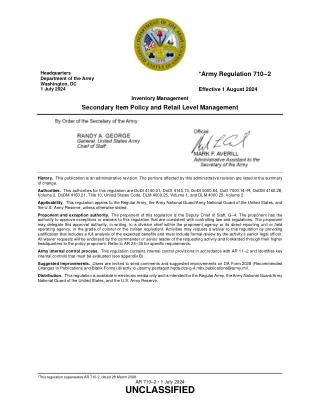 AR 710-2 ·Army ·2024
Secondary Item Policy and Retail Level Management
Section I General 1–1. Purpose This regulation prescribes Army policy for supply operations below the national level. This regulation also prescribes policy for the accountability and management of retail stocks that are received, stored,…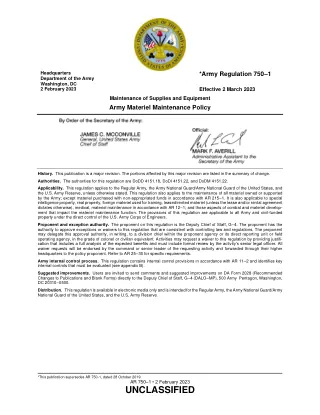 AR 750-1 ·Army ·2023
Army Materiel Maintenance Policy
1–1. Purpose This regulation establishes policies and assigns responsibilities for the maintenance of Army materiel. It provides and defines requirements for performance and management of the materiel maintenance function. It relates to… ATP 1-0.1 ·Army ·2023
Techniques for Human Resources Support to Operations
ATP 1-0.1 merges ATP 1-0.1 and ATP 1-0.2 into one new publication. ATP 1-0.1 nests with FM 1-0 and expands on techniques used to provide HR support. ATP 1-0.1 provides doctrinal guidance and techniques for conducting continuous… ATP 1-02.1 ·Army ·2025
Multi-Service Tactics, Techniques, and Procedures for Multi-Service Brevity Codes {mcrp 3-30B.1 | Nttp 6-02.1 | Afttp 3-2.5 | Sttp 3-9002}
1. Purpose This publication will improve coordination and understanding during multi-Service operations. A brevity code is a code that provides no security. Its sole purpose is the shortening of messages rather than the concealment of… ATP 1-05.01 ·Army ·2018
Religious Support and the Operations Process
ATP 1-05.01 describes the planning process for religious support execution, using the operations process (plan, prepare, execute, and assess). Religious support planning must be detailed and integrated in order to support diverse Soldier… ATP 1-05.02 ·Army ·2018
Religious Support to Funerals and Memorial Events
ATP 1-05.02 establishes a common understanding, foundational concepts, and methods for executing religious support during funeral services and memorial events. ATP 1-05.02 provides comprehensive doctrinal guidance on religious support… ATP 1-05.03 ·Army ·2019
Religious Support and External Advisement
ATP 1-05.03 expands upon FM 1-05, Religious Support, in describing external advisement as a required capability of chaplain sections and unit ministry teams. Chaplain sections and unit ministry teams advise commanders at all echelons in… ATP 1-05.04 C1 ·Army ·2017
Religious Support and Internal Advisement
23 March 2017 ATP 1-05.04 (INCL C1) v Introduction + ATP 1-05.04 expands upon FM 1-05, Religious Support, in describing internal advisement as a required capability of unit ministry teams (UMTs) and chaplain sections advising commanders at… ATP 1-05.05 ·Army ·2019
Religious Support and Casualty Care
ATP 1-05.05 expands upon FM 1-05, Religious Support, in describing care to the wounded as a core competency of chaplain sections and unit ministry teams. Chaplain sections and unit ministry teams execute this competency for units and… ATP 1-06.2 ·Army ·2017
Commanders' Emergency Response Program
ATP 1-06.2 provides doctrinal guidance to commanders and financial managers on how to leverage existing programs like the CERP, which has become a critical capability in the commander's toolbox for conducting stability, development, and… ATP 1-06.3 ·Army ·2015