
Own Your Information: Info Prepping for Sustainment and Survival
You've got canned goods by the stack, ammo by the case, and more toilet paper than you can reasonably use in a lifetime. You've gone through half a dozen disaster preparedness sites and checked all the boxes.
Congratulations. Your survival stockpile is complete. But your survival library is not.
Accessing information is simpler now than at any time before in human history. You can watch instructional videos for any topic on any device you have. Ask out loud how to do something, what something costs, or where it is, and your phone tells you the answer almost immediately.
That's an easy thing to get used to, even more so to take for granted. It isn't just Millennials and Gen Z folks who scoff at the need for a paper map or atlas in their car. I'd say most of us, even those who know better, fall victim to the faulty "Why would I need something so archaic" logic.
After all, if you have GPS or a driving/maps/navigation app, you don't need a map!
Well...except when you do.
The phrase ipsa scientia potestas est (knowledge itself is power) may sound trite. That's because it is. And it also happens to be true.
Why Plan for Information Storage?
Knowledge is critical, but information you can't access is worthless. And yet info and know-how are probably the least considered parts of any preparedness plan. We're so used to accessing information that we very rarely actually store it. Why keep more books than the Library of Alexandria on your tablet when you have something better in your pocket?
Because the unfettered knowledge you can access through your phone only works if the battery's charged, the cell towers are close enough, and someone else's servers are still running. That's why. A generator and plenty of fuel are great to have when the grid's down, but what if you can't find the manual when it quits on you?
Beware the "just in time" temptation. Few modern households keep any sort of mechanical or medical references on hand. That's because the internet's a 24/7/365 limitless external hard drive. But if that goes away, you're limited to whatever you know and can remember. For me, that's not a lot, especially when it comes to mechanical things and gadgetry.
Also keep in mind what you're renting vs. what you own. If you don't have the information locally and on hand, you don't own it. You're just borrowing or renting it. A physical book or secured local drive is owned information. Even your e-reader books are more often "leased," so to speak, than owned. The only way I know to make sure nothing with DRM disappears from my storage Kindle is to keep it disconnected from the internet and my Amazon account.
Information Counts as Prep: Building a Survival Library
Information is more than a force multiplier. It's what turns your initial survival into sustainment. It's what makes many of your other preparations work. Information prepping is important. Captured water needs to be purified immediately; stored water should be rotated (and may need purifying eventually). A trauma kit and medicine cache will do you little good if you don't know how to use or take it.
We'll go into greater detail over the course of the series, but that's the long term. The first thing we'll do, as they say, is start at the start.
Where to Begin?
This part is relatively easy. Decide you're going to do it. Determine some basic needs to address. Find the appropriate resources and store them. That might not sound simple, but it really is. Remember, lots of people and organizations have already done most of the heavy lifting for you. The most obvious one is the military.
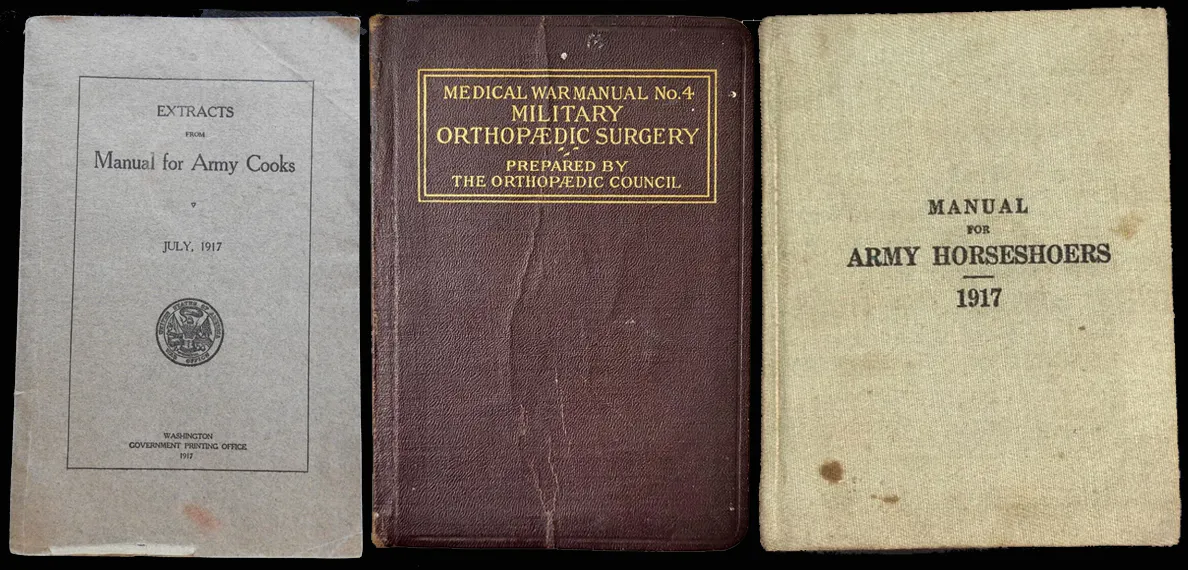
Militaries of the world have been issuing manuals and guides since before the invention of the printing press. 17th-century copper engravings showing how to use a musket or pike won't be much help when things go badly sideways; a WW2 field sanitation or tool maintenance manual for the individual soldier certainly might. Interestingly, while many of the older manuals are now grossly outdated, lots of them aren't. In fact, some of them would be better in a grid-down, WROL, or other emergency situation than the latest ones.
Because, like us, the most recent manuals assume a certain level of access to technology and information.
Military publications like Field Manuals (FMs), Technical Manuals (TMs), and the like offer some distinct advantages that make them relevant to a citizen's use.
- They are written in relatively plain speech (if you don't count the acronyms) with lots of illustrations.
- They were laid out for people who are stressed, exhausted, and potentially (especially the further back you go) less educated.
- They have been tested over time under harsh conditions and consistently revised.
So that is where we'll begin. I break it down into three basic steps:
- Acquisition
- Storage (includes recurring verification and inspection)
- Power and Access
Start Your Digital Prepping
This is also relatively easy. Figure out what you want and decide how to store it securely but accessibly. Bookmarking a link isn't going to work, but downloading or printing a PDF (or both) definitely will. We'll start with the what, then discuss storage.
It's hard to go wrong with a hard copy, but they take up a lot of space and are very susceptible to damage. Thumb drives and external drives are much easier to store, but you need a way to access them (such as a laptop) and, just as importantly, a way to power them. The simplest answer there is to utilize two or more portable solar panels and a handful of power banks you can keep topped off.
Better to have your own solar charger and cables than having to swap cat oil and wet wipes to someone for the juice to keep it running.
- Acquisition. Figure out what you want. This is hands-down the simplest step. Go somewhere like the T.REX Field Manual Vault and begin collecting the ones you want. They're all available for download and accessible to print. Focus on practical skills vs. tactics, at least initially! Field hygiene and land navigation are (hopefully) going to be of more use to you than how to conduct platoon maneuvers and coordinated fires. (Which isn't to say I wouldn't want some of those, especially MOUT, CBRNE, and the like.)
-
Storage.
- Copy. Put them on one or more storage devices, organize them properly, and then secure them. Redundancy is key! At a minimum, I would want one copy on an external drive (if possible), another already loaded to the access device (in my case, an old Kindle), perhaps a collection of specifically chosen screenshots on an older phone, and, in some very specific cases, a hard copy. Remember, a Kindle won't open EPUB files copied over by USB. Use Amazon's Send to Kindle function while you're still online or convert the files first with something like the Calibre app (which is free).
- Organize. Organize it. Make it as intuitive as possible, preferably not just for you. This could be organizing your books and manuals in specific folders by general topics, putting your own notes in there to remind yourself or someone else what is where and why, or even using separate storage modes by topic, e.g., all the medical stuff is in [this labeled drive here]. Spell out the contents of every document in the file name.
- Secure and Inspect. Secure (and inspect) the information. Both digital and print media are susceptible to environmental damage and wear. Fire, water, debris, extreme temperatures, and even old age can interfere with both. Even solid-state drives are vulnerable; they still hold an electric charge. Store all your electronics securely, in a fire safe rated for digital media, a Faraday container, or both. But that's not enough! You should also inspect them annually. Do it on your birthday; it's easy to remember. In fact, that's the day I check and often swap out the batteries on all my optics. And clean my guns!
- Power and Access. We'll go into this further later, but in the simplest terms: Make sure you've got the juice to read whatever electronic device stores your information. If the power's out and you don't have a way to get around it, you might as well not have started your digital prep at all. This is most easily answered with the purchase of a couple of portable solar panels (or more).
Start with the T.REX Field Manual Vault.
That's it in a nutshell.
Some Terms to Know
There are thousands of military manuals, and that's just counting those printed in the U.S. Almost all of them have been updated over the years, and they all use a shared lexicon. You'll want to check the date of each one, particularly in specific areas, like Tactical Combat Casualty Care (TCCC). Some of the changes there are significant (for instance, in the use of tourniquets).
If you're going to use the T.REX Field Manual Vault or other source of DoD/War Department material, it'll be good to understand some of what you see on the cover and inside.
And yes, I recognize the irony in needing a manual or guide to understand manuals and guides.
Basic Glossary of Terms
- Publication Types: There are so many to choose from! FM, TM, TC, ATP, ADP, GTA (graphic training aid, the laminated quick-reference cards), STP, MCRP/MCWP, AFH/AFMAN/AFPAM, NAVEDTRA, JP, and others. I would look more at the individual topic than the nomenclature. "Survival" is much easier to recognize than "ATP 3-50.21." Likewise, "Tactical Combat Casualty Care" or "First Aid" than "TC 4-02.1."
- Supersedes / Superseded: Means the indicated volume has been replaced by a newer edition. In a supersession case, earlier editions are no longer current (or acceptable for official use).
- Change (C1, C2): Indicates an incremental or operational change. An official update has been issued with replacement pages rather than a full new version. TC 4-02.1, the medical manual mentioned above, had [C]hanges made in 2016 and 2018.
- Distribution Statement: This tells you whether it's approved for public release, has ITAR restrictions, contains controlled information, etc. Administrative release markings are "Distribution A" through "Distribution F." Distribution A certifies the document has been approved for public release and unlimited distro. The others indicate more stringent restrictions based on operational sensitivity, critical technical data, export control laws, etc.
- Doctrine 2015: The Army reorganization that renumbered many manuals. For example, FM 21-10 became TC 4-02.3. It's the main reason old and new numbers get confused.
- TM Maintenance Levels: The number at the end of a TM tells you who it's written for. "-10" is the operator manual and "-20" is unit-level maintenance. For civilians, "-10" manuals are usually the useful ones.
- Lessons Learned / CALL: This refers to after-action material from the Center for Army Lessons Learned. There's typically very good information here, and it's usually circulated much faster than traditional manuals.
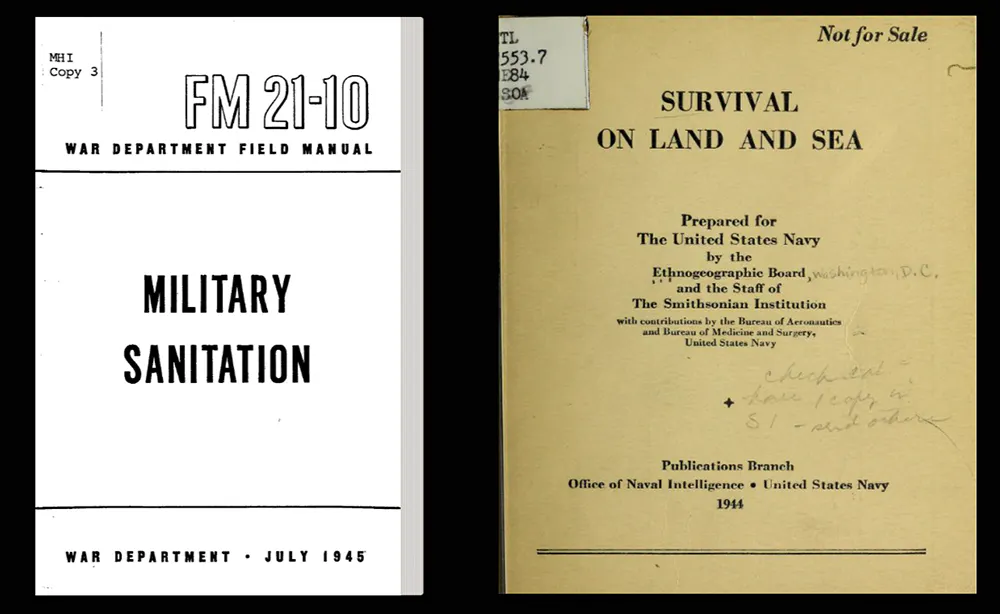
- Multi-Service Publication: One manual issued under several branches' numbers. The old first-aid manual was FM 4-25.11, NTRP 4-02.1, AFMAN 44-163(I), and MCRP 3-02G all at the same time. This explains a lot of the confusion over numbers (bringing me back around to search by topic if you can).
- Retired Publication Types: ADRP, ATTP, and FMI. (Army Doctrine Reference Publication; Army Tactics, Techniques, and Procedures; and Field Manual Interim.) You will almost certainly run into them in any archive.
- TECC and Stop the Bleed: The civilian counterparts to TCCC. Tactical Emergency Casualty Care is intended for civilians. The information contained therein is largely the same, with considerations made for things like legal scopes of practice (combat medic vs. civilian EMT), pediatric patients, etc.
- Public Domain vs. Distribution: Works created by officers or employees of the U.S. Federal Government as part of their official duties are not eligible for domestic copyright protection under 17 U.S.C. § 105. However, copyright status is separate from security, export control (ITAR/EAR), or operational distribution restrictions (Distribution Statements A through F). See distribution above.
Digital Dependency
If you're not sure how important information storage is, run a couple of drills. Get the family involved. Call it a data drill like you'd do a fire drill, or an information blackout exercise. A test like this will not only show you just how significant information access can be; it can inform how you prioritize the information to store as well as give you some ideas about how to inspect and inventory your digital survival and sustainment stockpile.
Some weekend, or even just one Saturday, turn off your Wi-Fi. Keep your cell phone on airplane mode unless you need to make a call or send a text, but don't use it to look at the weather, find an answer, check on a recipe, or anything else.
It'll be interesting (and informative) to see how dependent we all are, and it's relatively friction-free. Far more so than test-firing your system during an actual emergency.
Download at least one manual from the T.REX Field Manual Vault this weekend and try a focused drill!
We'll continue this in future installments, but I'm the first to admit I'm no expert. If you have hints, tricks, tips, or effective methods to share, please do. That's good for all of us.